Hydronic heating is quiet, even, and once it is working properly it tends to keep working for decades. It is also the system most Colorado homeowners understand least — and the one where a cold snap turns a small fault into a burst-pipe problem overnight.
Boilers and radiant systems are common here for good reasons. Older Denver and Pueblo homes were built with cast-iron radiators and never converted; mountain homes favour in-floor heat for big rooms and long absences; snowmelt loops are close to standard in the high country. All of it is pressurised water moving through a building in winter.
What you actually have
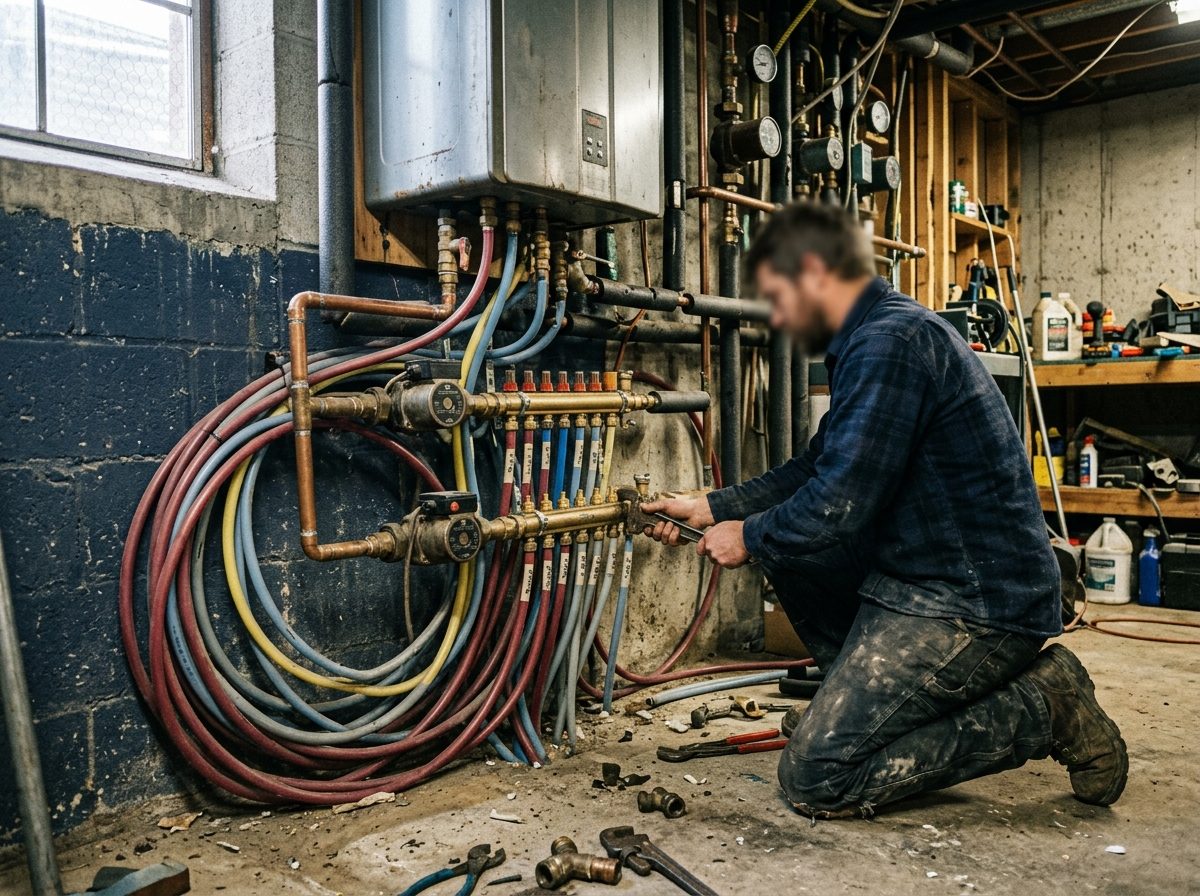
Cast-iron radiators. A boiler heats water, a pump or gravity moves it through large iron radiators, and the room warms by radiation. Slow to respond, extremely comfortable, common in pre-war Front Range housing.
Baseboard convectors. Finned copper tube in a metal enclosure along the wall. Faster, easier to zone, the standard postwar retrofit. Prone to bent fins, blocked airflow and air trapped at high points.
In-floor radiant. Tubing in a slab or under a subfloor, run at much lower water temperature with a mixing valve to blend boiler water down. Exceptionally comfortable, very slow, and unforgiving of anyone cutting into a slab blind.
Snowmelt. Radiant tubing under a driveway, walkway or entry, almost always on a glycol loop through a heat exchanger so it can freeze without splitting. Its own controls, its own sensors, and its own failure modes.
A forced-air furnace that quits leaves you cold. A boiler that quits in January leaves you cold and then starts freezing the pipes that were supposed to be heating the house.
Symptoms, and what they usually mean
One radiator or one zone cold, everything else fine. Most often trapped air at a high point, needing a bleed. Otherwise a stuck zone valve, a failed thermostat or actuator, or a balancing valve someone closed years ago and forgot.
Cold at the top, warm at the bottom of a radiator. Air in that radiator; bleeding fixes it in minutes. If it recurs every few weeks, air is getting in — a leak, a failing air separator, or constant make-up water.
Pressure gauge low. The system is losing water somewhere, and hydronic leaks hide well — under a slab, inside a wall, behind a boiler jacket. A system needing regular top-up has a leak, not a quirk. Leak detection is the next step.
Pressure gauge high, relief valve dripping. Usually a failed expansion tank, or a heat exchanger leak pushing domestic pressure into the heating loop. The valve is doing its job; the cause needs finding, not capping.
Call now
No heat below freezing
The house cooling down is the second problem. Freezing pipes is the first. Do not wait until morning.
Call soon
Pressure keeps dropping
A system needing regular top-up is losing water somewhere. Find it before the drywall does.
Book it
Relief valve dripping
Usually a failed expansion tank. Cheap to fix, expensive to ignore, never something to cap off.
Before winter
Annual service
Combustion check, glycol test, expansion tank and controls. September and October, not December.
When it is an emergency
Treat it as urgent if there is no heat below freezing — especially in an unoccupied property, which describes a great many mountain homes. Urgent too if you smell gas: leave the building and call from outside. And urgent if water is actively leaking; close the isolation valves if you can.
For everything else, a system limping along through a mild spell can wait for a scheduled visit — and you get a better technician and price for waiting a day. What you should not do is nurse it through a winter on fortnightly top-ups. See emergency plumbing for what counts as a night call.
No heat, and it is cold out? Call before the pipes are the problem too. The line is answered at any hour, including holidays.
Get someone out tonightAnnual service, and why it earns its cost
A proper annual service covers combustion (burner, ignition, flame sense, combustion analysis, vent and combustion air, altitude configuration), the water side (system pressure, expansion tank charge, air separator and vents, circulator operation, weeping at pump flanges) and controls (thermostats, zone valves and actuators, reset settings, low-water cutoff). On glycol systems, add a glycol test.
Timing matters. Book it in September or October — a boiler that fails on the first cold night competes with every other boiler that failed that night, and parts for older appliances are not guaranteed.
For mountain and second homes, ask about a low-temperature alarm. A cheap sensor that texts you when the house drops below a set temperature is the difference between a service call and a repiping job.
One zone cold and the rest fine? That is usually air or a circulator, and it is diagnosable over the phone before anyone drives out.
Describe the Cold ZoneRadiant floors and snowmelt
Radiant deserves its own note because the rules are different and the mistakes are more permanent.
Radiant runs at low water temperature, so it depends on a mixing arrangement to blend boiler water down before it reaches the floor. When a floor runs too hot, that valve or its control is usually the cause — and sustained overheating can damage flooring adhesives.
It is also slow. A slab has enormous thermal mass, so radiant holds a steady temperature rather than responding to setbacks. Drop the thermostat ten degrees overnight and the house never catches up. Set it and leave it.
The permanent mistake is cutting into a slab without locating the loops. A punctured loop in a finished slab is a genuinely difficult repair, and entirely avoidable with a thermal image or a layout plan taken first.
Snowmelt systems add glycol, a heat exchanger, slab sensors and controls. Common faults: a failed slab sensor leaving the system dormant in a storm or running through July, degraded glycol, and controls set so aggressively the running cost startles people.
If your house is empty part of the year
Most catastrophic hydronic failures in Colorado happen in properties nobody was in. Fit a low-temperature alarm that reaches your phone, have the glycol tested rather than assumed, and make sure whoever checks on the place knows where the water main and isolation valves are.
Repair or replace
Repair makes sense when the boiler body and heat exchanger are sound and the fault is in a serviceable component — a circulator, zone valve, expansion tank, control board or igniter. Those are ordinary parts on an appliance that may have decades left.
Replacement makes sense when the boiler section is leaking, parts are no longer obtainable, the same fault keeps returning, or the appliance is badly oversized — extremely common, since loads were estimated generously for decades. An oversized boiler short-cycles, wasting fuel and wearing components.
If you do replace, insist on a heat loss calculation for the building as it is now rather than a match of the old appliance size — that is where the real efficiency gain comes from — and correct configuration for your elevation, since the de-rating that applies to water heaters applies to boilers too (our high-altitude sizing page explains it). A correctly sized modulating condensing boiler is a real improvement, but only if the system it feeds can run at the low water temperatures that make condensing efficiency real.
- Note the fault code and the pressure gauge reading before you call
- Know where the boiler isolation valves and the water main shutoff are
- Book the annual service in early autumn, not in the first cold snap
- Have glycol tested on any snowmelt or freeze-protected loop
- Fit a low-temperature alarm on any property left unoccupied in winter
- Locate radiant loops before cutting or drilling into a slab
Boiler older than you have owned the house? Worth knowing where it stands before the deep cold arrives.
Book a Pre-Winter LookWhat drives the price
We refer to independent contractors and cannot quote for them, but hydronic work has a recognisable cost structure.
Diagnostic time is a larger share than in most plumbing: a multi-zone system with decades of modifications takes real investigation. Simple component swaps — circulator, actuator, expansion tank, thermostat, a bleed and rebalance — are ordinary service calls. Control boards for older appliances cost more and take time to source.
Leak repair depends on access: a weeping fitting in a boiler room is straightforward, a leak in a slab loop is not. Glycol is priced by volume, and snowmelt loops hold a lot. Full replacement covers appliance, near-boiler piping, controls, venting, gas work, permit, inspection and disposal.
Mountain and remote addresses may carry travel time, and winter access affects scheduling more than price. Annual maintenance, by contrast, is one of the few genuinely predictable line items in home ownership.
Want the system looked at before winter? Autumn is the right time to book, and the wait is shorter than it will be in December.
Book a boiler serviceHydronic heat, honestly explained
Boiler and radiant heat questions
Usually air trapped at a high point in that radiator, which bleeds out in minutes. If bleeding does not fix it, suspect a stuck zone valve, a failed actuator or thermostat, or a balancing valve closed years ago. Bleeding every few weeks means air is getting in.
It varies by system and building height, so use the range marked on the gauge or in the documentation. Stability matters more than the exact figure: a system needing regular top-up is losing water somewhere, and that deserves leak detection rather than more top-ups.
Usually a failed expansion tank, so expanding water has nowhere to go and pressure rises until the valve opens. It can also mean a heat exchanger leak pushing domestic pressure into the loop. The valve is working correctly — find the cause, and never cap it.
Not usefully. A slab holds a lot of heat and responds slowly, so a deep overnight setback leaves the house behind all morning. Radiant is designed to hold a steady temperature — set it where you want it and make small adjustments only.
Locate the loops first. A thermal image taken while the system runs, or an installation plan, shows where the tubing goes. Puncturing a loop in a finished slab is difficult and expensive to repair, and an hour of preparation avoids it entirely.
Yes, eventually. Glycol loses its inhibitors, can turn acidic, and its freeze protection weakens — a loop protected at installation may not be a decade later. Testing is quick and belongs in annual service; replacement is priced by volume, and snowmelt loops hold a lot.
It does. Thinner air means a gas burner cannot deliver its sea-level input, so boilers need altitude-rated configuration or the manufacturer de-rating applied, and combustion air and vent sizing need checking at elevation. It should be confirmed at commissioning and documented.
Not just because it is old — a sound cast-iron boiler with a serviceable fault is usually worth repairing. Replace when the boiler section is leaking, parts are unobtainable, faults keep recurring, or it is badly oversized for a house since insulated. Then insist on a heat loss calculation.
Hydronic heat, looked after properly.
Boilers, baseboard, in-floor radiant and snowmelt — serviced in autumn, answered in an emergency.
(833) 621-2904 — answered 24/7, statewide.