Water heaters give more warning than almost any other appliance in the house. Rumbling, a slow decline in capacity, rusty first-draw water, a weeping fitting — each of those is the tank telling you something specific, months before the morning with no hot water.
This page is about reading those signals: which faults are cheap and worth fixing, which are the tank announcing the end, and how to tell them apart before someone quotes you a replacement.
Two situations that need a call now
Water leaking from the tank body — shut the cold supply valve above the heater, turn the gas control to off or the breaker off, and call. Any smell of gas — leave the building first, then call the gas utility from outside, then (833) 621-2904.
Symptom triage
Nearly every water heater complaint sorts into five buckets, and knowing which one you are in tells you roughly what conversation to expect.
No hot water at all. A component has stopped — pilot, thermocouple, gas valve, element, thermostat, breaker. Usually repairable, often inexpensively.
Not hot enough, or running out fast. Capacity loss. Sediment, a failed lower element, a broken dip tube, a thermostat set low, or a heater genuinely undersized for the household.
Noise. Rumbling and popping are sediment. A high-pitched whine can be a valve. Neither is dangerous immediately; sediment shortens the tank's life measurably.
Discoloured or smelly water. Rusty water suggests a spent anode rod and a tank corroding internally.
No hot water at all
Start with the free checks. On a gas heater, look at the pilot or the status light — many modern units flash a diagnostic code, and the legend is printed on the label.
If those are clear, the common faults are as follows. On gas: a failed thermocouple or flame sensor, which no longer proves the pilot flame so the gas valve shuts; a dirty or blocked pilot orifice; a failed gas control valve; or a blocked flue causing a safety lockout.
Almost all of these are repairs rather than replacements, and most are modest parts.
One Colorado-specific item worth knowing: at altitude, combustion appliances have less oxygen available, and gas heaters are either rated for altitude or need de-rating. Our high-altitude sizing page covers that properly.
Lukewarm water, or hot water that runs out too fast
Three causes dominate, and they are distinguishable.
Sediment. On a gas heater the burner is under the tank, so a layer of accumulated mineral sediment on the bottom acts as insulation between the flame and the water.
A failed lower element. On an electric heater there are two elements. If the lower one fails, the upper continues heating the top third of the tank — so you get hot water briefly and then cold, reliably and repeatably.
A broken dip tube. Incoming cold water is supposed to be delivered to the bottom of the tank by a dip tube.
Also check the obvious: the thermostat setting, and whether household demand has changed. A heater that was adequate for two people is not necessarily adequate for four, and no repair fixes undersizing — that is a sizing conversation.
Rumbling and popping
Sediment
Mineral layer insulating the burner from the water. Flush annually; hard water makes this common here.
Hot then suddenly cold
Lower element
Electric heaters only. Upper element still working, bottom two-thirds cold. Straightforward repair.
Lukewarm immediately
Broken dip tube
Cold water entering at the top and mixing into the outlet. Cheap part, distinctive symptom.
Rusty first draw
Spent anode rod
The sacrificial rod is gone and the tank itself is now corroding. Replace the rod, or plan a new heater.
Rumbling every time it fires? That is sediment, and it is shortening the tank’s life right now. An annual flush is the cheap fix.
Book a flush and checkRumbling, popping, and the anode rod nobody mentions
Two maintenance items determine how long a tank heater lasts, and most Colorado homeowners have never been told about either.
Flushing. Draining a few gallons through the tank drain valve annually removes accumulated sediment before it forms a hard layer. On hard water — which is most of Colorado — this is the single highest-value maintenance task on the appliance. It takes half an hour. Skipping it for a decade is how a tank rated for twelve years fails at eight.
The anode rod. A sacrificial rod of magnesium or aluminium suspended in the tank corrodes preferentially so that the steel tank does not. When it is consumed, the tank becomes the anode and starts corroding from the inside. Rusty water on first draw is the classic symptom of a spent rod, and rusty water means the corrosion has already moved to the tank.
Rod life depends on water chemistry — three to five years is typical, less in aggressive water, and a softened supply consumes them faster. Replacing one is a modest job on an accessible heater. Replacing one at year four is what makes the difference between a tank that lasts eight years and one that lasts fifteen.
A related item: the sulphur or rotten-egg smell in hot water is usually a reaction between the anode rod and sulphate-reducing bacteria in the water, not a fault in the heater. Switching to a different anode material and sanitising the tank normally resolves it.
The two-item maintenance list
Flush annually. Check the anode rod every three years and replace it when it is more than half consumed. Two tasks, both cheap, and together they are the difference between replacing a water heater once and replacing it twice.
Leaks — and the one that ends it
Where the water is coming from decides everything, so this is worth diagnosing carefully rather than assuming.
Fittings and connections at the top. The cold inlet, hot outlet or a union weeping. Usually repairable, sometimes just needing tightening or a new connector.
The drain valve at the bottom. A common leak point, particularly after a flush, and often just needing the valve replaced. Cheap.
The temperature and pressure relief valve. If it is discharging, do not cap it or plug it. It is either doing its job — which means excessive temperature or pressure that needs investigating, possibly a failed thermostat or high street pressure and no expansion tank — or the valve itself has failed. Both need attention; neither needs a plug.
The expansion tank. A waterlogged or failed expansion tank can weep, and its failure also puts pressure stress on the whole system.
Worth adding: if the heater sits in a finished space, above living space, or anywhere a full tank of water would do real damage, ask about a drain pan piped to a drain and a leak sensor. Both are cheap and neither is standard.
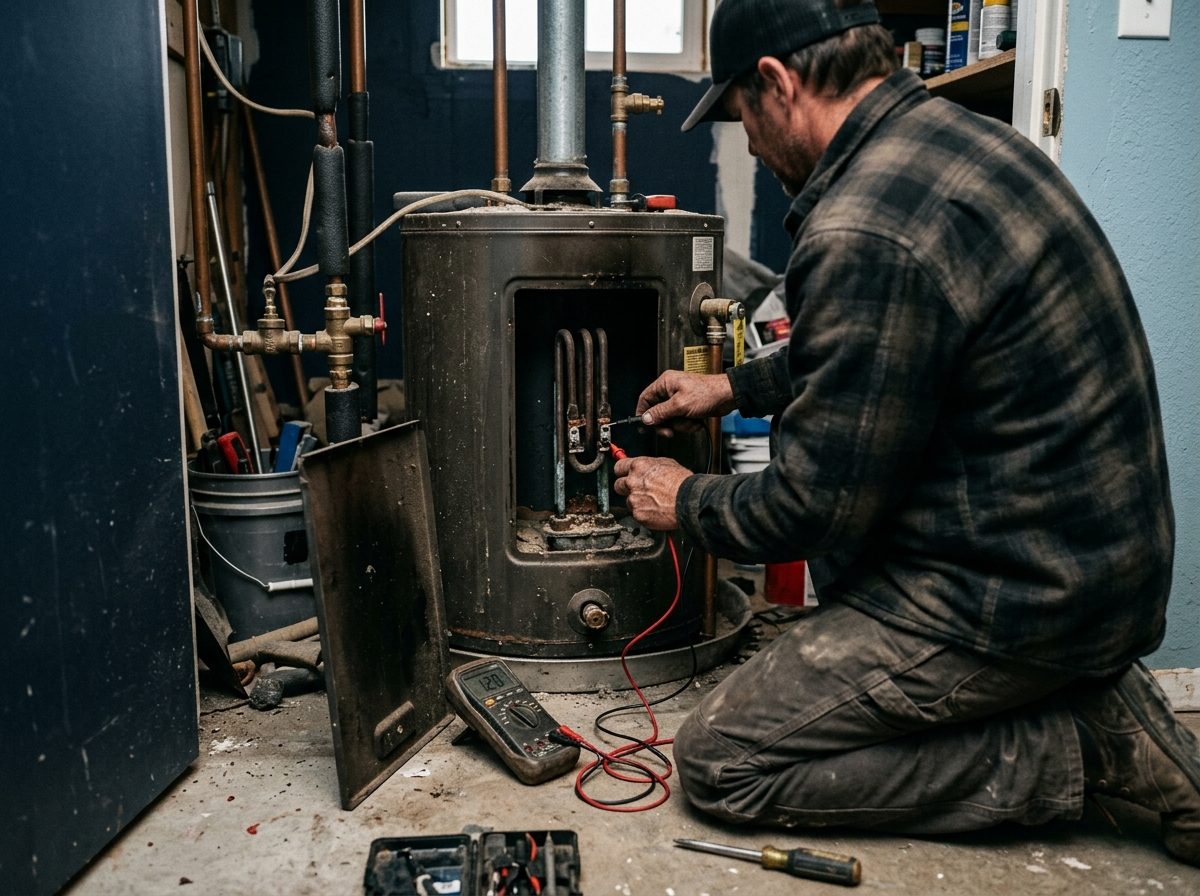
Repair or replace
The framework, plainly. A tank water heater has a working life in the range of eight to fifteen years depending on water chemistry and maintenance, and Colorado's hard water pushes toward the lower half of that range unless the tank was flushed.
Repair when the heater is under roughly eight years old, the fault is a component rather than the tank, and the repair cost is a modest fraction of a replacement. Thermocouples, elements, thermostats, dip tubes, drain valves and anode rods are all firmly in repair territory.
Replace when the tank body is leaking, full stop. Also when the heater is past about twelve years and needs a significant part, when it has needed multiple repairs in a year, when the tank is genuinely undersized for the household, or when the venting or installation is unsafe and correcting it means substantial work anyway.
Consider the alternatives at replacement time rather than defaulting. A tankless unit changes the economics and the venting requirements. A heat pump water heater is dramatically more efficient in the right space. Neither is universally better, and both deserve a real conversation rather than an upsell — that is what our installation page is for.
One more consideration specific to here: if you are in a mountain community and the existing unit has never performed well, altitude de-rating may be the underlying issue, and replacing like-for-like will reproduce the problem.
- Fault diagnosed and named, not just "the heater is old"
- Age of the unit checked against the serial number, not guessed
- Repair cost compared against replacement, in writing
- Anode rod and sediment condition assessed while the technician is there
- Relief valve, expansion tank and venting checked as part of the visit
Repair or replace? Age, fault and sizing all feed into it. We will give you the honest answer.
Get a Straight AnswerWhat drives the price
We refer to independent contractors and cannot quote for them, but water heater repair pricing is more predictable than most plumbing.
The part is often the smaller half. A thermocouple, an element, a thermostat, a dip tube or a drain valve are inexpensive components, and most of the cost is the visit. That is why bundling — having the anode checked and the tank flushed during the same call — is generally good value.
Access matters. A heater in an open basement is a straightforward job; one in a tight closet, an attic, or a crawlspace with a low hatch takes longer and sometimes takes two people. Gas heaters with venting to inspect take longer than electric.
After-hours response carries a premium, and "no hot water" is the classic call that feels urgent at 9pm and costs less at 9am — unless the tank is leaking, in which case the shut-off valve buys you the time to wait for normal hours.
And the honest note: on an older tank, ask for the repair cost and the replacement cost side by side before deciding. A good technician will give you both without being pushed.
Not sure whether to fix it or replace it? Tell us the age, the symptom and the fuel type. That is usually enough for an honest answer over the phone.
Get an honest readFix it or replace it
Water heater repair questions
On a gas heater, the usual causes are a failed thermocouple or flame sensor that no longer proves the pilot flame, a blocked pilot orifice, a failed gas control valve, or a flue problem causing a safety lockout.
Three common causes. Sediment on the tank bottom insulating a gas burner from the water, which is the most frequent complaint in hard-water Colorado.
Sediment. Mineral deposits settle on the tank bottom and water trapped underneath them boils and forces its way through, which produces the popping.
Annually in most of Colorado, because the water is generally hard and sediment accumulates faster than in soft-water regions.
A sacrificial rod of magnesium or aluminium suspended inside the tank that corrodes preferentially so the steel tank does not.
It depends entirely on where from. Leaks at the cold inlet, hot outlet, a union, the drain valve or the expansion tank are usually repairable.
Roughly eight to fifteen years for a tank unit, and Colorado’s hard water pushes toward the lower half of that range unless the tank has been flushed and the anode rod maintained.
Always when the tank body is leaking. Otherwise: when the unit is past about twelve years and needs a significant part, when it has needed multiple repairs within a year, when it is genuinely undersized for the household, or when correcting an unsafe installation means substantial work regardless.
Diagnose it before you replace it.
Most no-hot-water calls are a part, not a tank. One number for 135 Colorado communities.
(833) 621-2904 — answered 24/7, statewide.