A sump pump spends most of its life doing nothing, which is exactly why it is the plumbing appliance most likely to be broken without anyone knowing. It gets discovered during the first serious thaw, at two in the morning, by someone standing in water.
The good news is that this is a genuinely preventable failure. A five-minute test twice a year, and knowing what a correct installation looks like, covers most of the risk.
If the pit is filling and the pump is not running
Check the breaker and the GFCI outlet first — a tripped GFCI is the single most common cause and the fix is free. If neither is it, call (833) 621-2904 and move anything valuable off the floor while you wait.
Why Colorado basements need one
Colorado is a dry state with a specific, concentrated water problem, and the two facts are related.
Snowmelt saturates soil that is still partly frozen below, so water cannot percolate downward and instead travels laterally along the frost layer — straight toward the foundation, because that is where the disturbed backfill and the drainage gravel are.
Then there is the summer pattern: intense, short convective storms that drop an inch of rain in twenty minutes onto ground too hard to absorb it.
And the local factor that catches people out — expansive bentonite clay. Clay soils around a foundation swell when wet and hold water against the wall rather than draining it away, which means the perimeter drain and the pit are doing more work here than the same system would in sandy soil.
How sump pumps fail
Almost always in one of six ways, and most of them are visible before the flood.
Power. The most common cause of a silent pump is no electricity to it — a tripped GFCI, an unplugged cord after someone used the outlet, a tripped breaker, or a utility outage during the exact storm that needed the pump.
The float switch. Mechanically the weakest part. Floats jam against the pit wall, snag on the discharge pipe, get fouled by debris, or simply wear out after tens of thousands of cycles.
The check valve. A failed or missing check valve lets the column of water in the discharge pipe fall back into the pit every time the pump stops.
Debris and silt. A pit without a lid collects dust, drywall dust from a basement finish, pet hair and gravel.
Check first
GFCI and breaker
Most silent pumps are unpowered pumps. Free to check, and it is the answer more often than not.
Most common wear part
Float switch
Jammed on the wall or the discharge pipe, fouled, or worn out. Motor fine, pump dead.
Winter
Frozen discharge
Pump runs against a plug of ice, overheats, burns out just before the thaw.
Telltale
Short-cycling
On, off, on again within seconds. Usually a failed check valve returning the same water.
Testing yours in five minutes
Do this in early autumn and again in late February, before the thaw. It is the highest-value maintenance task in the basement.
Lift the lid and look in. The pit should be reasonably clean, the pump sitting flat on the bottom or on a small platform rather than in silt, and the float free to move without touching the wall or the pipe.
Then fill it. Pour water in with a bucket — five gallons or so, enough to raise the float — and watch. The pump should start promptly, run smoothly without grinding or rattling, empty the pit to its cut-off level, and stop cleanly without restarting immediately. Listen for water falling back down the discharge pipe after it stops: a sustained gurgle means the check valve is not holding.
Go outside and confirm water is actually leaving the discharge point, and that it is being carried away from the foundation rather than pooling next to it. Then check the cord is plugged into a working GFCI outlet and reset it once to confirm the outlet works.
Unplugging and replugging is not a test. It confirms the motor runs; it says nothing about whether the float will call for it when you are not there.
The five-gallon test
Pour water in the pit rather than lifting the float by hand. It exercises the whole system — float, motor, impeller, check valve and discharge — in the way it will actually be asked to work. Twice a year, and once more if you have finished the basement in the meantime.
Basement being finished this year? Get the pit, pump and discharge sorted before the drywall goes up, not after.
Book an assessmentWhat a correct installation looks like
Worth knowing because a large share of the sump pumps we hear about were installed badly rather than having failed honestly.
The pit should be sized to the inflow and deep enough that the pump is not cycling on a few inches of water, with a solid base — the pump should not sit directly in loose silt. It needs a sealed lid, both to keep debris out and because an open pit vents humidity and soil gas into the basement.
The pump itself should be sized to the actual inflow rate, which means someone should have observed or estimated it rather than defaulting to whatever is on the truck. Submersible pumps are standard now and quieter; older pedestal pumps are still serviceable and easier to work on, but they belong in unfinished spaces.
A check valve goes in the discharge line just above the pump, and it should be accessible — a check valve buried behind finished framing is a check valve nobody will ever replace. The discharge line should be full-size, not necked down, with as few elbows as the route allows.
Electrically, it should have a dedicated GFCI-protected circuit rather than sharing with the freezer and the workshop. And there should be a way to see that it is working: a high-water alarm at minimum, and on a finished basement, an alarm that will actually be heard.
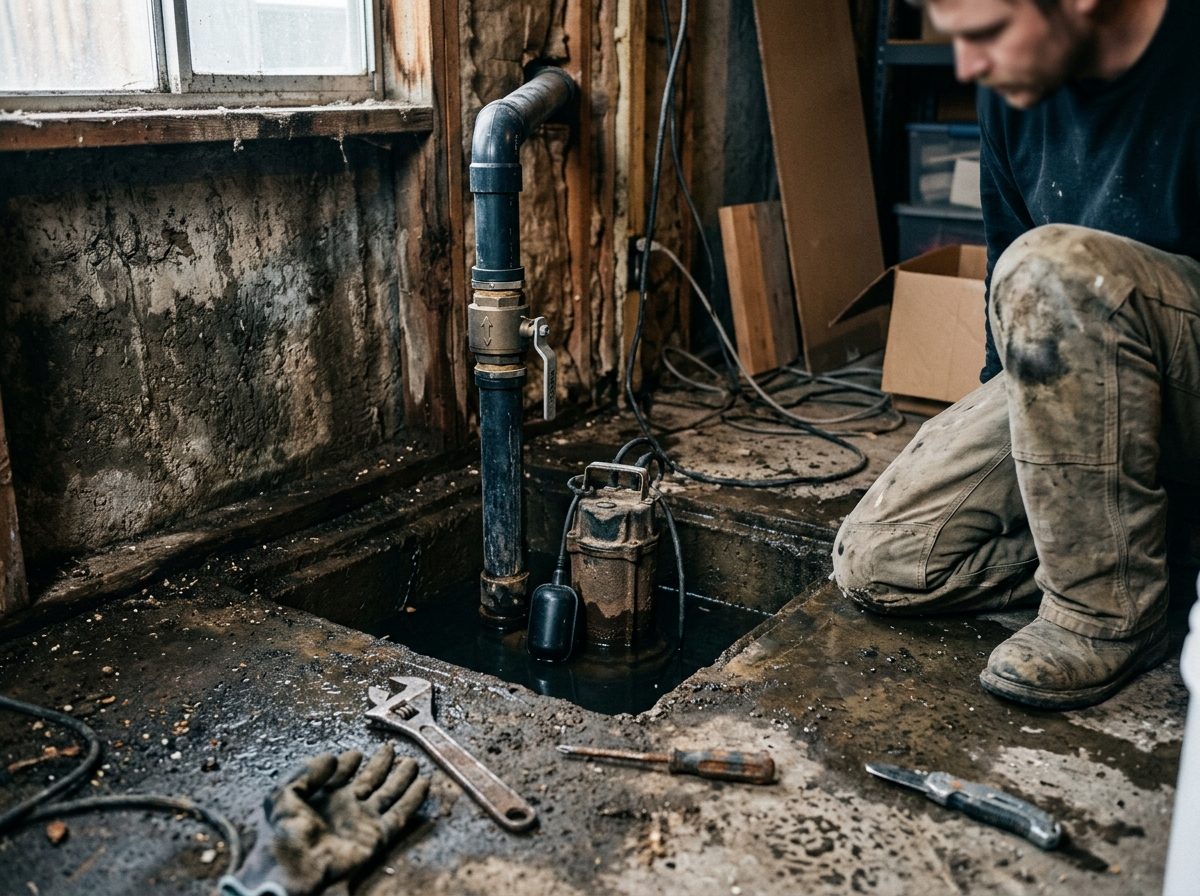
Battery and water-powered backup
Here is the uncomfortable arithmetic: the weather event most likely to flood your basement is also the event most likely to knock out your power. A single primary pump on utility electricity is a system with a shared failure point.
Battery backup is the common answer. A secondary DC pump with its own float sits in the same pit, wired to a maintained battery, and takes over when mains power is lost or when the primary pump fails. Runtime depends on battery capacity and inflow rate — enough for a typical outage, not enough for a two-day one. The battery is a consumable and needs replacing on a schedule; a backup with a dead battery is decoration.
Water-powered backup uses municipal water pressure through a venturi to move sump water, with no electricity at all and therefore unlimited runtime. It requires adequate city pressure, uses potable water while running, and is not permitted everywhere — some jurisdictions and water districts restrict it. It is not an option on a well.
A generator covers the pump along with everything else and is the right answer for some households, though it only helps if someone is home to start it.
Whichever route, add a high-water alarm — ideally one that notifies a phone. Knowing about six inches of water while you are away is worth considerably more than the alarm costs.
Where the water actually goes
The most-neglected part of the system, and the source of two expensive problems.
First: discharge too close to the foundation simply recirculates. Water leaves the pit, soaks into the ground next to the wall, returns to the perimeter drain and comes back to the pit. The pump runs constantly, wears out early, and the basement stays damp. Discharge should be carried well away from the wall and released where the grade takes it further away, not into a low spot beside the house.
Second: freezing. In Colorado this is the failure that kills pumps. The exterior discharge run needs to shed water completely between cycles so there is nothing standing in it to freeze, which means continuous fall away from the house and no dips. Where a buried line is used, it needs to be below frost depth or fitted with an above-grade freeze-relief arrangement so the pump has somewhere to put water if the buried section plugs.
And one legal point: connecting a sump discharge into the sanitary sewer is prohibited in most Colorado jurisdictions, because clean groundwater sent to a treatment plant is a cost everyone shares and it contributes to overloading during exactly the weather that causes sewer backups. Where a pump is currently plumbed that way, it is worth correcting.
- Pump sized to observed inflow, sitting on a solid base in a sealed pit
- Accessible check valve above the pump, full-size discharge, minimal elbows
- Dedicated GFCI circuit, not shared with other basement loads
- Discharge carried well clear of the foundation and drained to prevent freezing
- High-water alarm, and a backup pump if the basement is finished
Basement finished? Then backup power is worth discussing before the next storm, not after.
Ask About Battery BackupWhat drives the price
We refer to independent contractors and cannot quote for them. The cost drivers, though, are straightforward.
A like-for-like pump replacement in an existing, correctly built pit is the simple case: pump, check valve, a couple of hours. Adding a battery backup system is pump, battery, charger and wiring on top of that.
A new installation where no pit exists is a different order of work entirely, because it means breaking the basement slab, excavating the basin, setting it, connecting to the perimeter drain if there is one, patching the concrete and routing a new discharge line to the exterior. That is a day or more with concrete work involved.
Then the variables: whether the discharge route needs rebuilding or burying, whether a dedicated circuit has to be run by an electrician, whether the pit needs a new sealed lid, and whether the job is an emergency call during a thaw — response during the two weeks when every pump in the region is failing carries a premium for the obvious reason.
Thaw is coming and you have not tested the pump? Five gallons and five minutes. Call if it does not do what it should.
Get it checked before springBefore the thaw arrives
Sump pump questions
Pour about five gallons of water into the pit — enough to raise the float — and watch.
Three usual causes. A failed check valve lets the water in the discharge pipe fall back into the pit so the pump moves the same water repeatedly.
Around ten years is a reasonable expectation, and less for a pump that cycles heavily every spring.
If the basement is finished or stores anything you would mind losing, yes. The weather that floods a basement is the same weather that knocks out power, so a single mains-powered pump has a shared failure point.
In most Colorado jurisdictions, no. Sending clean groundwater to a treatment plant is prohibited because it wastes treatment capacity and contributes to system overload during exactly the weather that causes sewage backups.
The exterior discharge line held standing water and it froze, leaving the pump running against a solid plug until it overheated.
We cannot quote for the independent contractors we refer to, but the shape is predictable.
Sized to your actual inflow, which someone should observe or estimate rather than guess.
The pump only matters once.
Test it before the thaw, not during it. One number for 135 Colorado communities.
(833) 621-2904 — answered 24/7, statewide.