Most plumbing protects you from your own pipes. A backwater valve protects you from everyone else's — from the moment the public sewer main carries more than it can hold and starts looking for somewhere to put the difference.
It is a mechanically simple device solving a specific problem, and it is either exactly the right investment or entirely unnecessary depending on your house.
What the valve actually does
A backwater valve sits in the building drain — the horizontal pipe carrying everything out of the house toward the sewer lateral.
That is the whole mechanism. No power, no controls, no sensors. Reverse flow closes it; forward flow opens it.
The scenario it is designed for is main surcharge. When the public sewer is blocked or overloaded — heavy rain, fast snowmelt, a failure downstream — the level in the main rises above the elevation of your basement floor.
Colorado gets this in two distinct patterns: intense summer convective storms that overwhelm a system in twenty minutes, and rapid spring snowmelt that keeps it near capacity for weeks.
A backwater valve does not fix your sewer. It fixes the fact that your basement floor sits below the water level in the street.
Who actually needs one
The honest answer is: not everyone, and the deciding factor is elevation combined with history.
Strong case. A finished basement with fixtures below street level. A previous backup at your address, particularly one that coincided with heavy weather rather than a blockage in your own line.
Weaker case. An unfinished basement with nothing below grade you would mind losing. A property on high ground relative to the main.
Sometimes required. Some Colorado jurisdictions require a backwater valve on new construction or on remodels where fixtures are installed below the elevation of the upstream manhole cover.
Strong case
Finished basement, below grade
Fixtures below street level and material worth protecting on the floor above them.
Strong case
History at the address
A previous backup during heavy weather, or neighbours who have had one.
Strong case
Low point on the street
The sewer runs downhill toward you. Hydraulics is not on your side.
Check the code
Basement remodel
Some jurisdictions require a valve when adding fixtures below grade. Ask before framing.
Basement flooded once already? That is the pattern worth acting on. Describe what came up and where, and we will tell you whether a valve is the right answer.
Ask Whether You Need OneWhere it goes, and why that matters
Placement determines what the valve protects, and getting it wrong produces a device that works perfectly while your basement still floods.
The valve must be downstream of every fixture you want protected. Anything that ties into the drain past the valve — on the street side of it — is outside the protection. So a valve installed close to the wall where the drain leaves the house, with the basement bathroom teeing in beyond it, protects nothing that matters.
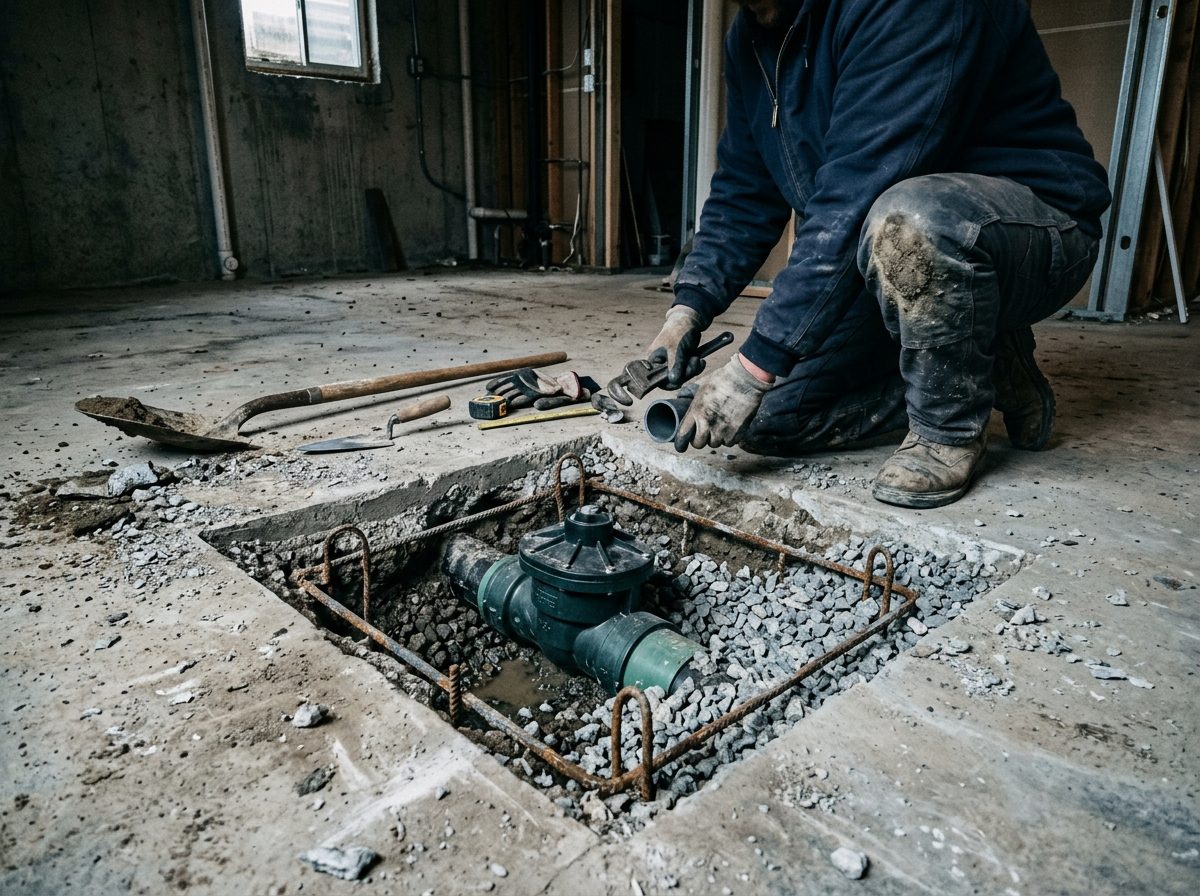
The two normal positions are inside, in the building drain within the basement, usually accessible through a floor-level access box; or outside, in a buried chamber on the lateral between the house and the property line, accessed through a lid at grade. Interior installation means breaking and patching the basement slab. Exterior means excavation, and a chamber that has to remain findable and openable in ten years.
There is a second consideration that is easy to miss: what happens to your own drainage while the valve is closed. With the flap shut, nothing can leave the house either. Anyone using water during a surcharge event is filling a closed pipe, and the water goes to the lowest opening — the basement floor drain again. This is why homeowners with a valve need to know it exists and understand that during a heavy weather event, water use in the house should stop.
Downstream of everything you care about
Ask the installer to show you, on the pipe, which fixtures fall on the protected side of the valve. A basement bathroom, laundry standpipe or floor drain connecting past the valve is unprotected, and that detail is invisible once the slab is patched.
Finishing a basement this year? A valve fitted while the slab is open costs a fraction of a retrofit. Worth a call at the planning stage.
Ask before you frameWhat installation involves
Start with the diagnosis, not the device. A camera survey should come first, for two reasons: it confirms the drain is sound enough to cut into and fit a valve, and it establishes whether your backups are actually caused by main surcharge or by a defect in your own lateral. Fitting a valve to a line with a collapsed section solves the wrong problem.
For an interior installation: locate the building drain, break out a section of the basement slab, excavate to the pipe, cut out a length, fit the valve body with the correct orientation and fall, set an access box so the valve can be reached and serviced, then backfill and patch the concrete. Half a day to a day for a straightforward case.
For an exterior installation: excavate to the lateral at the chosen point, cut in the valve, set a riser and lid at grade, backfill, restore the surface. Depth drives the effort, and Colorado laterals sit deeper than in mild climates.
In both cases: permit and inspection. This is code work in every Colorado jurisdiction, it involves cutting into the building drain, and an unpermitted alteration to the drainage system is a problem at resale. The permit should be in the quote.
Then commissioning. Ask for the valve to be demonstrated — the flap moving freely, seating properly, and the access cover fitting correctly. And get the location written down and photographed before the concrete goes back.
What it will not protect you from
Worth being direct about, because a valve is sometimes sold as general flood insurance and it is not.
It does not stop a blockage in your own lateral. If roots or a collapse block the line between the valve and the main, waste from the house still cannot get out, and it still backs up into the basement. The valve is indifferent — flow is going the right direction, so it stays open.
It does not stop groundwater. Water entering through foundation walls, the perimeter drain or a failed sump pump has nothing to do with the sanitary system. Those are separate problems with separate solutions.
It does not stop surface water entering at grade — a window well filling, a driveway draining toward the house, a downspout discharging at the foundation.
It does not protect fixtures connected downstream of it, as covered above. And it does not let you carry on using water during a surcharge event: a closed valve means your own drainage is also stopped, and continuing to run water will flood the basement without any help from the main.
Finally, it is a mechanical device with a moving part in sewage. It can be held open by debris, and a valve that has never been inspected in fifteen years is an assumption rather than a protection.
Maintenance and access
Low, but not zero. The flap has to be able to move freely and seat cleanly, and it lives in a pipe carrying grease, wipes and grit.
An annual look is the sensible interval: open the access cover, check the flap swings freely and closes fully, clear any debris caught on the seat or the hinge, and confirm the seat is not worn. Have it done alongside any other drain maintenance rather than as a separate visit.
Two failure modes to know. A flap held partly open by a wipe or a stick will not seal, and you find out during the next storm. A seized hinge — from corrosion or heavy scale — likewise. Neither is expensive to correct if found during an inspection.
Which is why access matters more than most people appreciate at installation time. An access box under a future storage rack, or an exterior lid that ends up under a new patio, is a valve that will never be serviced again. Record the location, keep it clear, and tell whoever buys the house.
- Camera survey first, to confirm cause and pipe condition
- Valve positioned downstream of every fixture being protected
- Permanent, unobstructed access cover — and the location recorded
- Permit and inspection included in the quote
- Household briefed: stop water use during a heavy-weather event
Want the honest limits before you commit? A valve is not a cure-all, and the pro should say so on the phone.
Talk It Through FirstWhat drives the price
We refer to independent contractors and cannot quote for them. The variables are unusually clear-cut on this job.
Location dominates. An interior installation means breaking, excavating and patching the basement slab. An exterior installation means excavating to the lateral, and depth is the driver — a valve at four feet and a valve at nine feet are different jobs. If a finished basement floor has to come up and go back, that adds a finishing trade.
Access to the building drain matters: a mechanical room with clear floor is straightforward, a valve position under a finished laundry room is not. The condition of the pipe you are cutting into can turn a valve installation into a partial lateral repair, which is a good reason to know the pipe's condition before starting.
Then the valve type and whether a combination cleanout is included, permit and inspection fees, and surface restoration — concrete, landscaping or hardscape. Doing it as part of a basement remodel or an existing sewer repair is substantially cheaper than doing it alone, because most of the cost is getting to the pipe rather than the device itself.
Not sure whether your basement is at risk? Tell us your street, your basement fixtures and whether it has happened before. That is usually enough to answer it.
Get a straight answerBefore you cut the slab
Backwater valve questions
A hinged flap inside the building drain hangs clear of the flow while water moves normally out of the house, and swings shut against a seat when water tries to move back toward the house.
The strongest cases are a finished basement with fixtures below street level, a previous backup at your address that coincided with heavy weather, a neighbourhood with a history of surcharge, and a house sitting at a low point on the street.
No, and this is the part homeowners are most often not told. While the flap is shut, nothing can leave the house either — so water used during a surcharge event fills a closed pipe and exits at the lowest opening, which is the basement floor drain.
Downstream of every fixture you want protected, which is the detail that matters most.
No. It stops sewage from a surcharging public main. It does not stop a blockage in your own lateral, because flow is still heading the right way and the valve stays open.
Yes. It is an alteration to the building drain and it is permitted, inspected work in every Colorado jurisdiction.
An annual inspection is the sensible interval: open the access cover, confirm the flap swings freely and seats fully, clear any debris caught on the hinge or seat, and check the seat for wear.
We cannot quote for the independent contractors we refer to, but the cost is dominated by getting to the pipe rather than by the valve itself.
One-way traffic only.
Keep the main out of the basement. One number for 135 Colorado communities.
(833) 621-2904 — answered 24/7, statewide.