Cabling opens a line. Jetting cleans it. The difference sounds like marketing until you have seen the inside of a kitchen branch that has been cabled four times in three years — a hole through the middle of a deposit that never left the wall.
What jetting actually is
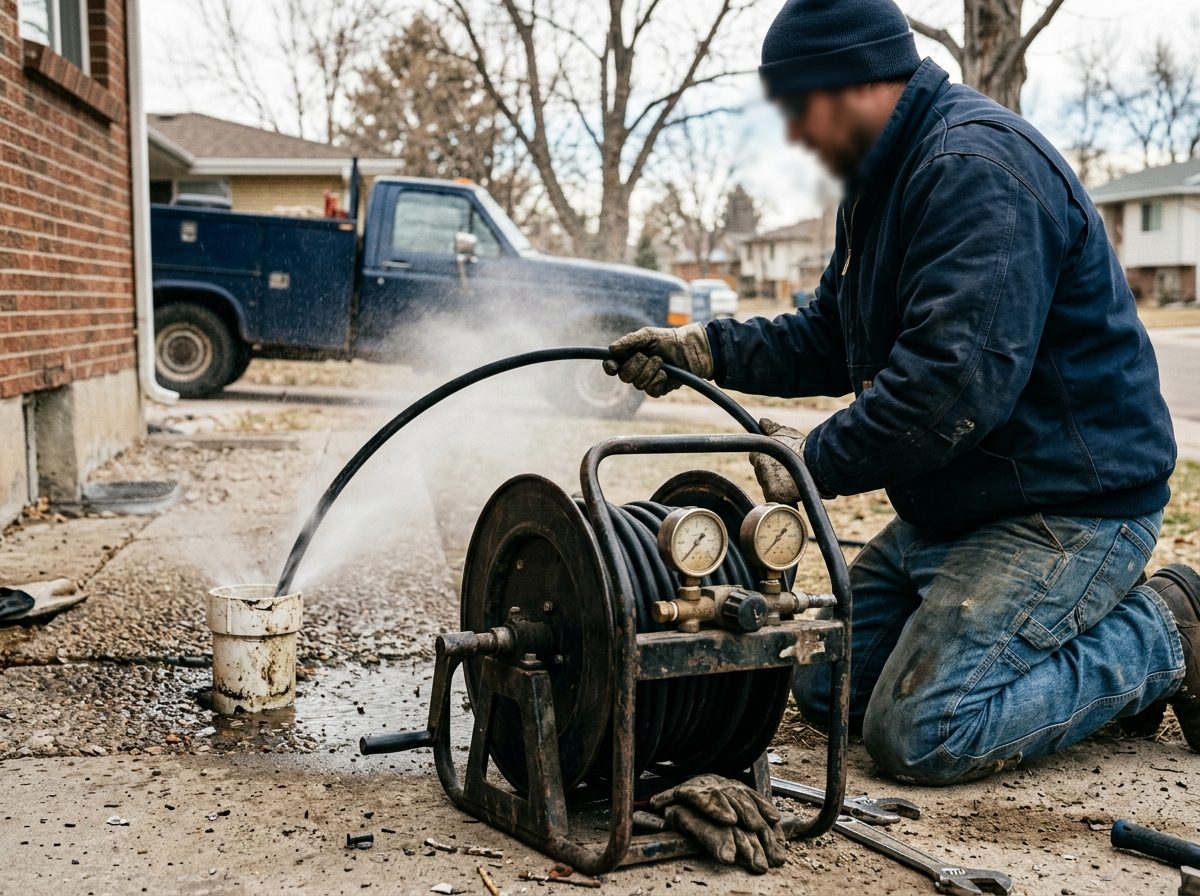
A hydro jetter is a high-pressure water pump feeding a flexible hose with a specialised nozzle on the end. The nozzle has a forward jet and, more importantly, several rearward jets. The rear jets do two things at once: they propel the hose up the pipe against the flow, and they scour the pipe wall in a full circle as the hose travels.
Pressures for residential work typically run between roughly 1,500 and 4,000 psi, with flow rates that matter as much as the pressure — volume is what carries the debris back out. The operator selects nozzle and pressure to suit the pipe: a grease-cutting head for a kitchen line, a chain or root-cutting head for a lateral with intrusion, a penetrating head to open a hard blockage before the cleaning pass.
The result, when it is done properly, is a pipe returned close to its original internal diameter, with the debris flushed downstream rather than left in place. On a camera, the difference is unmistakable.
Jetting versus cabling
These are not competing products; they are different tools with different jobs, and a good contractor uses both.
A cable is mechanical. It excels at a discrete obstruction — a mass of hair, a toy, a wad of wipes, a root ball at one joint. It gets there fast, it costs less, and on a straightforward blockage it is the correct answer.
Jetting is hydraulic and it is about surface. It removes the coating, the scale, the fine root hair and the sediment layer, and it does so along the whole length the hose travels rather than at one point.
Use a cable
Discrete blockage
Something specific is stuck in an otherwise sound line. Fast, cheap, correct.
Use a jetter
Coated pipe
Grease, scale, sludge or fine roots along a length of line. Recurring blockages at the same place.
Camera first
Unknown pipe
Old cast iron, clay, or a line nobody has ever seen. Inspect before choosing a pressure.
Neither
Broken pipe
Collapse, offset or a belly. No amount of cleaning fixes geometry — that is a repair.
Same blockage, third visit? That is the pattern jetting exists for. Call and we will get a camera and a jetter in the same appointment.
Talk through jetting optionsCabled it twice already? If it keeps closing up, the pipe wall is the problem, not the blockage.
Ask If Jetting SuitsWhen jetting is the right call
The clearest indication is repetition. A line that blocks, gets cleared, and blocks again at the same interval is telling you the deposit was never removed. Jetting breaks that cycle where cabling maintains it.
Kitchen branches are the classic case in Colorado housing, for the reason covered on the drain cleaning page: warm grease meeting cold pipe in an unheated basement ceiling sets within a few feet of the sink and builds year on year. By the time it blocks, the bore may be a third of what it should be, and only a jetter takes it back.
Main sewer laterals with fine root intrusion are the other. A cable cuts the visible roots at the joint; a jetter with a cutting head removes the fine hair growth along the pipe as well, which buys considerably more time before the next intervention. It does not fix the joint the roots came through — that still needs repair or lining eventually — but it changes the interval from months to years.
Restaurants and small commercial kitchens jet on a schedule rather than in response to a problem, and residential customers with a known grease-prone line increasingly do the same. Preventive jetting every couple of years on a problem branch is cheaper than one emergency call.
When it is the wrong call
This part matters more than the sales pitch, because jetting a pipe that cannot take it is how a drainage problem becomes an excavation.
Old, badly corroded cast iron is the main concern. A cast iron line that has lost significant wall thickness to internal corrosion can be perforated by high-pressure water, and the plumber who jets it will be the one who discovers that. Clay laterals with existing cracks and offsets are similar — the water finds the defect and enlarges it, or exits into the surrounding soil.
Any line with a known collapse, a severe belly or a substantial offset should be repaired rather than cleaned; jetting a bellied section flushes debris into the low point and it settles again within weeks.
The safeguard against all of this is straightforward: a camera inspection before the jetter comes out, on any line whose condition is unknown. A contractor who proposes jetting an unseen old pipe at full pressure without looking first is skipping the step that protects you. Ask for it.
The one question to ask
"Have you seen the inside of this pipe, and what pressure are you running?" A good operator answers both immediately and will show you the camera footage. Vagueness on either point is a reason to pause.
How the visit runs
Expect a longer appointment than a cabling call — commonly two to four hours including inspection, and longer on a difficult lateral.
Camera survey
Pipe material, condition, defects, and where the deposit actually is. This determines everything that follows.
Access and setup
Cleanout located and opened, hose reel and pump positioned, containment laid. Water supply from a hose bib.
Open, then clean
Penetrating pass to restore flow if the line is blocked, then a cleaning pass at working pressure back along the length.
Verify on camera
Second survey showing bare pipe wall. Ask for the footage — before and after is the proof you paid for.
The equipment needs water, so a working outdoor spigot matters, and in winter that is not a given. It also needs somewhere for debris to go, which is why the line has to be at least partially open before a full cleaning pass — on a completely blocked pipe the first task is restoring flow.
Jetting in a Colorado winter
Cold weather complicates this more than most services. Outdoor spigots are shut off and drained in most Colorado homes by November, so the operator needs an interior water source or a tank-fed unit, and that changes the setup and sometimes the price.
Equipment left standing in sub-freezing conditions has to be managed — pumps and hoses are winterised between jobs, and a truck that has been sitting outside on a January morning needs time. Discharge water freezing on a driveway or sidewalk is a genuine hazard the operator should be planning for rather than discovering.
None of this makes winter jetting impossible, and plenty of it happens in January because that is when the line blocked. It does mean a winter jetting call has more moving parts than the same job in June, and the sensible move on a known problem line is to schedule the preventive pass in autumn.
Value check
Jetting typically costs several times a routine cabling. It earns that on a coated or repeatedly blocking line, where it changes the interval from months to years. On a one-off blockage in a sound pipe it does not, and a contractor who recommends it for every slow sink is selling equipment time rather than solving your problem.
Old cast iron? Jetting is not always the right call on a fragile line. A camera decides first.
Ask for the Camera FirstAfterwards
A properly jetted line drains noticeably faster than it did before it blocked, not merely as well as it did last week. That is the marker of a full-diameter clean, and the after-camera footage should show pipe wall rather than a channel.
Keep the footage. On an older lateral it is a baseline: the next time something changes, someone can compare. It is also useful evidence for a real estate transaction, a shared-line dispute with a neighbour, or an insurance conversation.
Then act on what the camera showed. Jetting cleans; it does not repair. If the survey found a cracked joint, an intruding root path, a belly or a section of pipe at the end of its life, that is a decision to make while you have the information and not during the next backup. Camera inspection covers reading the footage, and trenchless repair covers the options that do not involve a trench across the garden.
Want the camera first? Sensible. Ask for inspection and jetting quoted together so you are not deciding twice.
Get it quotedPressure and pipe
Hydro jetting questions, answered plainly
A high-pressure water pump feeds a hose with a multi-jet nozzle into the drain. Rear-facing jets pull the hose up the line and scour the pipe wall in a full circle as it travels, while the water flushes the debris downstream.
A cable is mechanical and works on a discrete obstruction — it punches through and pulls back whatever is stuck. Jetting is hydraulic and works on surface: it strips grease, scale, sludge and fine roots off the pipe wall along the whole length the hose travels.
When the same line keeps blocking. A repeat blockage at the same interval means the deposit was never removed, only holed. Grease-coated kitchen branches, main laterals with fine root intrusion, and old lines with heavy scale are the classic jetting candidates.
It can, in the wrong pipe at the wrong pressure. Badly corroded cast iron that has lost wall thickness can be perforated, and clay laterals with existing cracks or offsets can be worsened.
Several times a routine cable clearing, with the range driven by line length, access, whether a camera survey is included and whether the line is fully blocked when work starts. It is worth that on a coated or repeatedly blocking line because it changes the interval from months to years.
Usually two to four hours for a residential job including the camera work before and after, and longer on a difficult lateral or where a cleanout has to be created. It is a longer appointment than cabling by design — the inspection, the penetrating pass, the cleaning pass and the verification survey are all separate stages, and skipping any of them is how you end up paying twice.
It removes them very effectively, including the fine hair growth along the pipe that a cable leaves behind, which is why the interval before regrowth is much longer after jetting. What it does not do is close the crack or open joint the roots came through, so they will return eventually.
Yes, though it has more moving parts than the same job in summer. Most Colorado homes have their outdoor spigots shut off and drained by November, so the operator needs an interior water source or a tank-fed unit.
On a known problem line, yes. Commercial kitchens jet on a schedule for exactly this reason, and residential customers with a grease-prone kitchen branch or a lateral with a root history increasingly do the same every couple of years.
Then cleaning is the wrong spend and the conversation changes to repair. A collapse, a substantial offset or a belly where the pipe has lost its fall cannot be resolved with water pressure — a bellied section simply refills with debris within weeks.
Clean the pipe once.
Camera first, jetter second, footage in your hands. Statewide, any hour.
(833) 621-2904 — answered 24/7, statewide.