A sewer camera inspection costs a few hundred dollars and routinely changes a five-figure decision. It is the highest-leverage plumbing spend available to a Colorado homeowner, and it is the one most people skip.
What you are buying is not a repair. It is evidence: what is wrong with the pipe, where along the run it is, how deep it sits, and therefore which repairs are possible and what they should cost.
Why the camera comes before everything else
Because the symptoms of a sewer problem are almost entirely non-specific. Slow drains, gurgling, a backup at the lowest fixture: these are produced equally by grease, by roots, by a cracked section, by a belly holding water, by heavy scale in cast iron and by a full collapse.
The other reason is the recurring blockage. If a line is cleared and blocks again on a predictable interval — spring and autumn, or every eight months like clockwork — that regularity is diagnostic.
And a camera survey protects you from the opposite error too. It rules things out. A homeowner told they need a full replacement, whose footage shows one cracked section in eighty feet of sound clay, has just saved the cost of seventy-something feet of pipe.
If sewage is backing up right now
Stop running water in the house and call (833) 621-2904. The camera is the right second step, not the first — the line usually has to be cleared before it can be seen. Basement backups covers the immediate response.
How the survey is actually done
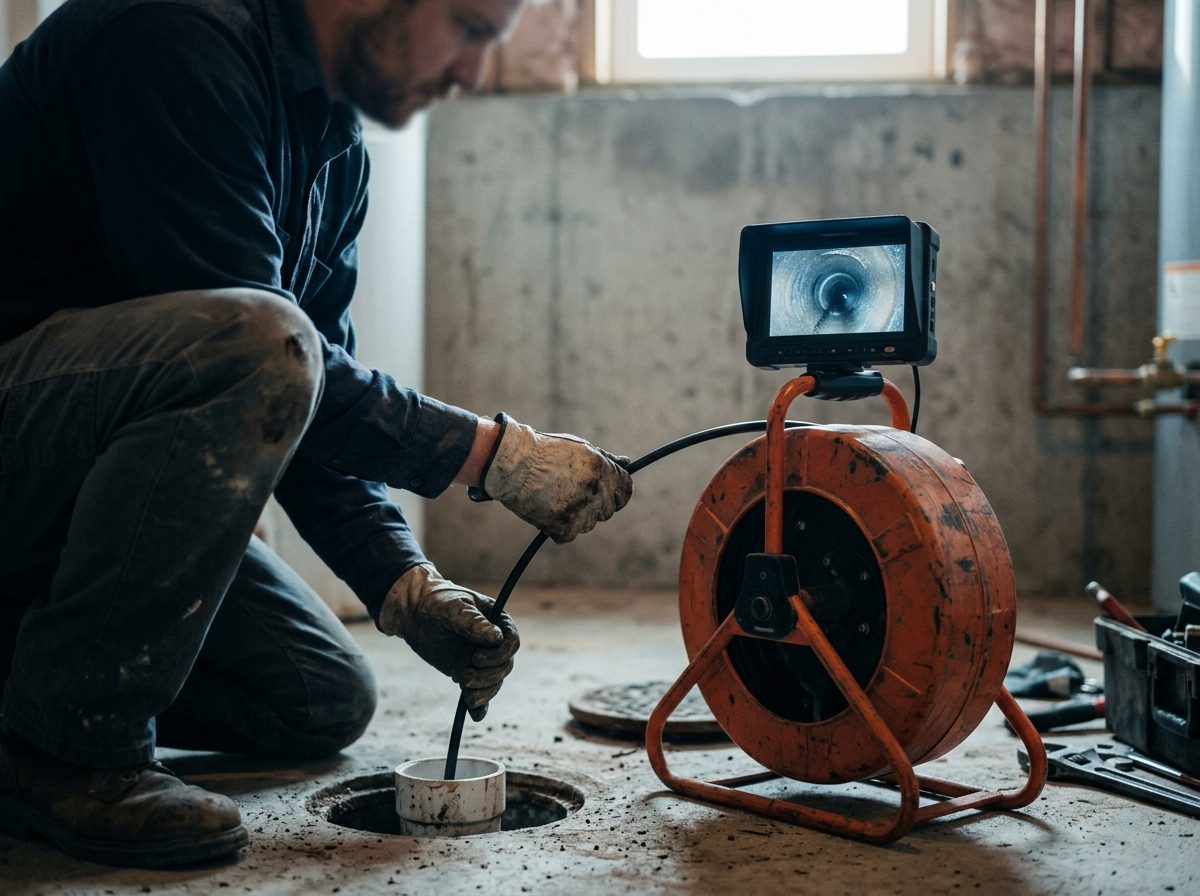
A self-levelling camera head on a semi-rigid push cable is fed into the lateral, normally through an exterior cleanout, sometimes through a basement cleanout or a pulled toilet if no cleanout exists.
The head carries its own lighting and, on any professional rig, a sonde — a transmitter that a surface locator can pick up.
One thing to know in advance: a line full of standing water or packed with roots and grease cannot be inspected usefully. This is why a survey is often paired with cabling or hydro jetting first, and why an inspection quoted with no cleaning allowance sometimes turns into a second visit.
Been quoted a replacement without footage? Ask to see the line first. It is your pipe and your money.
Ask to See the FootageReading the footage without being a plumber
You do not need to interpret it like a technician, but you should be able to follow the narration and ask the right question at each finding. There are roughly six things a survey turns up on Colorado laterals.
Root intrusion. Fine hair-like masses or thick ropes entering at a joint. The question to ask: is the surrounding pipe otherwise sound? If yes, lining that section stops it permanently. If no, this is a bigger conversation.
Cracks and fractures. Longitudinal lines along the pipe wall, or circumferential breaks. Ask how many, and how far apart. One is a spot repair; six spread over the run is a replacement discussion.
Offsets. A step at a joint where one section has shifted relative to the next — the classic signature of expansive clay soil moving seasonally. Minor offsets can be lined. Severe ones cannot.
Bellies and sags. The camera enters standing water mid-run and the picture goes brown. This is a section that has lost its fall and now holds water and solids. It is the most consequential finding on this list, because no trenchless method fixes it — grade correction requires digging.
Scale and buildup. Heavy internal deposits, typical of aging cast iron, narrowing the bore. Often a jetting job rather than a repair, though badly scaled iron eventually needs replacing.
Material identification. Clay shows regular bell joints every few feet. Cast iron shows a dark, rough, scaled wall. Orangeburg shows an oval, blistered, delaminating surface — and if the camera finds Orangeburg, that changes the whole plan.
A survey that produces a verdict but no footage has sold you an opinion. You paid for evidence.
Locating and depth — the part that costs money
This is where a survey earns its keep and where cheap inspections quietly fall short. Knowing there is a break somewhere in your lateral is nearly useless. Knowing there is a break fifty-two feet from the cleanout, seven feet deep, under the north edge of the driveway, is a costed excavation.
The sonde in the camera head is parked at the defect and a surface locator finds it, giving a position that gets marked with paint or a flag and a depth that gets written next to it. Those two numbers drive everything: whether trenchless is viable, how much shoring a trench needs, what surface has to come up, whether the work crosses into the public right of way, and how much of the quote is restoration.
So when comparing inspections, ask directly: does this include locating and depth marking at any defect found, and do I receive the recording? An inspection without those is a look, not a survey.
The three things you should leave with
The video recording, in a format you can actually open. A written summary naming each defect with its distance from the access point. And surface marks with depths at anything that will need excavating. Any repair quote you collect afterwards should reference those, and quotes from different contractors should be built from the same footage.
Before you buy a Colorado house
A standard home inspection does not include the sewer lateral. It is not an oversight or a cost-cutting measure — it needs different equipment and different credentials, and it is almost always a separate engagement that the buyer has to request.
On any Colorado property built before roughly 1980, request it. The reasoning is specific to this state: the older housing stock still carries clay, cast iron and Orangeburg laterals; expansive bentonite clay soils across the Front Range work those joints apart every season; and mature trees in established neighbourhoods spend their lives hunting for the wettest thing on the lot, which is a leaking sewer pipe.
The arithmetic is uncomfortable in the seller's favour if you skip it. A few hundred dollars either buys peace of mind or buys a documented five-figure negotiating position during inspection objections. Sellers of older homes are increasingly commissioning their own survey before listing for exactly this reason — if you are handed one, ask when it was recorded and by whom, and consider whether you want your own.
What a camera cannot tell you
Worth knowing so you do not over-read the footage. A camera shows the inside surface of the pipe. It does not show the condition of the pipe wall from outside, the soil around it, or a void underneath it. It cannot measure how much longer a marginal pipe will last.
It cannot see through standing water, which is why bellies get reported as bellies rather than as detailed inspections of what is inside them. It cannot reliably pass a severe offset or a collapse, so the run beyond an obstruction may be unsurveyed — and a report should say so explicitly rather than implying the whole lateral was seen.
And it cannot see the pipe under a building slab unless there is access. For leaks inside the building envelope, leak detection uses different tools entirely.
- Recording provided to you, not just shown on a screen
- Distance from access point noted at every defect
- Surface locate and depth marked at anything needing excavation
- Report states how far the camera reached and what was not seen
- Pipe material identified along the run
Under contract with a deadline? Say so when you call — inspection scheduling bends for closing dates.
Book Around Your ClosingWhat it costs, and the conflict to watch for
We cannot quote on behalf of the independent contractors we refer to. In broad terms a straightforward residential lateral survey is a few hundred dollars, more if cleaning is needed first to make the line visible, more again for a long run or difficult access with no cleanout.
The thing worth naming is the incentive. An inspection performed free by the company hoping to sell you the repair is not neutral evidence, and a survey where the footage stays with the contractor is worth less than one where it leaves with you. Neither of those makes the finding wrong — plenty of no-charge inspections are entirely honest — but on a job heading toward full replacement, paying an independent party for the survey and then shopping that footage is money well spent.
Once you have the footage, sewer line repair sets out what each finding implies, and trenchless repair covers which defects lining and bursting can and cannot address.
Buying an older Colorado home? Add a lateral survey to your inspection objections window. Call and we will arrange one.
Book a pre-purchase surveyWhat you are actually buying
Sewer camera inspection questions
Typically a few hundred dollars for a straightforward residential lateral, and we cannot quote on behalf of the independent contractors we refer to.
You should insist on it. A recording you can open, plus a written summary naming each defect and its distance from the access point, is the whole product.
Often, yes. A camera cannot see through standing water or a line packed with roots and grease, so a blocked lateral usually has to be cabled or hydro jetted before a useful survey is possible.
On any Colorado property built before about 1980, yes — and note that it is not part of a standard home inspection, so you have to request it separately.
Root intrusion at joints, longitudinal or circumferential cracks, offset joints caused by seasonal soil movement, bellies where the pipe has lost its fall and holds water, heavy internal scale in aging cast iron, and deformed Orangeburg fibre pipe.
The camera head carries a sonde, a small transmitter that a surface locator picks up. The operator parks the head at the defect, finds it from above, marks the spot with paint or a flag and notes the depth.
Only if there is access into that pipe and the line can be reached. A camera inspects the inside of drain lines; it does not see through concrete or find pressurised water leaks.
Sometimes, and plenty of them are honest. Be clear about the incentive though: a free survey performed by the company that hopes to sell you the repair is not neutral evidence, particularly if the footage does not leave with you.
Commonly under an hour for a standard residential lateral with a usable cleanout, plus time for locating and marking any defects. Add substantially if the line needs clearing first, if access has to be created, or if the run is long and the operator is documenting several findings.
There is no mandated interval, and inspecting a line with no symptoms and no history is usually unnecessary. Good triggers are: buying a property built before about 1980, a blockage that has recurred more than once, a known clay or cast iron lateral with mature trees on the lot, and before any significant landscaping or hardscaping that would sit over the pipe run.
See the pipe before you spend on it.
Footage, distances and depths — evidence you keep. One number for 135 Colorado communities.
(833) 621-2904 — answered 24/7, statewide.