A frozen pipe is a problem with a deadline. Right now it is an inconvenience — one tap that will not run. In a few hours, when it thaws, it is either still an inconvenience or it is a flood, and which one depends largely on what happens next.
Before you apply any heat
Find your main shutoff and confirm it turns. Ice can be holding a split closed, and the moment it melts the water starts. Knowing where the valve is beats finding out later.
How a pipe actually freezes, and why it splits
Water expands as it freezes, by roughly nine percent. That expansion is not usually what breaks the pipe, though — copper and PEX both tolerate a surprising amount of it. What breaks the pipe is hydraulic pressure.
Ice forms first at the coldest point of the run and grows into a plug. Water beyond that plug is now trapped between ice and a closed faucet, and as the plug keeps growing it compresses that trapped column. Pressure climbs far past what the system was designed for and the pipe lets go wherever it is weakest — a solder joint, a crimped fitting, a spot thinned by years of hard water.
Pipes rarely burst where they freeze. They burst where the pressure has nowhere to go.
Which explains two things that puzzle homeowners. First, why opening the faucet helps so much: it gives the trapped column an escape route, and a pipe with an open end has a much harder time building destructive pressure. Second, why the damage often turns up in a room away from the cold wall.
Where it happens in Colorado houses
Freezes here are less about record lows and more about where the pipe was run and what the wind is doing. A dry, windy 8°F night with a north-west blow does more damage than a still night at -5°F, because moving air strips heat out of a rim joist far faster.
- Unheated crawlspaces, especially with a vent that was never closed for winter
- Supply lines through a garage ceiling to a bathroom above
- Runs inside north and west exterior walls, behind kitchen sink cabinets
- Hose bibs with a hose still attached in November
- Rim joist penetrations where a drill hole was never sealed
- Basement laundry lines on an exterior wall in a partly finished basement
There is also a housing-stock pattern. Homes built through the mid-century Front Range boom often have plumbing tucked into places that made sense with a coal or gravity furnace running constantly. Turn the thermostat down to 58°F while you are away, close a few interior doors, and a run that has been fine for sixty years finds its limit.
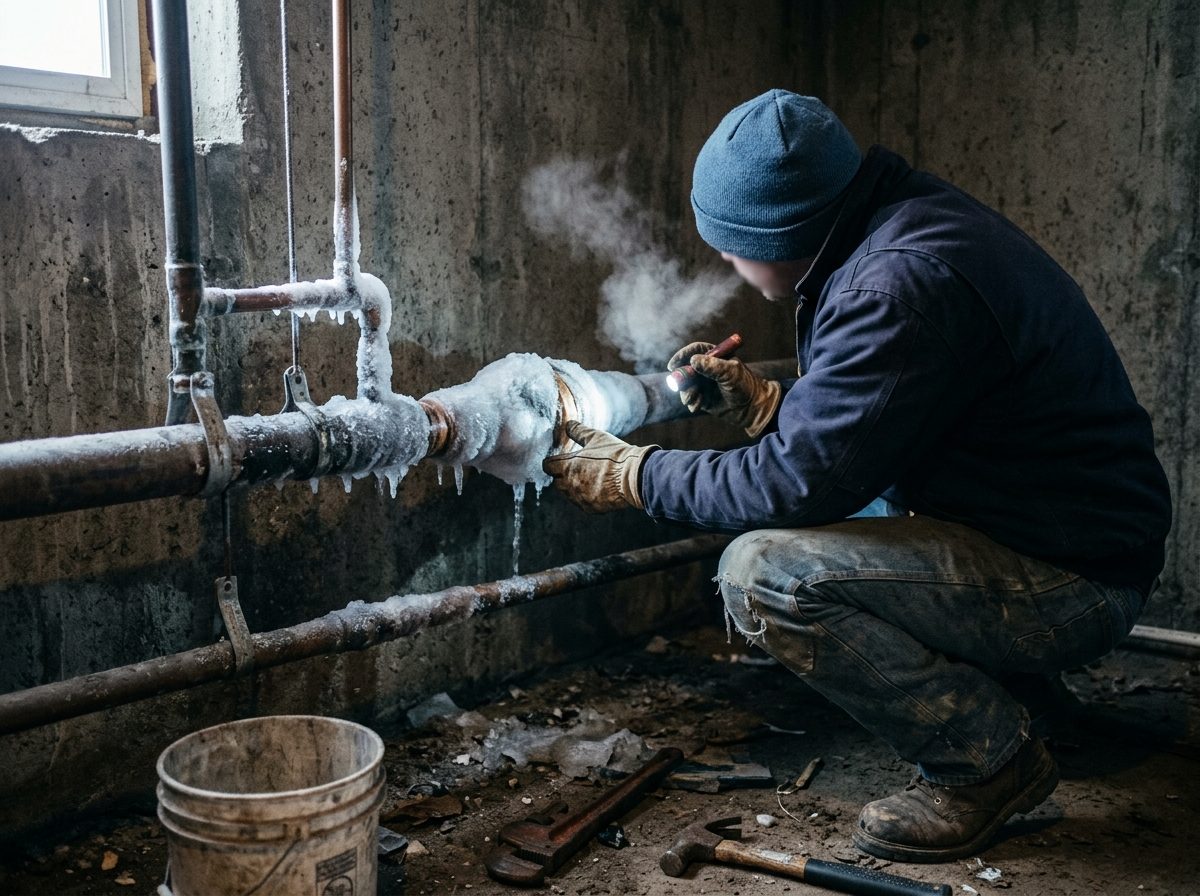
Frozen, or already split?
These are different jobs and it is worth knowing which one you have before you start heating things.
Probably just frozen
No flow, no sound
One fixture dead or dribbling, nothing audible in the walls, no damp anywhere, and the water meter is still. The pipe is blocked but intact.
Probably split
Sound or moisture
Hissing or trickling inside a wall, a damp patch, a ceiling stain, or the meter dial creeping with every tap closed. Shut the main now.
Split, thawing
Flow that keeps growing
You applied heat, got a trickle, and then it kept increasing after you stopped heating. That is not the pipe clearing; that is water finding an opening.
Not sure which one you have? Describe what you can hear and where. That usually settles it in under a minute.
Ask us on the phoneNo water at one tap only? That is a localised freeze and it is still catchable. Do not wait for it to split.
Catch It Before It SplitsWhat you can safely do before anyone arrives
Open the faucet
Both handles on the affected fixture. This relieves pressure and gives you a live indicator — the first dribble tells you the plug is moving.
Locate the main
Confirm it turns before you add heat. If it is seized, you are now running a different job and should say so when you call.
Warm the space, not just the pipe
Open cabinet doors under sinks, raise the thermostat, close crawlspace vents. Warm air reaching the whole run beats a hot spot in one place.
Heat from the faucet back
Hair dryer or heat lamp, moving steadily toward the suspected blockage. No flame, no torch, nothing unattended, and nothing hot against plastic.
Stop and call if the pipe runs inside a finished wall, if it is a drain rather than a supply line, if the meter is moving, or if you have thawed it and lost pressure elsewhere in the house. Those all point at damage rather than a simple blockage.
How the repair goes
A pro arriving at a frozen line works in a fixed order, and it is worth knowing so you can follow along.
First, control: main off or ready to close, and the affected zone isolated. Second, controlled thawing — often a purpose-built thawing machine that passes low-voltage current through a metal pipe to heat it internally, which is dramatically faster than warming a crawlspace and does not put an open flame anywhere near your framing. See pipe thawing for detail on that step alone.
Third, test. The system is brought back up to pressure and watched. This is the step that finds the split the ice was hiding, and it is done deliberately with the shutoff in hand rather than by turning everything on and hoping.
Fifth — the part people skip — the cause. A pipe that froze once in that spot will freeze again in that spot. Insulation, heat cable on a thermostat, sealing the air path that was feeding cold to it, or rerouting the run out of the exterior wall entirely are all cheaper than doing this again in February.
Key point
Insulation alone does not add heat; it only slows heat loss. A pipe in a genuinely unheated space with no warm air reaching it will still freeze eventually inside insulation. The durable fixes either give the pipe a heat source or move it somewhere warm.
Stopping the repeat
The prevention list is short, cheap and boring, which is why it does not get done.
Disconnect hoses before the first hard freeze and drain the bibs — a connected hose holds water against the valve and freezes it from outside in. Get the irrigation blown out properly in autumn rather than hoping; see sprinkler blowout and winterization.
If your plumbing is old galvanised steel, freeze damage tends to be the event that finally forces the conversation about repiping. Corroded, thin-walled pipe fails at lower pressures than new pipe, so the same cold night that a modern PEX system shrugs off can open two or three pinholes in a 1950s system.
House empty for the week? Freezes in unoccupied homes do the most damage because nobody hears them.
Call About an Empty HouseMountain, plains and metro are not the same problem
On the Front Range, most freezes are single-run failures in occupied houses, caught within hours, and repaired the same day. In the mountain communities, the dominant pattern is the unoccupied house: a second home or a rental where a furnace failed, and the discovery comes days later. That changes everything about the visit, because the question is no longer one pipe but which pipes survived.
On the eastern plains, wind is the variable. Sustained wind on an exposed north wall pulls heat out of a wall cavity relentlessly, and freezes happen at temperatures that would be survivable in a sheltered Denver neighbourhood. Well houses and pressure tanks in outbuildings are a common failure point out there, and they are usually the coldest structure on the property.
Thawed it and now it is leaking? Shut the main and call. That is the sequence, in that order.
Call about a leakCold-weather answers
Frozen pipe questions we get all winter
Open the faucet fully and watch. A frozen line usually gives you a dribble or nothing at all, and it is normally one fixture or one side of the house rather than everything. Cold-only or hot-only loss points at a specific run.
Often, carefully, if you can reach the pipe. Open the faucet the line feeds so melting water and pressure have somewhere to go, then apply gentle heat starting at the faucet and working back toward the blockage — a hair dryer, a heat lamp, or towels soaked in hot water.
Because melting ice has to go somewhere. If you heat the middle of a blockage first, you create water trapped between two ice plugs, and heating it expands it with nowhere to escape. Working from the open faucet backward means every drop you release has a clear route out of the pipe.
A short accessible run in a warm room can clear in twenty minutes. A long run under an unheated crawlspace can take hours, and a line frozen inside an exterior wall may not clear at all until the wall cavity warms.
The ice was holding the failure closed. Freezing expansion split the pipe or opened a joint, and the ice plug was acting as a plug in every sense; when it melts, the split starts flowing. Shut the main and see burst pipe repair.
Anything in an unheated crawlspace, a garage ceiling, an exterior wall on the north or west side, a hose bib that was left connected, a line running through a rim joist, and irrigation or basement lines in a home that was built assuming the furnace would always be running.
Colder and windier, mostly. Mountain communities see longer freezing spells and deeper frost, so a line that survives in Denver can fail in Fairplay. The bigger altitude factor is occupancy: a lot of high-country housing sits empty in the coldest weeks, and a house with no one in it has no one to hear a running pipe.
Get the water off, thaw the run under control, then pressure-test it and look for what the ice did. If the pipe is sound, the work turns to prevention — insulation, heat cable, rerouting a run out of an exterior wall, or air-sealing the spot the wind was hitting.
Homeowner policies commonly cover sudden water damage from a burst pipe, and commonly exclude damage where the house was left unheated or the loss was gradual. That distinction is exactly why photographs and a dated invoice matter, and why leaving heat on at a minimum setting in an empty house is worth more than the gas it costs.
A frozen line does not stay a small problem
Get instructions now and a pro on the way before the thaw decides how bad this is.
(833) 621-2904 — answered 24/7, statewide.