In Colorado, the sprinkler blowout is not optional maintenance. Water left in an irrigation system freezes, expands and splits whatever is holding it — and the first hard freeze arrives earlier than most people plan for.
The physics is unforgiving and the timing is unforgiving too. A hard freeze can arrive in September in the high country and by mid-October along much of the Front Range, and the damage does not announce itself in autumn.
Why draining is not enough
Water expands when it freezes, by roughly a tenth of its volume, and it does so with enough force to split brass, crack PVC and rupture the internals of a backflow assembly.
Simply shutting the system off and opening a drain does not remove the water.
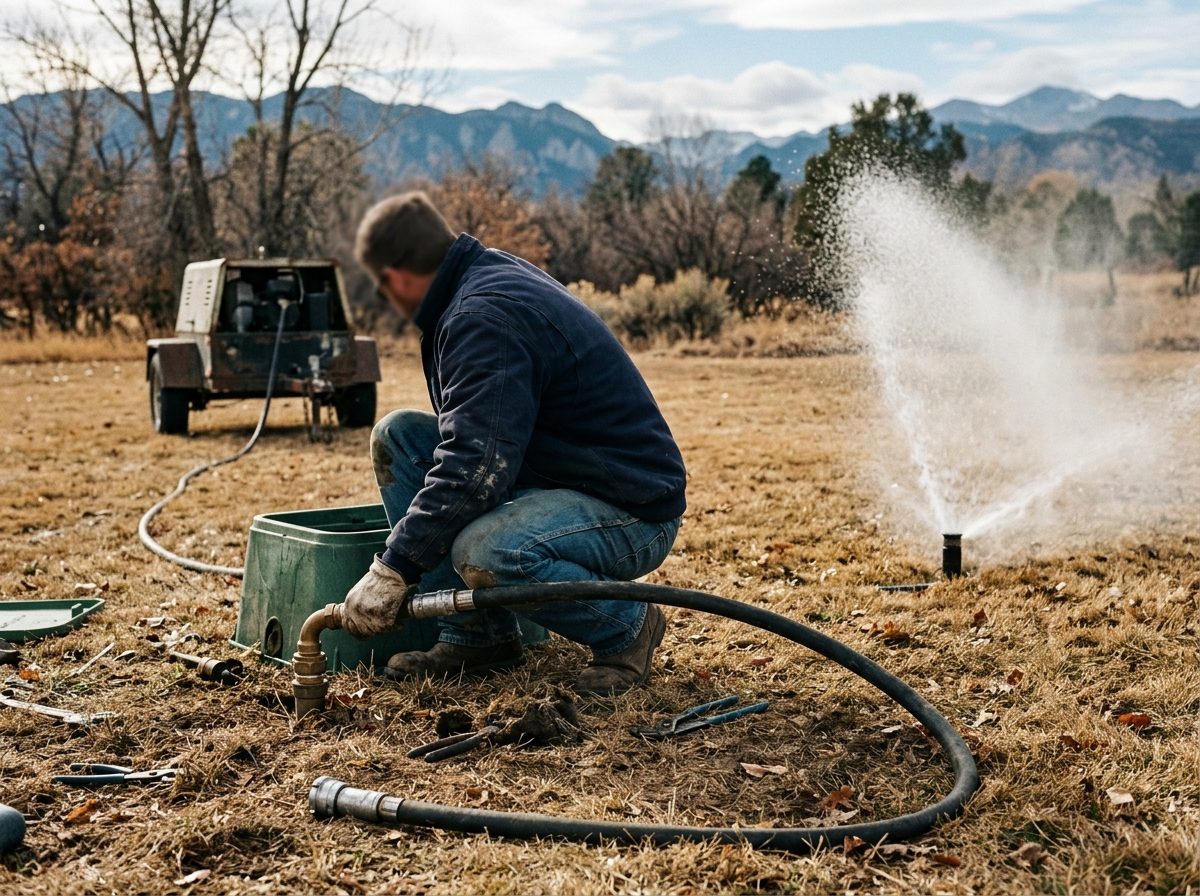
That is why compressed air is the standard method. Air blown through the system, zone by zone, pushes the water out through the heads.
The parts that fail when this is skipped are, unhelpfully, the expensive ones. A backflow prevention assembly is the most common casualty and the most costly single item; valve bodies and manifolds are next; and split laterals mean digging.
Draining removes some of the water. Freezing only needs some of the water. That gap is the entire reason blowouts are done with compressed air.
Timing, honestly
The question everyone asks is when, and the honest answer is: earlier than feels necessary, and before you are the fiftieth person calling on the first cold morning.
Along the Front Range, late September into October is the sensible window. In the mountain communities and the higher foothills, September — and in some places earlier, because a hard freeze in late August is not remarkable at elevation.
The risk of going early is a few weeks of hand-watering if autumn turns mild, which is a minor inconvenience.
Practical scheduling point: the first genuine cold snap generates an enormous spike in calls, and everyone doing blowouts is booked for days.
One more consideration for the high country and for anyone with a second home: if the property will be unoccupied, the irrigation system is only part of it. The house itself needs proper winterisation, and that is a different job — see frozen pipe repair for what happens when it is not done.
Mountain communities
September, or earlier
A hard freeze in late August is not unusual at elevation. Do not wait for October.
Front Range
Late September to October
Book in advance. The first cold morning generates days of backlog everywhere.
Eastern plains
October, watching the forecast
Cold arrives fast and dry. The window is real but it closes quickly.
Also now
Disconnect the hoses
The most common freeze failure of all, and it takes thirty seconds to prevent.
First hard freeze already forecast? Blowout slots close fast in the week the temperature drops. Call early.
Get on the Blowout ListHow a proper blowout is done
It is a straightforward job done well and a damaging one done badly, and the difference is mostly about air volume, pressure discipline and patience.
The water supply to the irrigation system is shut off at its isolation valve and the system is drained as far as gravity allows.
Then each zone is run in turn with air, starting with the zone furthest from the connection, and each is left running until the heads produce a mist rather than water.
The backflow assembly is drained through its test cocks and its internals cleared, and its isolation valves are left in the correct partly-open position so any residual water has somewhere to go rather than being trapped against a closed valve.
The critical discipline is pressure, not volume. Air pressure is kept modest — well below the pressure the system uses in operation — because high-pressure air is what damages seals, cracks fittings and destroys gear-driven rotors.
Then the controller is shut down for the season or set to off, and any rain sensor or wiring left in a sensible state.
Not booked yet and it is already October? Call today rather than after the forecast changes. Availability disappears the morning of the first freeze.
Get on the scheduleDoing it yourself, and the honest caution
Plenty of homeowners blow out their own systems successfully, and we are not going to pretend otherwise. But the failure modes are worth understanding before you rent a compressor.
The compressor is usually the problem. A small pancake compressor cannot deliver the air volume needed to push water through a zone, so the temptation is to raise the pressure instead — which is precisely what damages seals, valve diaphragms and rotor gears. You need volume, at low pressure. Most homeowner compressors provide the opposite.
The backflow assembly is where the money is. It is the most expensive component and the easiest to damage with air, and on many systems it is also the component that must be re-tested and signed off. Getting it wrong is not a small mistake.
Isolation matters. Air must not be introduced in a way that pushes back into the house plumbing or past the backflow device. That means using the proper blowout connection with the correct valves closed.
Eye protection, genuinely. Heads under air pressure can eject nozzles and debris. It is the one safety item people skip and the one they should not.
Where the system is simple, the compressor is genuinely capable, and you understand the isolation and the backflow assembly, it is a reasonable job. Where any of those is uncertain, a blowout costs a small fraction of a backflow assembly and comes with someone who does forty of them a week.
The rest of the autumn list
While someone is on site for the irrigation, there are a handful of other Colorado autumn jobs that prevent the calls we get all winter.
Disconnect every hose. The single most common freeze failure in Colorado homes. A hose left connected traps water in the sillcock, and even a frost-free sillcock cannot drain with a hose attached — so it freezes inside the wall and splits, then floods the basement at the first thaw.
Check the sillcocks themselves. Frost-free sillcocks need to be pitched slightly downward to drain, and a house that has settled can leave one pitched the wrong way.
Insulate what runs through cold space. Crawlspaces, garages, unheated basements, exterior walls and vented attic spaces. Pipe insulation is inexpensive and effective, and heat cable is worth considering for the genuinely exposed runs — see pipe thawing for what happens otherwise.
Know your main shutoff. Find it, confirm it turns, and make sure everyone in the household knows where it is. A shutoff you cannot find during a burst pipe is the difference between a wet floor and a rebuilt ceiling — see burst pipe repair.
If the property will be empty this winter
A blowout protects the irrigation. It does nothing for the house. An unoccupied property — a second home, a rental between tenants, a cabin — needs the interior plumbing winterised properly, or heat maintained with a low-temperature alarm that reaches your phone.
Spring start-up, briefly
The other half of the cycle, and worth mentioning because how it is done affects what survives.
Wait until the hard freeze risk has genuinely passed, which along the Front Range means later in spring than the first warm week suggests — a system charged in March and frozen in a late April cold snap is a common and avoidable loss.
Then open the supply slowly. Charging a dry system fast produces a pressure surge that damages the components a careful blowout just protected. Slow filling, then a walk-through of every zone: heads that did not survive the winter, misaligned nozzles, leaks at manifolds, controller programming and the rain sensor.
And if your backflow assembly requires annual certification in your district, spring is when it gets tested and the report filed. That is an approved tester's job and it has a deadline.
- Book the blowout in late August or early September, not after the forecast turns
- Air volume at low pressure clears lines — high pressure breaks them
- Backflow assembly drained through its test cocks and left correctly valved
- Disconnect every hose from every sillcock
- Controller switched off for the season
- Winterise the house properly if it will be unoccupied
Missed it last autumn? Then spring startup is the moment to find out what the freeze cost you.
Ask About Spring StartupWhat drives the price
We refer to independent contractors and cannot quote for them, but a blowout is one of the most standardised jobs in this trade and the variables are few.
Zone count is the main one — more zones means more air time. Then access to the blowout connection and the backflow assembly, and whether valve boxes need locating and digging out.
Scheduling affects price and availability more than most people expect. Booking early in the season, on a weekday, when the contractor can group several properties in one neighbourhood, is the cheapest way to have it done.
Bundling helps. Adding a sillcock replacement, pipe insulation, a sump pump test or a water heater flush to the same visit costs far less than separate call-outs, and autumn is the right moment for all of them.
Against any of that, the comparison is simple: a blowout is a small fixed cost, and a split backflow assembly plus a cracked manifold plus a dug-up lateral is not.
Want the whole autumn list done in one visit? Blowout, hoses, sillcocks, sump pump test and a heater flush.
Book the autumn visitOne small job, one large saving
Sprinkler blowout questions
Earlier than feels necessary. Late September into October along the Front Range, September or earlier in the mountain communities and higher foothills, and October on the eastern plains with an eye on the forecast.
No, and this is the central point. Irrigation laterals run nearly level and sag between heads, so they hold water in every low spot, and valve bodies, heads and the backflow assembly all hold water internally.
Water left in the system freezes, expands and splits whatever contains it — and the damage usually appears in spring rather than in winter.
Some homeowners do it successfully, but the compressor is usually the problem. You need high air volume at low pressure; most homeowner compressors deliver the opposite, and raising the pressure to compensate is exactly what damages seals, valve diaphragms and rotor gears.
Modest — well below the pressure the system runs at in operation. This is the detail that matters most.
Yes, on both counts — it is the most expensive component in the system and the easiest to damage.
Yes, and it is the single most common freeze failure in Colorado homes. A connected hose traps water in the sillcock, and even a frost-free sillcock cannot drain with a hose attached — so it freezes inside the wall, splits, and floods when it thaws.
No. A blowout protects the irrigation system and does nothing for the interior plumbing.
Air out now, or a split backflow in spring.
Blowouts, sillcocks, insulation and the rest of the autumn list — across 135 Colorado communities.
(833) 621-2904 — answered 24/7, statewide.