A frozen line is not yet a burst line. That distinction is the whole reason this page exists — there is a window between "no water at the tap" and "water in the ceiling," and what happens inside that window decides which of the two you are dealing with by morning.
If you have already found water
Stop reading and shut the main. A pipe that froze and split will not leak until the ice melts, and then it leaks all at once. That is burst pipe repair, and it is a phone call right now: (833) 621-2904.
The first twenty minutes
You turned on a tap and got a dribble, or nothing, or a groan from inside the wall. The house is cold somewhere it should not be.
Leave the tap open. This is the single most useful thing a homeowner does. An open faucet gives the melt somewhere to go and relieves the pressure that builds between the ice plug and the closed valve — and it is that trapped pressure, not the ice itself, that splits pipes.
Then find out how far the problem goes. Check every fixture in the house and write down which ones work. One dead bathroom means a branch line froze.
Open the cabinet doors under any sink on an exterior wall, and if you have a crawlspace hatch or a garage that shares a wall with plumbing, get warm air moving into it.
Open the tap
The fixture served by the frozen line, hot and cold both. Leave it open the entire time. It relieves pressure and announces the thaw.
Map the dead fixtures
Every tap, every toilet, both temperatures. The pattern tells a pro where the ice is before they arrive.
Warm the space
Cabinet doors open, crawlspace hatch open, heat turned up. Warm the room and the pipe follows.
Find the shutoff now
Not later. Locate the main and confirm it turns, so that if the thaw reveals a split you are already standing next to the answer.
Finding the ice
Ice forms where the pipe is coldest and least protected, and in Colorado housing that is a short and predictable list. Rim joists at the top of a foundation wall, where the framing meets the concrete and the insulation was cut short.
A pro locates the plug by touch and by sound before touching a heat source. Running a hand along an accessible line finds the cold section quickly; a surface thermometer confirms it; and where the line disappears into a wall, the geometry of which fixtures work and which do not brackets the frozen length to a few feet.
The ice does not break the pipe. The pressure trapped between the ice and a closed faucet does. Leave the tap open.
No water and it is dropping below freezing tonight? Describe which fixtures are dead and we will tell you what to open, what to warm, and how fast someone can get to you.
Call about a frozen lineThinking of using a torch? Do not. Ask first — this is the single most common way a freeze becomes a fire.
Ask Before You Heat ItHow a pro actually thaws a line
The professional approach is boring on purpose: slow, even heat applied from the fixture end of the frozen section, working back toward the middle, so that meltwater has an open path out rather than being trapped between two plugs of ice.
On accessible copper or steel, an electric pipe-thawing machine passes low-voltage current through the pipe itself, warming the whole frozen length from the inside out in minutes. It is fast, controlled, and it is not something to attempt with a welder and a hopeful attitude — it requires the right equipment and a real understanding of what else is electrically connected to that pipe. It also does not work on PEX or plastic, which do not conduct.
For plastic, buried, or inaccessible lines, the method is heat guns, heat blankets, and patience, or in the case of a frozen underground service line, a hot-water jetting head fed down the pipe. Underground work is slow and occasionally ends in excavation, which is why the diagnosis stage matters so much.
Throughout, the pro watches the line as it opens. A pipe that froze hard has often already been damaged, and the failure shows itself in the first seconds of restored flow. Being present with a shutoff in hand at that exact moment is the difference between a wet floor and a wet house.
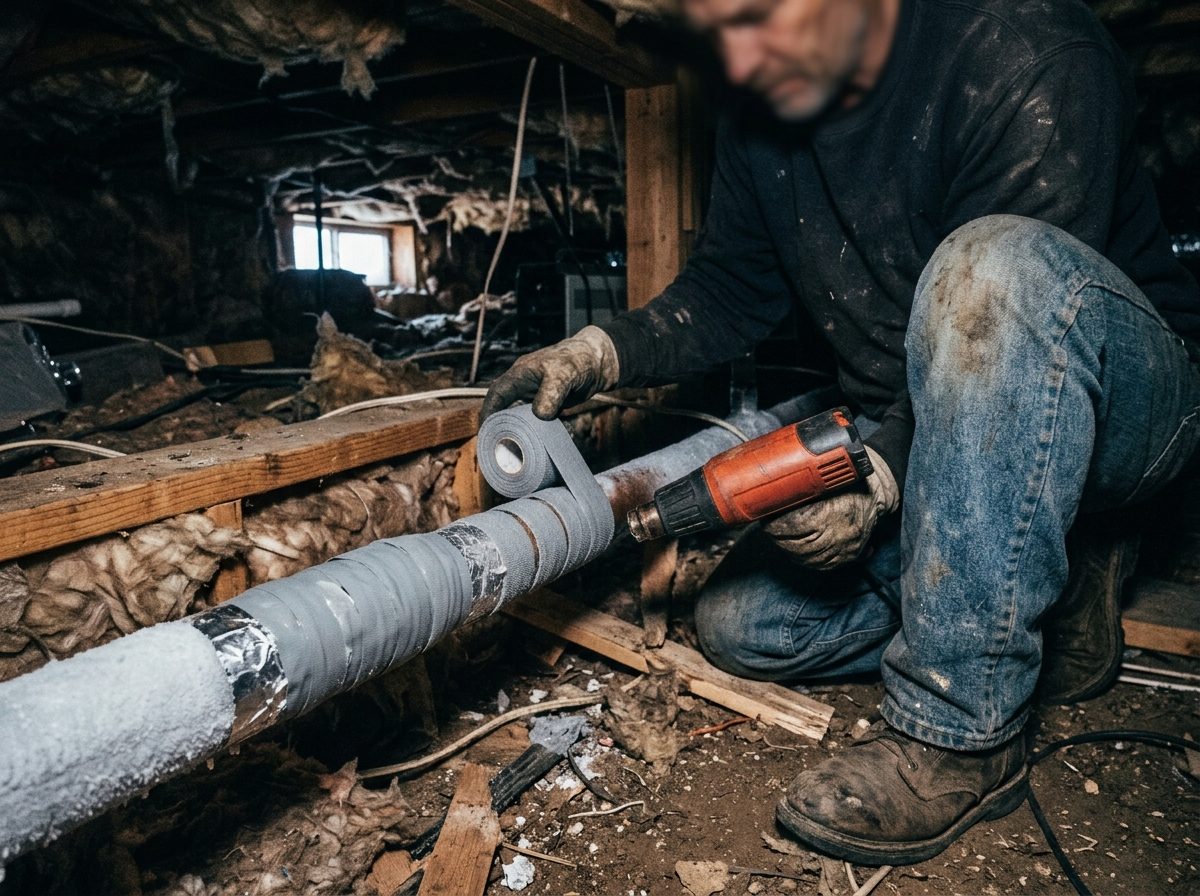
What not to do, and why
No open flame. Ever. Propane torches on frozen pipes are a recurring cause of structural fires in cold snaps, because the ignition point is usually not the pipe — it is the dust, the paper facing on old insulation, or the framing behind it, and the fire starts inside a wall cavity where nobody sees it for twenty minutes. There is no version of this that is worth the risk.
No boiling water poured on a pipe in a wall. It runs off, soaks insulation, refreezes, and leaves you worse off.
No sudden intense heat on a single spot. Rapid localised heating on a pipe that is already stressed encourages exactly the failure you are trying to avoid, and on plastic it deforms the wall.
What is fine, and genuinely helpful, is a hair dryer on a low setting moved constantly along an accessible run, a space heater warming the room from a safe distance and never left unattended, or towels soaked in hot tap water wrapped around exposed pipe and refreshed. If twenty or thirty minutes of that produces nothing, the ice is somewhere you cannot reach and it is time to call.
- Hair dryer, low, kept moving along the pipe
- Space heater warming the room, attended, clear of anything flammable
- Hot-water towels wrapped and refreshed on exposed runs
- Cabinet and crawlspace access opened to circulate house heat
Frozen drains and vents
Supply lines get the attention, but drains freeze too and behave differently. A frozen drain does not burst — it backs up. Washing-machine standpipes on an exterior garage wall, basement floor drains in unheated spaces, and condensate lines from high-efficiency furnaces are the usual candidates, and the condensate line is the one that catches people out, because when it freezes the furnace shuts itself down as a safety measure and now the house is getting colder while you work out why.
Plumbing vents freeze at the roof, which is a specifically Colorado problem: warm moist air rising through the vent hits sub-zero air at the roofline, frost accumulates inside the pipe, and eventually the vent closes. The symptom is not a blockage but a gurgle — drains that empty slowly and burp, toilets whose water level moves when another fixture runs. That is a roof job, in winter, and not one to do yourself.
Cabins, second homes and long absences
A significant share of our winter thawing calls come from properties nobody was in when it happened. Mountain communities, rental cabins, houses whose owners spend February somewhere warmer. The pattern is consistent: the heat was set low or failed entirely, the freeze ran for days rather than hours, and the discovery happens when someone finally opens the door.
If that is your situation and you are calling from out of town, the most valuable thing you can arrange is for whoever gets there first to shut the main before the house is warmed up. A property that has been frozen for three days should be brought back with the water off and a plumber present, not by turning the thermostat up and hoping.
For anything left empty over a Colorado winter, the real fix is upstream of all this — proper winterization, lines drained, or a monitored low-temperature alarm. Winterization is a few hundred dollars in October and a very different number in January.
Worth knowing
A pipe that freezes once will freeze again in the same place, because the reason it froze — missing insulation, an open vent, a cold cavity — has not changed. Ask the pro to tell you exactly where the ice was, and fix the cause before next winter.
Line thawed but now dripping? The split was already there. It needs looking at today.
Report a Post-Thaw LeakAfter it opens
Restored flow is the beginning of the inspection, not the end of it. Water will run dirty or air-locked for a minute; that is normal. What is not normal is pressure that comes back noticeably lower than the rest of the house, which suggests a partially collapsed or still-obstructed section, or any damp at all on the joists, subfloor or drywall near the frozen run.
Check every fixture on that line, then check the ceiling below it an hour later, then again the next morning. Freeze splits sometimes weep before they open, and a pinhole found on Tuesday is a repair while a pinhole found in April is a mould remediation.
Then deal with the cause. Insulate the run, seal the air leak that was chilling it, close the crawlspace vents, disconnect the hose from the sillcock. If the same line has now frozen in two consecutive winters, rerouting it out of the cold cavity is cheaper than the third time. And if the freeze did leave damage, frozen pipe repair covers what that repair looks like.
Tap open and still nothing after half an hour? The ice is somewhere you cannot reach. That is the point to hand it over.
Get someone outCold-snap answers
Pipe thawing questions, answered plainly
With the right equipment on an accessible line, often fifteen to forty minutes once the pro is on site and has located the plug.
Yes, and it matters more than most people realise. The pipe does not split because of the ice, it splits because water expanding behind the ice has nowhere to go and pressure builds against a closed valve.
On an exposed, accessible run, yes — a hair dryer on a low setting, kept moving along the pipe rather than held in one spot, is a reasonable thing to try.
Work out which fixtures still run. If one bathroom is dead and the rest of the house is fine, the ice is on that branch.
Not necessarily, and plenty of frozen lines thaw with no damage at all. The risk rises with how hard and how long it froze, what the pipe is made of, and whether pressure was trapped.
Very possibly. High-efficiency furnaces drain condensate through a small plastic line, and if that line runs through unheated space it freezes, the safety switch shuts the furnace down, and the house then cools fast enough to freeze supply pipes as well.
It depends heavily on access and on the hour. An exposed line in a basement during business hours is at the low end.
Shut the main before doing anything else, and do not simply crank the heat and leave. A property frozen for days may have multiple splits that will all open at once when it warms.
Tap open, still no water?
One number covers the whole state, through every cold snap, at any hour.
(833) 621-2904 — answered 24/7, statewide.