A burst pipe is the one plumbing failure where minutes have a price tag. Everything on this page is ordered accordingly: stop the water, then understand it, then decide what to do about the rest of the system.
Do this before reading on
Shut the main. Then open the lowest faucet in the house to bleed the pressure left in the lines. Then call (833) 621-2904 and tell us what you shut off.
Minute one: stop the water
Every decision after the first minute is cheaper than the first minute was expensive. The main shutoff is normally where the supply enters the house — a basement wall facing the street, a crawlspace access, or a mechanical closet near the water heater.
If you are outside a municipal boundary on a well, the equivalent move is the valve at the pressure tank, and cutting power to the pump stops it refilling. If you cannot find any of it, there is a curb stop at the meter pit, and your water utility can close the street side — that is a legitimate call to make while you are waiting.
Then bleed the system. Water sitting in the pipes above the break will keep running out of it under gravity long after the main is closed, and opening a basement faucet gives it an easier route than your ceiling.
Main off
Clockwise until it stops. If the handle spins with no effect, the valve has failed and you need the curb stop or the utility.
Bleed low
Open the lowest fixture in the house, plus an outside bib if it is not frozen. Drains the head of water still in the lines.
Power away from water
Breakers off for any circuit the water is heading toward. Do it from a dry position or not at all.
Photograph, then mop
Source, spread, and the wet materials. Wide and close. This is the cheapest insurance work you will ever do.
Water is off. Now what? Call and describe the pipe and the room. We will tell you what to move, what to open up, and how long the wait looks.
Get a pro movingWhy Colorado pipes burst
Freeze damage is the headline cause here and deserves its own page — see frozen pipe repair for the mechanics of why a pipe splits on the thaw rather than in the cold. But a meaningful share of the bursts we take calls about have nothing to do with winter.
Pressure is the quiet one. Municipal supply pressure across the Front Range varies considerably with elevation within a single water district, and a house sitting low in a zone can see street pressure well above what residential fittings are designed for. A pressure-reducing valve is supposed to handle that, and a pressure-reducing valve is a mechanical part that fails silently. Nothing announces it; you just start replacing supply lines and toilet fill valves more often than seems reasonable, and eventually something lets go properly.
Then there is age and chemistry. Much of Colorado has genuinely hard water, and hardness varies enough between neighbouring districts that two houses a few miles apart age their plumbing at different rates. Scale builds, flow narrows, velocity rises, and copper wall thickness quietly erodes at elbows. Galvanised steel from the mid-century boom corrodes from the inside out, which is why a pipe that looks fine can be paper-thin where it matters.
Most bursts are not accidents. They are the last event in a sequence the house had been signalling for years.
Main already off? Good. Now call and we will get someone out while you start moving what is still dry.
Call While You MopWhat the delay costs
It helps to think in volume rather than in time. A half-inch line at typical residential pressure delivers several gallons a minute. That is a bathtub every few minutes, and unlike a bathtub it is going into places designed to stay dry.
Minutes
Wet floor
Surface water, a soaked rug, a plumbing repair. Annoying, contained, and the cheapest version of this story.
An hour
Into the structure
Subfloor, wall cavity, insulation. Now you are drying materials you cannot see and pulling baseboard.
Half a day
Ceilings and finishes
Water below the break, stained or fallen drywall, ruined flooring, and cabinetry that swells and never recovers.
Days away
A different project
The classic unoccupied-house scenario. At this point the plumbing repair is a small line item on a much larger invoice.
How the repair actually goes
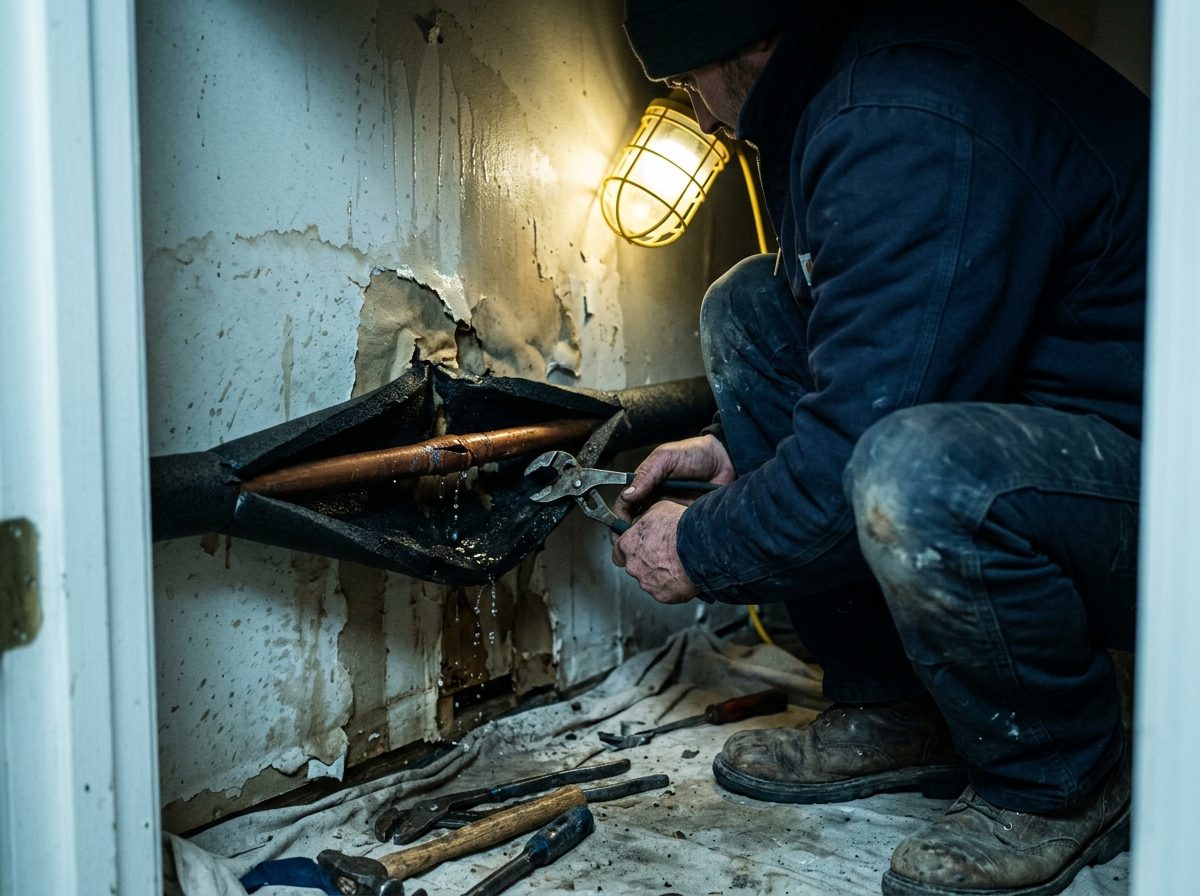
Once the water is off, the sequence is access, cut, replace, test, and then a conversation about the rest.
Access is usually the thing that determines the length of the visit. An exposed run in a basement ceiling is quick work. The same failure behind tile in a second-floor bathroom means opening a wall, and a good pro will show you exactly where they intend to cut and why before touching it.
The failed section gets cut out well past the visible damage, because a split rarely stops precisely where you can see it, and the replacement is joined in with fittings appropriate to the existing material. Then the system comes back up to pressure under supervision, with the shutoff in hand, and it gets watched.
If the break is on the line coming in from the meter rather than inside the house, that is a different job with different equipment; see main water line repair. And if water is clearly getting out somewhere you cannot see, leak detection comes before demolition rather than after.
Ask this question
Before the pro leaves: what is my static water pressure at the hose bib, and what is my pipe material? Two numbers, thirty seconds, and together they tell you whether tonight was an event or a preview.
Which materials fail here, and how
Copper is the workhorse of Front Range housing and it fails predictably: pinholes at elbows where velocity and scale do their work, and split joints after a freeze. It gives warning if anyone is looking — green staining, a weeping fitting, a stain on a joist.
Galvanised steel is what a lot of pre-1960 housing still has in places, and it fails from the inside. Interior corrosion narrows the bore, drops your flow, and thins the wall until pressure finds it. Rusty water first thing in the morning is the tell.
Polybutylene, the grey plastic installed widely from the late 1970s into the mid 1990s, has a well-documented history of fitting and pipe failures. If you have grey plastic supply lines with crimped fittings, knowing that now is better than knowing it during a flood.
PEX is what most replacement work uses today and it handles freezing far better than copper, expanding rather than splitting in many cases. It is not immune — fittings still fail, and UV exposure degrades it — but a PEX system in a Colorado crawlspace is a materially different risk profile from the copper it replaced.
Documenting for a claim? Ask the pro what to photograph before repairs begin — it is easier than reconstructing it later.
Ask What to PhotographDocumentation and insurance
We are not your adjuster and cannot tell you what your policy covers. What we can tell you is what makes a claim straightforward: photographs taken before cleanup, a clear date and time of discovery, a dated invoice describing the failure, and evidence the house was heated and occupied where that is relevant.
The distinctions that come up repeatedly are sudden versus gradual, and heated versus unheated. A pipe that split tonight and flooded a room is a different claim from a fitting that has been weeping into a wall for eight months, and a burst in a house left at 45°F while the owners were in Arizona is a conversation nobody enjoys. Keeping the thermostat at 60°F in an empty Colorado house in January is cheap by comparison.
Repair, or repipe?
One failure in sound pipe is a repair. Full stop. Anyone who responds to a single split copper joint by quoting a whole-house replacement is not doing you a favour.
But the calculation changes when the same system has failed before, when the material is at the end of its life, or when the pipe is buried in walls you are about to renovate anyway. Repeated patching on old galvanised is a slow, expensive way of arriving at the same place — see whole-home repiping for how that work is usually staged, often room by room rather than all at once. And if the underlying problem is pressure, a pressure regulator is a small job that protects everything downstream of it.
Still finding water? If it keeps coming with the main shut, something else is open. Call and we will work through it with you.
Call and describe itFast answers
Burst pipe questions, answered plainly
Main shutoff, clockwise, until it stops. Then open the lowest faucet in the house to drain the pressure still sitting in the lines, which stops the leak feeding from what is already in the pipes.
Look on the wall facing the street in a basement, in a crawlspace access, or in a mechanical closet near the water heater. Outside city limits on a well, it is usually near the pressure tank.
More than people expect, and fast. A half-inch supply line at normal residential pressure moves several gallons a minute, and it does not stop when the room is wet — it keeps going into the subfloor, down the wall cavity, and into the ceiling below.
In Colorado, freeze damage leads, but it is not alone. High street pressure with no working regulator, galvanised steel that has corroded from the inside, failed polybutylene, water hammer from a fast-closing valve, and hard-water scale thinning a copper wall all show up regularly.
A single clean failure in otherwise sound pipe is a straightforward cut-out and replace, and that is a genuine repair rather than a bodge. Repair clamps and epoxy wraps exist and have their place as a temporary hold, but they are a way to get through the night, not a fix.
The plumbing itself is often an hour or two once the pipe is accessible. Access is the variable. A line in an open basement ceiling is quick; the same failure inside a finished wall behind tile means opening the wall, and that stretches the visit.
Sudden accidental water damage from a burst pipe is commonly covered, and slow long-term seepage commonly is not, as is damage where a property was left unheated. Photograph the source and the damage before you clean up, keep the invoice, and note the date and time you discovered it.
Getting standing water out and air moving is genuinely useful and worth doing immediately. Pull soaked carpet padding, which holds water like a sponge. Where to stop is anything structural or anything you would need to put back: cutting into drywall, pulling flooring you want to keep, or opening a ceiling.
It is a pattern, not luck. Repeated failures on the same system usually mean the pipe material has reached the end of its service life, or that a pressure problem is being ignored. Ask for a pressure reading at a hose bib and ask what the pipe material is.
Water off? Good. Now get a pro on the way.
One call covers the whole state, at any hour, on any day of the year.
(833) 621-2904 — answered 24/7, statewide.