Nobody repipes a house because they want to. They repipe because the third pinhole in eighteen months has made it clear that each individual repair is cheap and the sequence is not.
The decision is genuinely difficult, because a repipe is disruptive and expensive and the alternative — keep patching — is always cheaper this month.
When repiping is actually the answer
Not on age alone. Plenty of Colorado houses have fifty-year-old copper in excellent condition, and replacing sound pipe is a waste of money.
Repeat failures in the same system. One pinhole is an event. Three in two years, in different rooms, is the pipe telling you its wall thickness has run out.
A material with a known end. Galvanised steel and polybutylene both fail predictably rather than randomly.
Flow that has never recovered. Chronically poor pressure at upper-floor fixtures, worse when two things run at once, in a house where the street pressure is fine.
Discoloured or metallic water. Rusty water on first draw in the morning, a metallic taste, or visible sediment in aerators and toilet tanks.
Strong signal
Repeat pinholes
Multiple leaks in two years, in different locations. The pattern is the diagnosis.
Strong signal
Galvanised or polybutylene
Both have a known failure trajectory. Plan the work rather than waiting for it.
Worth investigating
Chronically poor flow
Weak upstairs fixtures with good street pressure — often lost bore, not lost pressure.
Good timing
Walls already open
During a gut renovation the pipe work costs a fraction of what it costs later.
PEX or copper
This is the question homeowners are given least useful information about, so here it is plainly. Both are legitimate.
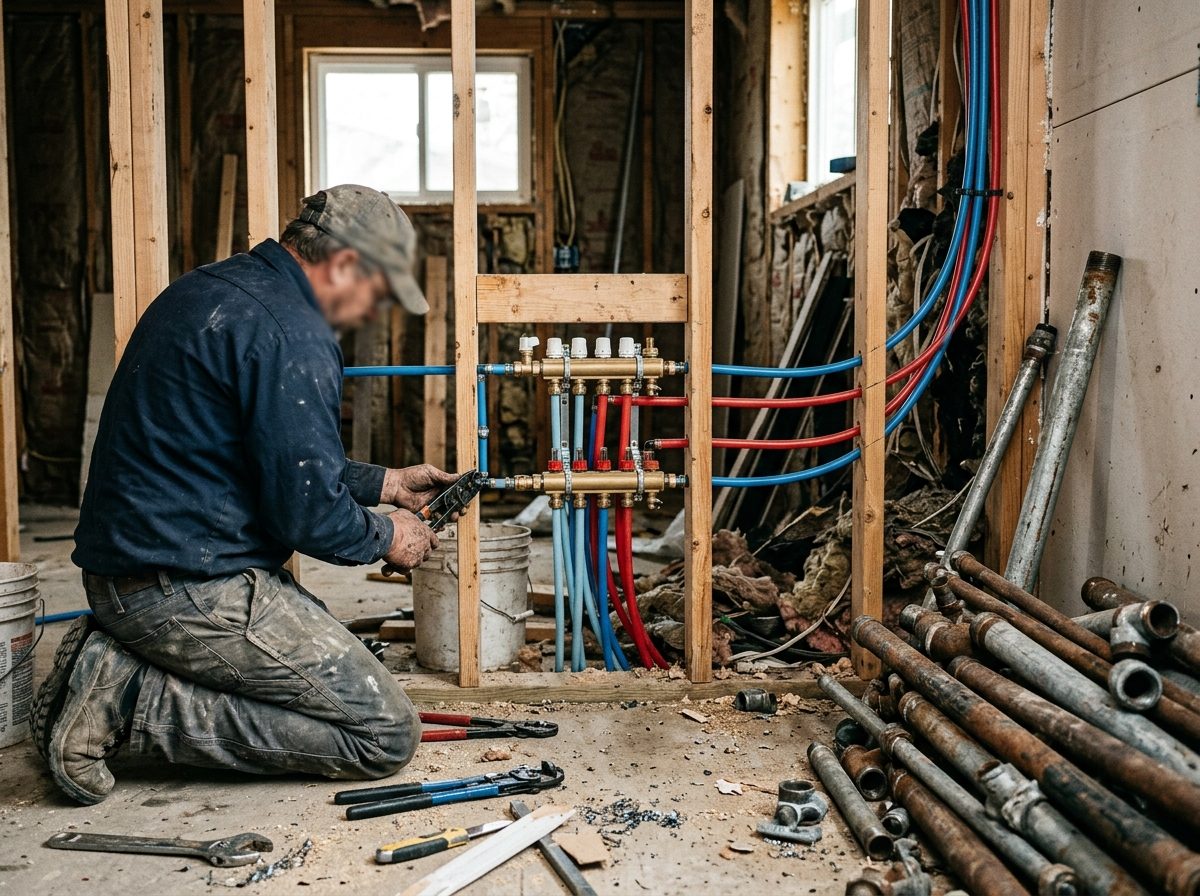
PEX is cross-linked polyethylene tubing. It is flexible, which means long runs with far fewer joints and the ability to route through existing wall and ceiling cavities with much less demolition.
Copper is rigid, proven over many decades, immune to UV and rodents, and tolerant of high temperatures, which keeps it standard for water heater connections and near boilers.
In practice, most residential repipes in Colorado today use PEX for the distribution runs, with copper retained or used for exposed mechanical connections and at the water heater.
The argument is not PEX versus copper. It is which material suits each run, and whether the person installing it does that kind of work every week.
Not sure what your pipes are made of? Look at an exposed run in the basement and call us. Two minutes on the phone usually settles it.
Ask about your pipingGalvanised steel and polybutylene
These two account for most Colorado repipes, and they behave differently enough to be worth separating.
Galvanised steel was standard into the 1950s and appears in older properties across Denver, Pueblo, Colorado Springs and the established Front Range towns. Its zinc coating protects the steel until it does not, after which the steel corrodes from the inside. Two things follow: the bore fills with rust scale until flow is badly restricted, and the wall thins until it pinholes. Restricted flow arrives first, which is why poor pressure in an old house is often a piping problem rather than a supply problem. Note also that galvanised joined directly to copper without a dielectric fitting corrodes faster at that junction.
Polybutylene is a grey — occasionally silver or black — flexible plastic pipe installed in houses built from roughly the mid-1970s to the mid-1990s. It was the subject of extensive litigation, and while opinions vary on how much of the failure rate belonged to the pipe versus the acetal fittings used with it, the practical position is settled: most plumbers recommend replacing it, some insurers surcharge or decline properties that have it, and it can complicate a sale. It fails without warning and often at a fitting. If you have it, treat replacement as planned maintenance.
A third case worth mentioning: copper with widespread pitting. Aggressive water chemistry, high velocity from oversized pressure, or a stray-current issue can pit copper from the inside. Where a plumber cuts out a leaking section and the pipe wall is visibly pocked, that is a systemic finding, not a local one.
Get the failed section
Ask the plumber to leave you the piece of pipe they cut out. A cross-section showing heavy scale, a thinned wall or interior pitting is the most persuasive evidence you will get about the state of everything you cannot see — and it is worth having if you are comparing repipe quotes or discussing coverage with an insurer.
Pinholes appearing one after another? Once copper starts, patching becomes a subscription.
Ask If It Is TimeWhat actually happens
A repipe is a construction project with a plumber attached, and understanding the sequence removes most of the anxiety.
It starts with a walk-through and a plan: which fixtures exist, where the runs will go, whether a manifold layout makes sense, where access has to be opened. A good contractor will show you the intended route before touching anything, because the route determines how much drywall comes out.
Then access. Openings are cut in walls and ceilings at strategic points — the aim is a small number of deliberate holes rather than continuous demolition, and flexible tubing is what makes that possible. New lines are run, usually leaving the old ones in place, because removing dead pipe from inside walls costs more than abandoning it.
Fixtures are connected in stages so the house is not entirely without water for the whole job. Then the system is pressure tested, inspected under permit, and only then are the walls closed and finished.
That last part matters commercially. Ask explicitly whether the quote includes drywall repair, texture matching and paint, or whether it stops at "patched" — the gap between those two positions can be thousands of dollars, and it is the single most common source of repipe disputes.
Living through it
Honest expectations: a typical single-family repipe runs several days to a couple of weeks depending on size, number of bathrooms, number of storeys and how accessible the runs are. Most households stay in the house.
Water is off during working hours on active days and generally restored each evening. There is dust, there is drilling, and there will be openings in walls and ceilings for several days before the finish work happens. Furniture near work areas needs moving and covering. If you work from home on calls, plan around the noisy days rather than being surprised by them.
Two practical requests worth making up front: ask for the crew to isolate and restore water to at least one bathroom each evening, and ask for plastic sheeting and floor protection to be specified in writing rather than assumed. Both are normal for a good contractor and neither is guaranteed if unstated.
Partial and phased repipes
A full repipe is not the only option and pretending otherwise does homeowners a disservice.
Partial repipe targets the worst of it — commonly the hot water distribution, which fails first in galvanised systems because heat accelerates corrosion, or one bathroom stack, or the horizontal runs in an accessible basement or crawlspace. This is a genuine strategy when accessible runs are the failing ones and the pipe buried in finished walls is a different, sounder material.
Phased repipe spreads a full replacement across scheduled stages: basement and mechanical runs now, upstairs bathrooms during next year's renovation. It costs somewhat more in total than doing it all at once, because mobilisation happens twice, and it can be the difference between doing the work and deferring it indefinitely.
What is not a strategy is repeated emergency patching with no plan. Each of those repairs is cheap, and three of them plus the water damage from the one that let go while you were away costs more than the repipe would have.
Two adjacent items worth handling at the same time: a pressure regulator if street pressure is high, because sustained high pressure is what shortened the life of the last system, and a water softener if hardness is contributing to scale and fixture wear.
- Written scope naming material, layout and every fixture connected
- Drywall repair, texture and paint explicitly included or excluded
- Permit, pressure test and inspection named in the quote
- Daily water restoration and site protection agreed in advance
- Warranty terms in writing, separating labour from materials
Only part of the house on old pipe? A partial repipe is sometimes the right call. Sometimes it is not.
Ask About a PartialWhat drives the price
We refer to independent contractors and cannot quote for them, and any statewide site giving you a repipe figure without seeing the house is guessing. The variables, in roughly descending order of impact:
Size and layout first — square footage, number of bathrooms and kitchens, and number of storeys, because vertical runs between floors are the expensive ones. Then access: a house with an open basement or a crawlspace under the whole footprint is a fundamentally cheaper job than a slab-built house with finished ceilings throughout.
Material choice matters, with copper costing meaningfully more than PEX in both material and labour. Then the extent of restoration, which as noted is where quotes diverge most. Then whether the service line is being replaced in the same project, whether the water heater connections and shut-offs are being renewed, and how many fixtures are being reworked rather than reconnected.
Permits and inspection are real costs and should be listed. Get two or three quotes with the same written scope, and compare what is included in restoration before comparing the totals — that is where apparently cheaper bids usually turn out not to be.
Weighing a repipe against another patch? Call and walk us through the last two years of leaks. The pattern usually answers the question.
Get a straight answerBefore you commit to the work
Whole-home repiping questions
Look for a pattern rather than a single event: repeat pinhole leaks in different rooms within a year or two, chronically weak flow at upper-floor fixtures despite good street pressure, rusty or metallic water on first draw, and visible sediment in aerators.
Both are legitimate and they fail differently. PEX is flexible, corrosion-proof, cheaper and faster to install, needs far fewer joints and routes through existing cavities with much less demolition, but it cannot be exposed to sunlight and rodents will sometimes chew it.
Typically several days to about two weeks for a single-family house, driven by square footage, number of bathrooms, number of storeys and how accessible the pipe runs are.
Usually not. Most households stay in place, with water off during working hours and restored in the evenings.
Not always, and this is the single most common source of repipe disputes. Some quotes include full drywall repair, texture matching and paint; others stop at rough patching or leave the openings entirely to you.
Most plumbers say yes, and there are practical reasons beyond the pipe itself. Polybutylene fails without warning and often at the fittings, some insurers surcharge or decline properties that have it, and it can complicate a sale.
Yes, and it is a real strategy rather than a compromise. Common partial scopes are the hot water distribution, which fails first in galvanised systems because heat accelerates corrosion, a single bathroom stack, or the accessible horizontal runs in a basement or crawlspace.
If the problem was restricted bore, dramatically. Galvanised steel fills with internal rust scale until a three-quarter-inch pipe passes water like a straw, and replacing it restores flow that the house has not had in decades.
Stop paying for the same leak.
A plan beats a patch. One number for 135 Colorado communities.
(833) 621-2904 — answered 24/7, statewide.