A slow drain is information. Which fixture, how slow, and whether anything else in the house is affected tells you almost everything about what is wrong and how much it will cost — usually before anyone puts a tool down the pipe.
Read the symptom first
Start with scope, because it separates a twenty-minute job from a sewer investigation. One fixture draining slowly while everything else behaves normally means the blockage is local — in that trap or in the branch line serving it.
Then listen. Gurgling from a nearby fixture when you drain a sink is air being pulled through a trap because the line cannot breathe past the obstruction — meaningful, and often the first sign of a partial main blockage.
Smell tells you about the material. Kitchen lines smell of rancid grease. Basement floor drains that smell of sewage have either a dry trap or a backing-up main, and those are very different problems: one is fixed with a jug of water, the other is not.
One fixture
Local blockage
Trap or branch line. Hair, soap, grease or an object. Quick, cheap, usually resolved on the spot.
Several fixtures
Shared branch
The blockage sits where those lines meet. Needs access through a cleanout rather than through the fixture.
Lowest fixture
Main line
Basement floor drain or lowest toilet backing up when other fixtures run. Stop using water and call.
Recurring
Structural
Cleared four months ago and back again? Something is wrong with the pipe, not with what went down it.
What is actually in there
Bathroom lines block with hair bound together by soap scum, and in hard-water areas — which is most of Colorado — that scum sets considerably harder than people expect.
Kitchen lines block with grease, and grease behaves differently in a Colorado basement than the diagram in the brochure suggests.
Laundry lines block with lint and detergent residue. Floor drains block with sediment, construction debris and, in older homes, whatever was swept toward them over decades. And main lines block with roots, which is a different page — see sewer line repair — or with the accumulated result of everything above.
Then there are wipes. Nothing marketed as flushable survives the trip. They do not break down, they catch on any irregularity in the pipe, and they collect everything that follows.
More than one fixture slow? That usually means the shared line, not the sink. Describe which fixtures and we will tell you how urgent it is.
Get it looked atHow a drain gets cleaned properly
The professional version differs from the homeowner version in two respects: access and thoroughness.
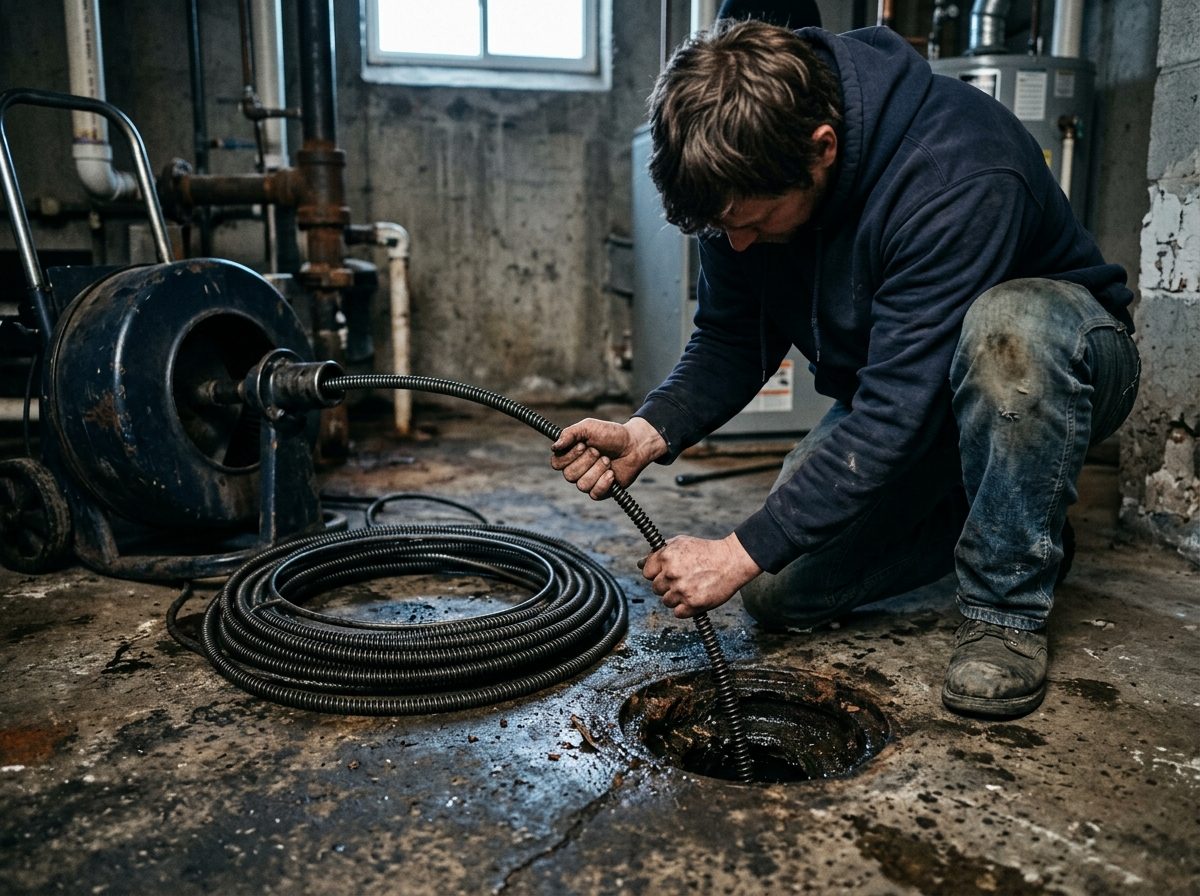
Access means going in through a cleanout rather than through the fixture wherever possible. A cable fed down a sink is working against every bend between the bowl and the blockage; a cable fed through a cleanout has a straight run at it.
Thoroughness means clearing the pipe rather than punching a hole through the blockage. A cable with the wrong head bores a channel through a grease ring, water flows again, everyone is happy, and the line re-blocks in a season because ninety percent of the obstruction is still on the wall. Where the buildup is heavy, that is the point at which hydro jetting becomes the better tool.
Then it gets tested — a proper volume of water run through while the pro watches the flow, not a hopeful ten seconds at the tap.
Scope it
Which fixtures, how slow, any gurgling. Establishes whether this is a branch or a main before a tool comes out.
Find the access
Cleanout first, fixture second. The right entry point determines whether the line gets cleared or merely poked.
Cut, do not bore
Correctly sized head, taken back to the pipe wall, so the line is actually clear rather than temporarily open.
Flow test
Real volume, watched. Then camera if the line fought back or if this is a repeat visit.
Already poured something down it? Tell us what and how much — it changes how the pro protects themselves on arrival.
Tell Us What Went DownWhy the bottle makes it worse
Caustic drain openers are the most reliably counterproductive product in the hardware aisle, and it is worth understanding why rather than just being told.
They work by generating heat and dissolving organic matter, which does very little to a cold grease ring or a mass of wipes. What they do reliably is sit in the trap. If the blockage does not clear, you now have a pipe full of caustic solution that the next person to open that trap will wear, which is why a plumber will ask what you poured down before they touch anything — and why some will decline to cable a line that has had a bottle in it.
The heat also matters. Repeated use degrades older PVC and ABS joints and attacks the remaining wall thickness of corroded metal pipe. On a marginal old drain line, chemical openers are a genuine way to convert a blockage into a leak.
Enzyme-based maintenance products are a different category and are broadly harmless — they will not clear an existing blockage but used monthly they slow organic buildup in a kitchen line. Boiling water and dish soap down a kitchen drain weekly does much the same for free.
Tell the plumber
If you have poured anything caustic down the drain, say so before they start. It is a safety issue for them and it changes how the job is approached — not something to be embarrassed about, just something to mention.
What is reasonable to try yourself
Plenty, actually, and on a single slow fixture it is worth twenty minutes before calling.
A sink trap comes apart by hand or with slip-joint pliers, and the blockage is inside it more often than not. Put a bucket underneath, unscrew both nuts, and look. This is the highest-yield fifteen minutes in domestic plumbing.
A plunger works if you seal the overflow — on a bathroom sink or a bathtub, the overflow opening lets your pressure escape, and blocking it with a wet cloth transforms the result. A cheap plastic barbed drain strip clears hair from a shower or bath in seconds. A hand auger reaches a couple of metres down a branch line and handles most bathroom blockages.
Where to stop: a toilet that will not clear with a flange plunger and a closet auger, anything involving the main line, any fixture where sewage is coming up rather than water going down, and any line you have already put chemicals into. Also, if the fix keeps needing repeating, stop repeating it and find out why.
- Pull and clean the sink trap before anything else
- Block the overflow before plunging a sink or bath
- Barbed hair strip for shower and tub drains
- Boiling water and dish soap weekly on the kitchen line
Same drain, third time? Repeat clogs in one line usually mean a defect further down.
Ask About the CauseKeeping it clear
Grease is the whole game in a kitchen. Not just bacon fat — butter, oil, dairy, salad dressing and the residue rinsed off every plate. Wipe pans with a paper towel before washing, and run hot water for thirty seconds after the dishes rather than shutting off the moment the sink drains. A disposal does not change any of this; it grinds solids finer and sends the same grease down the same cold pipe.
Bathrooms need hair caught at the drain, which is a two-dollar problem with a two-dollar solution that most houses do not have installed. Floor drains that are rarely used need a jug of water down them every couple of months to keep the trap sealed — a dry trap is the single most common cause of an unexplained sewer smell in a Colorado basement, and it is not a blockage at all.
Wipes, cotton buds, dental floss, cat litter and paper towel do not go down a toilet regardless of packaging claims. Neither does coffee grounds down a sink.
The pattern that matters
Cleared and re-blocked within six months is not bad luck and not something you did. It means the pipe itself has a problem — a belly holding water, a root intrusion, an offset joint, or a section of pipe that has lost its diameter. Ask for a camera before you pay to clear it a third time.
When cleaning is not the answer
Drain cleaning solves blockages. It does not solve pipes. If the line keeps failing, the honest next step is a camera inspection, which usually costs less than the second unnecessary clearing and tells you which of a small number of things is actually happening.
Roots entering at a joint are common in older Front Range neighbourhoods where mature trees sit over clay laterals. A belly — a sag where the pipe has lost its fall, often from soil movement in our expansive clay — holds water and catches solids at the same point every time. Offset joints, crushed sections, and scale buildup on old cast iron all produce the same recurring symptom from different causes, and each has a different remedy, from jetting through spot repair to trenchless lining.
And if sewage is backing up into a basement fixture rather than a drain simply running slow, that is a backup, not a slow drain, and it should be treated as urgent.
Second blockage this year? Stop paying to clear it. Ask for the camera and find out what the pipe is doing.
Book a proper lookSlow drain answers
Drain cleaning questions, answered plainly
No, and it is also the version you can often fix yourself. A single slow fixture means the blockage is in that trap or the short branch serving it.
That the blockage is downstream of where those lines join, not in any one fixture.
They are poor at the job and genuinely damaging as a habit. They generate heat and attack organic matter, which does little to congealed grease or wipes, and the unspent solution then sits in the trap where the next person to open it gets a face full.
Cold pipe and warm grease. Fat, oil and dairy go down the sink warm, hit a line running through an unheated basement ceiling or crawlspace, and set within a few feet of the fixture.
It changes the size of the solids and nothing else. The grease still goes down, the same pipe is still cold, and the finer particles bind to the deposit rather than passing through it.
A single accessible fixture during normal hours is at the low end; a main line through a cleanout costs more; after-hours emergency work and jobs where a cleanout has to be created or excavated cost more again.
Because the clearing addressed the blockage and not its cause. Recurring blockages at the same point usually mean root intrusion at a joint, a belly where the pipe has sagged and lost its fall, an offset joint catching solids, or heavy scale on old cast iron.
Most often a dry trap. Floor drains, unused shower drains and old laundry standpipes have a water seal that keeps sewer gas out, and in Colorado’s dry air that water evaporates within weeks if the fixture is not used.
Cleared today, and cleared properly.
One number for 135 Colorado communities, seven days a week.
(833) 621-2904 — answered 24/7, statewide.