A running toilet is the most expensive small fault in a house. It makes no mess, causes no alarm, and quietly sends hundreds of gallons a day down the drain — in a state where water is the thing we are all being asked to use less of.
Toilets are also the fixture most homeowners have a reasonable go at themselves, and often that is the right call.
The running toilet, and the flapper
Start here because it is the most common call and the cheapest fix.
Inside the tank there are two things that can leak water away. The flapper — or on newer designs a canister seal — sits over the flush valve opening and holds the tank's water.
Diagnosing it takes five minutes. Put a few drops of food colouring in the tank and do not flush. Come back in twenty minutes: colour in the bowl means the flapper or flush valve seal is leaking.
Flappers perish. Rubber hardens, warps and stops sealing, and in Colorado's hard water mineral deposits on the seat make it worse.
What makes this urgent rather than merely annoying is the volume. A steadily running toilet can waste more water in a day than a household uses for everything else, and on a metered supply the bill arrives before anyone noticed the noise.
A toilet that runs quietly for a month costs more than the plumber who would have stopped it on day one. It is the cheapest repair in the house and the most expensive to postpone.
Other symptoms, and what they point to
Weak or incomplete flush. First suspect the flapper closing too early, or a chain that has too much slack. Then the water level in the tank, which should be near the marked line.
Bowl empties slowly, or gurgles. Slow drainage points at a blockage in the toilet, the branch drain, or further out. Gurgling in a toilet when another fixture drains points at venting or at a partial main line blockage — that is a drain cleaning question rather than a fixture one.
Bowl water level drops on its own. Either evaporation in a rarely used bathroom, or a crack, or a venting problem siphoning the trap.
Rocking or moving toilet. Loose closet bolts, a deteriorated flange, or a soft subfloor beneath. Do not ignore it: every rock breaks the wax seal a little more, and the leak that follows goes into the floor rather than onto it.
Do it yourself
Flapper and fill valve
Cheap parts, ten to thirty minutes, no special tools. Genuinely worth trying first.
Worth a call
Wax ring and flange
Pulling a toilet is doable but the flange is where it gets complicated. Often cheaper done once, properly.
Call promptly
Rocking, or water at the base
Both damage the subfloor while you wait. Small job now, floor repair later.
Stop and call
Multiple fixtures backing up
Not the toilet. Main line. Stop running water and get it looked at.
What is worth doing yourself
We are a referral service, so there is no advantage to us in overstating what needs a professional. Honestly:
Worth doing yourself: replacing a flapper or a full fill valve, adjusting the float level, replacing the handle and chain, clearing a simple clog with a proper flange plunger or a closet auger, tightening the tank-to-bowl bolts gently, and descaling rim jets with a mild acid cleaner.
Worth calling for: anything involving the flange, because that is where a straightforward wax ring replacement turns into a repair — a broken, corroded or below-floor-level flange needs the right repair part rather than three stacked wax rings, which is the classic homeowner mistake and fails within a year.
Not worth trying: chemical drain cleaner in a toilet. It rarely works on the kind of obstruction that blocks a toilet, it sits in the trap where the next person to work on it will meet it, and it can damage the fixture.
One more caution specific to old houses: on a fixture that has not been touched in decades, the supply stop and the closet bolts are frequently seized.
Toilet running, rocking or leaking at the base? Any of those is a same-week job, not a someday job. Call and we will get someone out.
Get a toilet looked atReplacement, and choosing well
Replacement makes sense when the bowl or tank is cracked, when the fixture is a very old high-volume model, when repeated clogs point at a poorly performing design, or simply as part of a remodel.
A few things genuinely matter when choosing, and a lot of things do not.
Rough-in dimension. Measure from the finished wall to the centre of the closet bolts. Most are twelve inches; ten and fourteen exist, particularly in older Colorado homes, and buying the wrong one is a wasted afternoon.
Flush performance. Modern low-volume toilets are dramatically better than the first generation of them, which is where the reputation for weak flushing came from. Independent flush performance testing exists and is worth looking at. A good 1.28-gallon toilet clears better than a bad 3.5-gallon one, which is the whole reason the standards moved.
Water use. High-efficiency models are standard now and matter in this state. Where the household is large, the payback on replacing genuinely old fixtures is quick, and some districts have offered rebates worth asking about.
Bowl height and shape. Comfort-height bowls suit most adults and are easier for anyone with mobility limitations. Elongated bowls are more comfortable; round saves a couple of inches in a tight bathroom.
What matters less than people expect: brand prestige and finish detail. What matters more than people expect: whether replacement parts for the flush valve are commonly available in five years. Unusual imported mechanisms are a nuisance to service.
What a proper installation includes
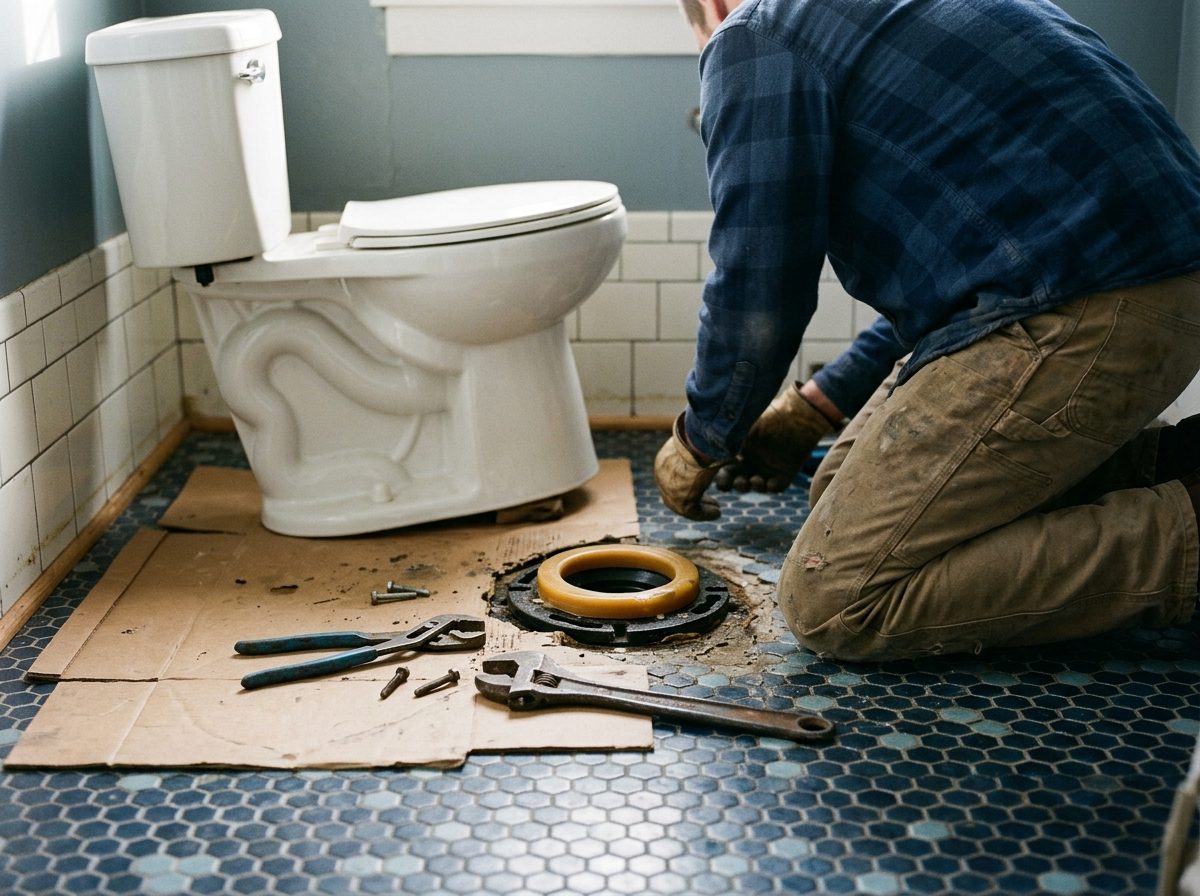
Setting a toilet is quick when the substrate is right and slow when it is not, and the difference is all in what happens before the fixture goes down.
The flange is inspected and repaired or replaced if it is broken, corroded or sitting below the finished floor — a common finding where tile has been added over an original floor. It should be secure to the subfloor, not just to the tile. The subfloor itself gets checked for softness, which is a sign of a long-running leak and needs dealing with before a new fixture hides it.
Then a new wax ring or a modern waxless seal, new closet bolts, the fixture set level and shimmed where the floor is not, bolts tightened evenly and progressively — porcelain cracks if they are overtightened — and the base sealed at the front and sides while leaving the back open so that a future leak becomes visible instead of trapped.
The supply stop is replaced if it is old or weeping, because a stop that will not close is what turns the next small problem into a flooded bathroom. A braided stainless connector rather than a plastic one. And then the fixture gets tested: several flushes, a check for movement, and a look underneath for weeping at the tank bolts.
The three-wax-ring mistake
When a flange sits below the finished floor — usually because tile was laid over the original floor — the temptation is to stack wax rings until the gap is filled. It seals for a while and then it does not, and the leak goes into the subfloor. The correct fix is a flange extender or repair ring bringing the flange to the right height. It costs a few dollars more and it is the difference between a repair and a re-repair.
Water at the base? A seal that has gone needs pulling and resetting, not caulking over.
Report a Leak at the BaseWhat drives the price
We refer to independent contractors and cannot quote for them, but toilet work has a predictable shape.
Internal repairs — flapper, fill valve, handle, chain, tank bolts — are the lowest-cost service call there is, often bundled if there are several fixtures. Clearing a blocked toilet with an auger is similarly modest, unless it turns out the blockage is further down the line, in which case it becomes drain work.
Pulling and resetting a toilet with a new wax ring, bolts and supply stop is a short job with a clear price — unless the flange needs repair, which adds parts and time, or the subfloor is soft, which is carpentry rather than plumbing and should be quoted separately.
Replacement adds the cost of the fixture, which varies enormously, plus removal and disposal of the old one. Relocating a toilet is a different order of job entirely: it means opening the floor and moving drain and vent piping, and the drain has to fall correctly to its connection, so it is priced as remodel work. Our shower and bathtub plumbing page covers the wider bathroom rough-in picture.
Two things reliably raise the price and are nobody's fault: fixtures that have not been touched in forty years, where every fastener is seized, and second-floor bathrooms where a long-running leak has already reached the ceiling below.
- Do the food-colouring test before assuming the flapper is fine
- Never use in-tank cleaning tablets — they destroy rubber parts
- Measure the rough-in before buying a replacement fixture
- Fix a rocking toilet early, while it is still a wax ring and not a subfloor
- Repair a low flange properly rather than stacking wax rings
- Two or more fixtures backing up means stop and call about the main line
Replacing more than one fixture? It is usually cheaper in a single visit than spread across three. Call and we will line it up.
Book toilet workSmall fixture, large water bill
Toilet repair questions
Almost always the flapper or canister seal has hardened and stopped sealing, so water passes into the bowl and the fill valve keeps topping the tank up.
Far more than people imagine — a steadily running toilet can waste more in a day than a household uses for everything else combined, and it makes almost no noise while doing it.
Yes, and you probably should. It costs a few dollars, needs no special tools, and takes ten minutes: shut the supply stop, flush to empty the tank, unhook the old flapper, fit the matching new one, adjust the chain so it has just a little slack.
Loose closet bolts, a deteriorated flange, or a subfloor that has softened — often from a slow leak that has been going for a while.
Four candidates: condensation on the tank in a humid bathroom, a failed wax ring, weeping from the tank-to-bowl bolts, or a cracked bowl.
In a bathroom that is rarely used, evaporation. Otherwise either a hairline crack in the bowl or a venting problem siphoning the trap seal.
No. It seldom works on the kind of obstruction that blocks a toilet, it sits in the trap waiting for whoever works on the fixture next, and it can damage the porcelain and the seals.
Measure from the finished wall behind the fixture to the centre of the closet bolts. Twelve inches is the common dimension, but ten and fourteen inch rough-ins turn up regularly in older Colorado homes.
A running toilet is a leak with a schedule.
Flappers, flanges, wax rings and full replacements — 135 Colorado communities, one number.
(833) 621-2904 — answered 24/7, statewide.