Fitting a new faucet is a twenty-minute job on new plumbing and a half-day job on old plumbing, and you find out which one you have about ten minutes in — usually when the supply stop refuses to turn.
That gap is the entire subject of this page. The fixture you chose is rarely the difficult part. What is behind it — a forty-year-old angle stop, a corroded galvanised nipple, a sink that has to come out to reach the nuts, a valve nobody has closed since the house was built — decides whether this is a small job or a real one.
What is behind the fixture
Colorado housing stock spans a wide range, and each era brings its own version of this problem.
Older homes with original supply piping. Galvanised steel supply lines corrode from the inside, and the last few inches before a fixture are usually the worst.
Multi-turn angle stops that have never been closed. The small valve under the sink is designed to close, but an old multi-turn stop that has sat open for decades often will not, or closes and then weeps around the stem afterwards.
Polybutylene and early plastic systems. Where these are still in service, fittings are brittle and unforgiving. Work at the fixture is a good moment to ask an honest question about the system as a whole — see whole-home repiping.
Hard water everywhere. Scale seizes threads, blocks aerators and cartridge passages, and turns a cartridge swap into a fight. It is also why a beautiful new faucet can start dribbling within two years if nothing was done about the water.
The fixture is the easy part. The supply stop that has not been closed since 1974 is the job.
Common faults, and whether they need replacement
Plenty of faucet problems are repairs rather than replacements, and knowing which saves money.
Dripping from the spout. A worn cartridge, ceramic disc or washer, depending on the design. On most modern faucets it is a cartridge, and cartridges are available for the major brands — often free under a lifetime warranty.
Leaking at the base of the spout or the handle. Usually O-rings, which are cheap. Worth doing before it soaks the countertop or the cabinet below.
Low flow at one fixture only. Start with the aerator, which unscrews and rinses out — in hard water this alone fixes it most of the time. Low flow at every fixture is a different problem: that is pressure, and it belongs on pressure regulator.
Hot and cold reversed or mixing oddly. On a single-lever mixer, often a cartridge fitted the wrong way round or a failed pressure-balance element.
Usually a repair
Drip at the spout
A cartridge or washer. Often warranty-covered on major brands. Keep the fixture.
Usually a rinse
Low flow at one tap
Unscrew the aerator and clear the scale. In hard water this is the answer more often than not.
Replace while you are there
Old supply stops
Quarter-turn ball stops instead of seized multi-turn valves. Cheap now, essential later.
Time to replace
Parts unobtainable
Corroded body, failing finish, or a brand nobody stocks cartridges for. Cut your losses.
Choosing fixtures that will still work in ten years
There is a lot of fixture on the market and the price range is enormous. A few things actually predict how a faucet will age.
Solid brass body. The single best predictor of longevity. Plastic and zinc-alloy bodies fail earlier, particularly in hard water, and they cannot be repaired when they do.
Ceramic disc or a well-supported cartridge. Ceramic disc valves handle hard water better than most alternatives. More importantly, buy a brand whose cartridges you can walk into a store and buy in five years. This matters far more than the finish.
Parts availability and warranty. The major manufacturers offer long warranties on cartridges and finishes and will send you parts. Deeply discounted online fixtures frequently have no parts channel at all, which turns a two-dollar washer problem into a fixture replacement.
Hole configuration. Measure before buying. Single-hole, three-hole eight-inch centreset, three-hole widespread — a mismatch means either a deck plate or a new sink. Count the holes and measure between the outer ones.
What matters less: touchless activation, which is pleasant and adds a failure point; and filtration built into the faucet, which usually means a proprietary cartridge and is better handled by a proper filtration setup.
What a proper installation includes
The details that make a difference are almost all upstream and downstream of the fixture itself.
New supply stops where the old ones are suspect. Quarter-turn ball valves, replaced while access is already open. If a stop will not close fully, it gets replaced rather than nursed.
New braided stainless connectors. Not reused, not plastic. Correct length, no sharp bends, not overtightened.
Fixture secured properly. Mounting hardware tightened so the faucet does not rotate on the deck, with the deck seal or gasket seated. A faucet that wobbles will loosen and then leak under the deck, where nobody looks until the cabinet swells.
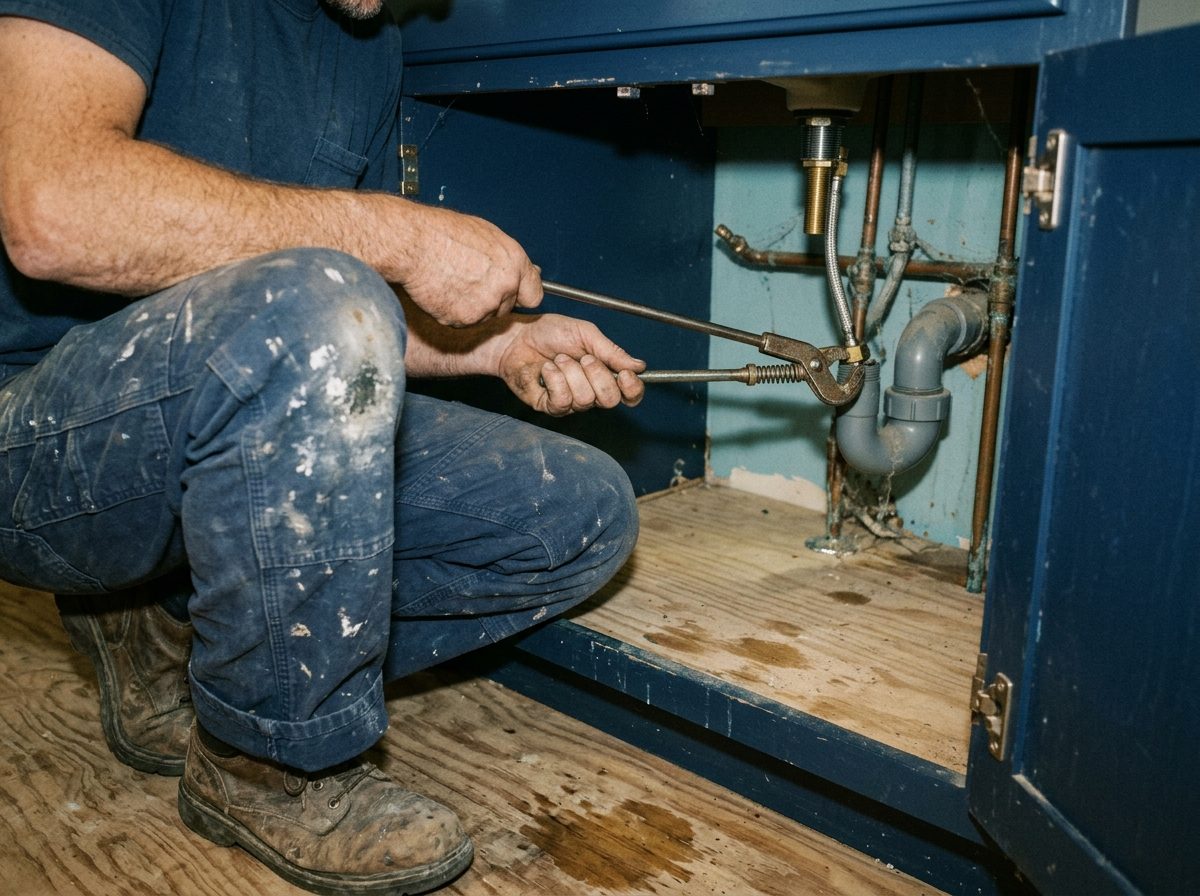
Drain and trap done at the same time. A sink change is the right moment to replace the tailpiece, trap and trap arm rather than reusing corroded parts, and to make sure the trap arm has proper fall to the wall connection. Slip-joint work that was disturbed and reassembled dry is a common source of the slow cabinet leak discovered months later.
Beyond faucets
Fixture installation covers more than taps, and most of it shares the same pattern — the fitting is straightforward, the connection to old plumbing is the variable.
Kitchen sinks. Drop-in is straightforward; undermount depends on the countertop and often needs a fabricator involved. Either way the drain position may change, which means the trap arm has to work with it. Adding a disposal changes the drain arrangement too, and needs a dedicated switched circuit.
Bathroom vanities. The rough-in for the old vanity is rarely exactly where the new one wants it. Vessel sinks change the height relationship between the drain and the trap arm. Wall-hung units need blocking and a lower rough-in. All solvable, all worth knowing before delivery day.
Laundry connections. A good time to fit a single-lever shutoff valve that closes both hot and cold at once, and to replace rubber hoses with braided stainless. Failed washing machine hoses are one of the most common sources of serious household water damage, and they cost very little to change.
Utility sinks, bar sinks and outdoor taps. Straightforward, except that outdoor taps in Colorado must be frost-free sillcocks pitched to drain, with the hose disconnected each autumn. See winterization.
Water dispensers and pot fillers. Both mean running a new supply line to a place that did not have one, which is where the cost sits.
Two upgrades to do while the cabinet is open
Quarter-turn ball stops on every fixture you touch, so the next repair starts with a valve that actually closes. And braided stainless connectors everywhere, especially at the washing machine, where a single-lever shutoff plus stainless hoses is the cheapest insurance against water damage available anywhere in a house. Neither adds much to a visit that is already happening.
What drives the price
We refer to independent contractors and cannot quote for them, but the variables here are unusually clear.
A straight faucet swap on accessible modern plumbing with working stops is a short, cheap visit. A cartridge replacement is cheaper still, and often the right answer instead of a new fixture. Where the cost grows is in what has to be dealt with along the way: replacing seized supply stops, repairing corroded supply piping, removing a fixture whose nuts are inaccessible behind a sink that has to come out, or discovering rot in the cabinet base.
Sink and vanity installations depend on the countertop, whether the drain position moves, and whether the trap and trap arm need reworking. Undermount sinks may involve a countertop fabricator. Adding a fixture where none existed — a pot filler, a bar sink, a second lavatory — is priced by the difficulty of the supply and drain runs, and the drain is almost always the expensive half because it needs fall and venting.
Multiple fixtures in one visit is meaningfully cheaper per fixture than separate calls, so it is worth batching. And the fixture cost itself is yours to control — with the reminder that a solid brass body with obtainable cartridges from a supported brand will cost less over ten years than a bargain fixture replaced twice.
- Measure hole spacing and count holes before buying a faucet
- Choose a solid brass body and a brand whose cartridges are stocked locally
- Try the aerator first when one tap has poor flow
- Replace old multi-turn stops with quarter-turn ball valves
- New braided stainless connectors, never reused flexes
- Batch several fixtures into one visit where you can
Several fixtures to change? One visit costs less per fixture than three separate ones. Call and we will schedule it in a block.
Book fixture workThe fixture is the easy part
Faucet and fixture questions
Repair, usually. A drip from the spout is a worn cartridge, ceramic disc or washer, and on the major brands cartridges are readily available and often covered by a lifetime warranty.
Start with the aerator: unscrew it and rinse the scale out, which fixes it more often than not in hard Colorado water.
On modern accessible plumbing with working shutoff valves, yes — it is a reasonable job with basin wrench and patience. The risk in older Colorado homes is what you find: a supply stop that will not close, corroded galvanised nipples, or nuts you cannot reach without pulling the sink.
A solid brass body, a ceramic disc or well-supported cartridge, and a brand whose replacement parts you can buy locally in five years.
If they are old multi-turn stops, yes. They frequently will not close fully after decades open, and a valve that will not close is what turns a small future leak into a flooded room.
It is good practice. Slip-joint parts that have been disturbed after years in place often do not reseal reliably, and corroded tailpieces and traps are cheap to replace while everything is apart.
Usually debris. Opening the supply after work dislodges scale and fragments that lodge in the aerator or the cartridge. The right procedure is to remove the aerator and flush both lines before final assembly.
They are pleasant, particularly in a kitchen, and they do add electronics, a solenoid valve and a power source to something that would otherwise be purely mechanical.
Replace rubber hoses with braided stainless, and fit a single-lever valve that shuts both hot and cold together. Failed washing machine hoses are among the most common causes of serious household water damage, and the parts cost very little.
Yes, and the cost sits in the runs rather than the fixture. A supply line can usually be routed with modest disruption.
New fixtures, on plumbing that is decades older.
Faucets, sinks, vanities and laundry connections — batched into one visit, across 135 Colorado communities.
(833) 621-2904 — answered 24/7, statewide.