High water pressure feels like a luxury and behaves like a slow leak generator. It is one of the few plumbing problems that damages everything in a house simultaneously — and one of the cheapest to measure and correct.
Colorado has a particular exposure to this. Much of the state is built on slopes, and water districts have to deliver adequate pressure to the highest houses in a zone.
Why high pressure is a problem
Plumbing systems and appliances are designed for a working pressure range. Push beyond it and the failure rate of everything rises together.
Appliance valves. Washing machines, dishwashers and ice makers all contain small solenoid valves that open and close against the incoming pressure.
Fixture seals and cartridges. Faucet and shower cartridges wear faster, and the dripping tap that returns three months after a repair is often a pressure problem being mistaken for a parts problem.
Supply connectors and joints. Every flexible connector, compression fitting and solder joint is under sustained load.
Water heaters. The tank is under system pressure continuously. High pressure combined with thermal expansion and no expansion tank is what produces a relief valve that weeps, and eventually a tank that fails early.
The pattern that gives it away: fixtures failing across the house rather than in one place, repeated cartridge replacements, appliance valves failing early, and a relief valve on the water heater that occasionally drips.
If you are replacing faucet cartridges every couple of years and appliance valves keep failing, stop buying parts and buy a pressure gauge. It costs about as much as one cartridge.
Measure it — it takes five minutes
This is the rare plumbing diagnostic a homeowner can do completely, for the price of a gauge from any hardware store.
Screw a hose-thread pressure gauge onto an outside tap or the laundry sink connection, open the valve fully, and read it.
Then do it again at night. This is the step most people skip and it is the important one: municipal pressure often rises overnight when district demand falls, and a system that reads acceptably at 6pm can be well over the limit at 3am — which is when the joint fails.
Residential systems are generally expected to sit within a moderate band; codes commonly set an upper limit around 80 psi, and comfortable operating pressure is usually meaningfully below that.
Low pressure is worth measuring too, because the answer is different. Low readings at every fixture point at a failing regulator stuck closed, a partly closed main valve, a blocked whole-house filter, corroded galvanised supply piping, or a problem on the service line — see main water line repair.
Step one
Gauge on an outside tap
Static pressure with nothing running. Five minutes, and the cost of one faucet cartridge.
Step two
Check again overnight
District pressure often rises when demand drops. The 3am peak is the one that breaks things.
Above the limit
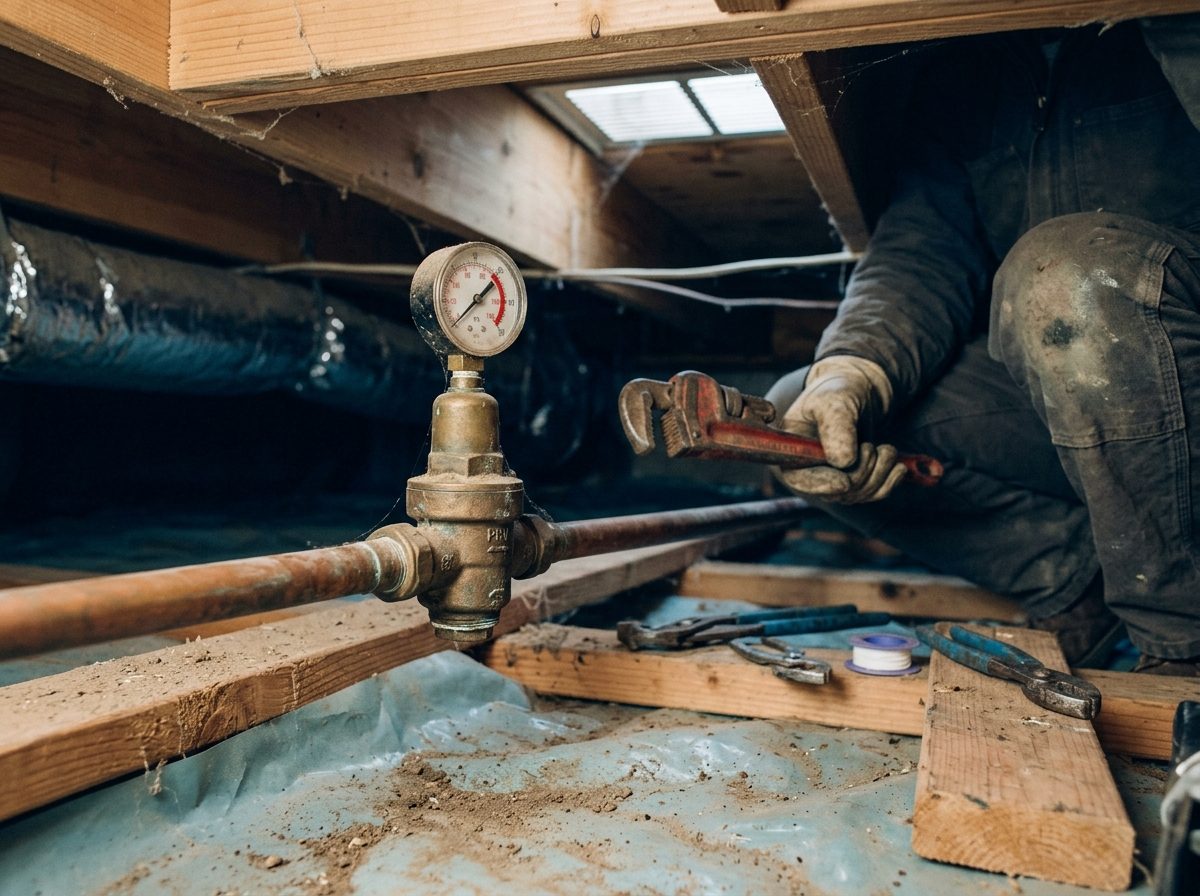
Fit or replace the PRV
Codes commonly cap residential pressure around 80 psi. Above that it is a requirement, not an option.
While you are there
Expansion tank
A closed system needs somewhere for heated water to expand. Otherwise pressure spikes every cycle.
Measured over 80 psi? That is doing quiet damage to every fixture in the house right now.
Report Your Pressure ReadingWhat a pressure-reducing valve does
A pressure-reducing valve — a PRV, sometimes called a regulator — sits on the incoming water line just after the main shutoff and reduces incoming street pressure to a set outlet pressure. It is a mechanical device with a spring and a diaphragm, adjustable within a range, and it is entirely passive: no power, no controls.
Most Colorado homes in high-pressure districts have one already, whether the owner knows it or not. Which raises the more common question: not whether to fit one, but whether the existing one still works.
PRVs wear out. A typical service life is somewhere in the region of ten to fifteen years, and they fail in three recognisable ways.
Failed open, passing full street pressure into the house. The symptom is exactly the high-pressure damage pattern above, in a house that used to be fine.
Failed closed or restricted, throttling flow and producing poor pressure everywhere. Often misdiagnosed as a supply line problem, and it is a much cheaper fix.
Unstable, hunting and producing pressure that varies or thumps. Noisy and hard on the system.
Because they are inexpensive relative to the damage they prevent, a PRV of unknown age on a house with high street pressure is generally worth replacing rather than testing repeatedly. Fitting one where none exists is a straightforward job on accessible piping, and the valve should go in with an accessible shutoff and a union so that the next replacement is simple.
Reading over 80 psi? That is above the usual code limit and it is quietly shortening the life of everything in the house. Call and get it brought into range.
Get pressure correctedThermal expansion, and the part people forget
This is the detail that turns a correct PRV installation into a complete one, and it is skipped often enough to be worth its own section.
Water expands when heated. In an open system, that expansion pushes back toward the street harmlessly. But a PRV — and a backflow preventer, and a closed check valve — makes the house a closed system: water cannot flow backwards. So every time the water heater fires, the expanding water has nowhere to go, and system pressure spikes sharply.
The consequences show up as a relief valve on the water heater that weeps or discharges periodically, pressure readings that vary wildly depending on when you look, banging or creaking in the pipes after hot water use, and a water heater that fails earlier than it should.
The fix is a thermal expansion tank — a small tank with an air cushion, fitted on the cold supply near the water heater, giving expanding water somewhere to go. It is inexpensive, it is required by code in closed systems in most jurisdictions, and it is the single most commonly omitted item in a water heater or PRV installation.
Two things worth knowing about them. The air charge has to be set to match your system pressure, not left at the factory default — a tank charged wrongly does very little. And they fail: the bladder eventually goes, at which point the tank waterlogs and stops working, so it belongs on the checklist during any water heater service. If your relief valve drips and there is an expansion tank fitted, suspect the tank rather than the valve.
When the problem is low pressure
Plenty of calls are the opposite complaint, and the diagnosis follows the same discipline: measure, then narrow.
Low at every fixture, hot and cold: a PRV failed closed or set too low, a main shutoff or meter valve not fully open, a clogged whole-house filter, or corroded galvanised supply piping narrowed by decades of scale. That last one is common in older Colorado housing and it is the case where repiping is the real answer rather than a valve.
Low at every fixture but only sometimes: district-side variation, or demand exceeding what the service line can deliver — worth checking against what the neighbours experience.
Low on hot only: sediment in the water heater, a partly closed heater isolation valve, or scale in the heater's outlet. See water heater repair.
Low at one fixture: aerator, cartridge, or a partly closed supply stop. Nearly always the aerator in hard water.
Sudden loss of pressure with no obvious cause, particularly with a wet spot in the yard or a meter that turns with everything off, points at the service line — and that is a different urgency. On a well, low pressure has its own set of causes covered under well pump service.
Three numbers worth knowing about your house
Static pressure with nothing running. Overnight peak pressure, captured on a maximum-reading gauge. And whether there is an expansion tank, with its air charge set to match.
Banging pipes when a tap shuts? High pressure, a failed PRV or a missing expansion tank.
Ask About Banging PipesWhat drives the price
We refer to independent contractors and cannot quote for them, but this is one of the better-value repairs in plumbing and the cost structure is simple.
Replacing an existing PRV is a short job where the valve is accessible and already has unions and a shutoff.
Fitting a PRV where none exists adds the work of cutting into the incoming line and setting up the valve, shutoff and gauge properly.
An expansion tank is an inexpensive part with modest labour, and it should be fitted or checked whenever a PRV or a water heater goes in.
Set against that: appliance valves, faucet cartridges, supply connectors and water heaters all last longer at correct pressure, and the leak that does not happen is the saving that does not appear on any invoice.
- Measure static pressure with a hose-thread gauge, nothing else running
- Capture the overnight peak with a maximum-reading gauge
- Above the code limit means a PRV is required, not optional
- Replace a PRV of unknown age rather than testing it repeatedly
- Fit an expansion tank on any closed system, charged to system pressure
- Ask for a permanent gauge and unions so the next job is quick
Relief valve on your water heater dripping? That is usually pressure or a failed expansion tank, not a faulty valve.
Have the pressure checkedOne number explains a lot
Water pressure questions
Within a moderate band — codes commonly cap residential pressure at around 80 psi, and comfortable operating pressure usually sits meaningfully below that.
Buy a hose-thread pressure gauge from any hardware store, screw it onto an outside tap or the laundry connection, open the valve fully with nothing else running, and read it.
Because it shortens the life of everything simultaneously. Appliance solenoid valves, faucet and shower cartridges, flexible connectors, joints and the water heater are all under sustained load, and they fail earlier — often as leaks in places with no floor drain.
Commonly in the region of ten to fifteen years. They fail in three ways: open, passing full street pressure into the house; closed or restricted, throttling flow and imitating a supply problem; or unstable, producing varying pressure and noise.
It is a strong candidate — a PRV failed closed or set too low produces exactly that, and it is a much cheaper fix than the alternatives.
Usually thermal expansion in a closed system rather than a faulty valve. Once a PRV or check valve is fitted, heated water cannot expand back toward the street, so pressure spikes each time the heater fires and the relief valve does its job.
A small tank with an air cushion, fitted on the cold supply near the water heater, giving heated water somewhere to expand into.
Its air charge should be set to match your system pressure rather than left at the factory default, because a wrongly charged tank does very little.
Street pressure is not your pressure.
Measured, reduced and protected with an expansion tank — across 135 Colorado communities.
(833) 621-2904 — answered 24/7, statewide.