On a well, you are the water utility. There is no district to call when the pressure drops, nobody testing the water but you, and no crew arriving to fix the main — which makes understanding the system genuinely worth an hour of your time.
A great many Colorado properties are on private wells: the eastern plains, the foothills, mountain subdivisions, and rural land all across the state.
What the system is made of
Five parts, and knowing which one you are describing makes the phone call far more useful.
The well and casing. A drilled borehole with a steel or plastic casing, a sanitary cap at the top, and a static water level somewhere below ground that varies seasonally and with drought.
The pump. Almost always a submersible pump hanging in the well on the drop pipe, with its wiring running alongside.
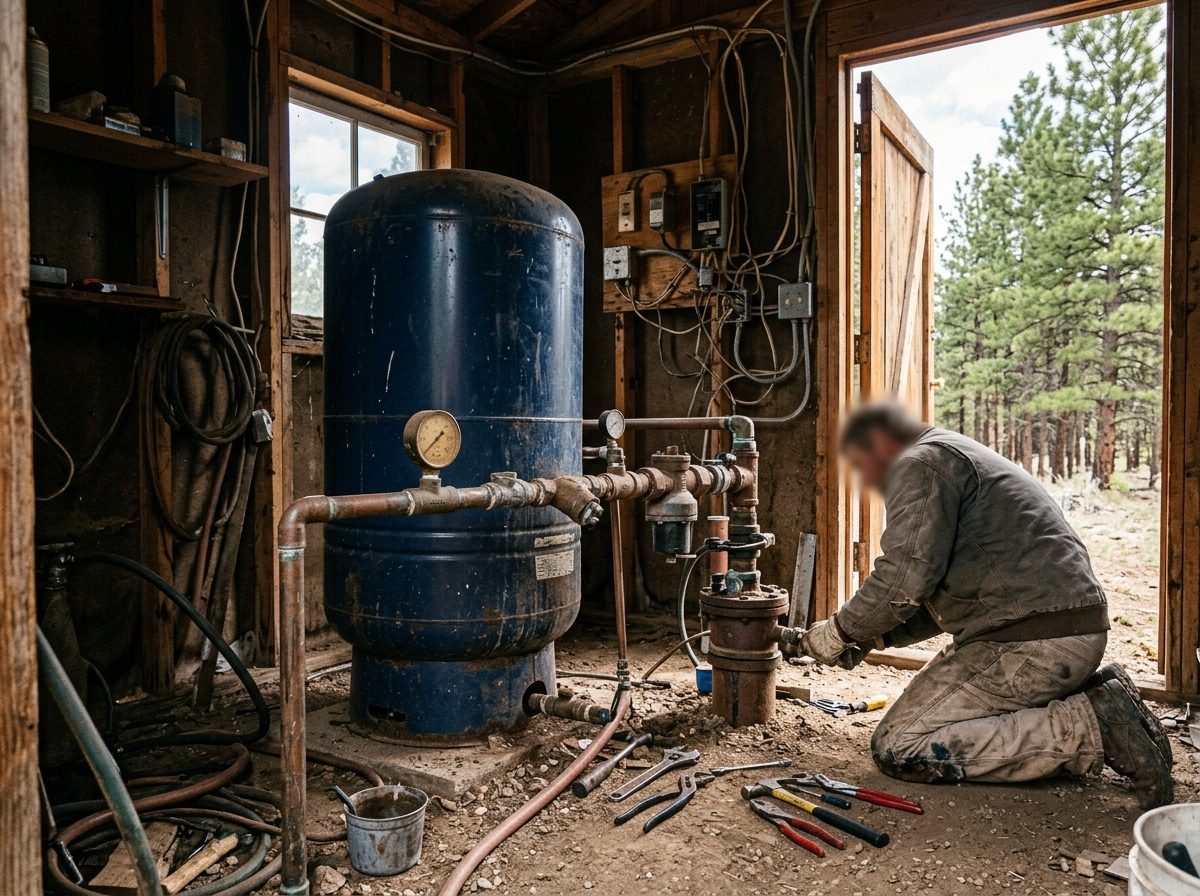
The pressure tank. A tank containing an air cushion, usually separated from the water by a bladder.
Controls. A pressure switch that starts and stops the pump at set points, a control box for the pump motor on many systems, and a pressure gauge.
Rapid cycling, fluctuating pressure, a pump that never seems to rest — nine times in ten the pressure tank has lost its air charge, and that is a far cheaper conversation than a new pump.
Symptoms and what they usually mean
Pump cycles on and off rapidly — every few seconds when a tap runs. The classic waterlogged pressure tank.
Pressure fluctuates noticeably in the shower. Same cause most of the time. Also check the pressure switch settings and the gauge, which is a cheap part that fails and lies.
No water at all. Work through it in order: is there power to the pump — breaker, control box, disconnect; is the pressure switch operating; is there any pressure on the gauge.
Water pressure gradually declining over months. Could be a worn pump losing efficiency, a clogged well screen, a dropping water level, or a fouled filter or treatment system.
Most common
Waterlogged tank
Rapid cycling and pressure swings. Cheap to fix, expensive to ignore — it kills pumps.
Check first
Power and pressure switch
Breaker, disconnect, control box, switch. A surprising share of no-water calls end here.
Urgent
Pump running constantly
A leak, a failing pump or a well being outpaced. All three get worse and cost money hourly.
Test the water
Sand, cloudiness, smell
New grit or turbidity is a well problem, and possibly a contamination one. Do not just filter it.
Winter, and Colorado specifics
Private water systems have failure modes that municipal supplies do not, and most of them arrive in winter.
The pitless adapter and the buried line. The connection from the well casing to the buried line to the house should be below frost depth. Where it is marginal — or where the line was laid shallow, which happens — a hard cold spell can freeze it. Thawing a buried supply line is not a quick job, so this belongs on the prevention list rather than the repair list. See pipe thawing if it has already happened.
Well houses and pump houses. Above-ground jet pumps and exposed pressure tanks in an unheated structure are a freeze risk. Insulation and a thermostatically controlled heat source, checked before winter, is cheap insurance.
Power outages. No power means no pump means no water, and rural power is exactly where winter outages happen. It is worth knowing this before it happens: keep drinking water stored, know that the pressure tank holds only a small working volume, and consider a generator if outages are routine where you are. It also means no toilet flushing, which surprises people.
Drought and declining water levels. Colorado water levels vary with drought and with local demand. A well that has served a house for thirty years can begin to struggle, and the symptoms — sputtering, air, reduced yield in late summer — are worth taking seriously rather than treating as a pump fault. Lowering the pump, if the well allows, is sometimes the answer.
Testing, because nobody else will
This is the part that most well owners under-do, and it is genuinely important.
A municipal district tests continuously and publishes results. On a well, there is no testing unless you arrange it. The sensible schedule is bacteria and nitrates annually, and a broader panel every few years — hardness, iron, manganese, pH, total dissolved solids, plus anything of local concern such as arsenic, uranium or radon depending on the geology where you are. County and state health resources will tell you what is worth including for your area.
Test additionally after any work on the well or the pump, after flooding or heavy runoff, if a neighbour reports a problem, and any time the water changes in taste, smell or appearance.
Two more habits worth building. Keep the wellhead area clear and sloped away, with the sanitary cap intact and above grade — a well cap that sits in a puddle is a direct route for surface contamination. And keep records: the well permit, the drilling log with depth and yield, the pump model and installation depth, and every test result. That file is worth real money when the system needs work and when the property is sold.
Repair, replacement and pulling a pump
Well work divides into what can be done at the surface and what requires the pump to come out of the well, and the cost difference is substantial.
At the surface: pressure tank recharge or replacement, pressure switch and gauge, control box, wiring at the disconnect, above-ground piping and valves, and all treatment equipment. These are ordinary service calls, and the great majority of well complaints resolve here.
Requiring the pump to be pulled: pump or motor replacement, drop pipe failure, wiring failure down the well, a check valve at the pump, or lowering the pump to reach a declining water level. Pulling a submersible pump means removing hundreds of feet of pipe and wire from the borehole, which needs equipment and access, and is where the day's cost sits.
Because of that split, the sensible sequence is always to eliminate the surface causes properly before assuming the pump. A waterlogged tank and a failed pressure switch imitate a failing pump convincingly, and both are a fraction of the cost.
When a pump does have to come out, it is worth doing the associated items in the same visit — the check valve, any suspect wiring, the drop pipe if it is original, and the pressure tank if it is old. The labour of pulling the pump is the expensive part; the parts are comparatively cheap while it is out. Typical submersible pump life is in the region of a decade or two, so if yours is at that age and it is coming out anyway, replacing rather than reinstalling is usually the better call.
Know these four things before you need them
Where the well is and where the sanitary cap sits. Where the pump breaker or disconnect is, so you can isolate it. The well depth, pump depth and pump model from the original paperwork. And the date and results of the last water test. Whoever comes out to a no-water call on a rural property can move enormously faster with those four facts than without them — and on a winter evening, that matters.
No water at all on a well? There are three likely causes and only one needs the pump pulled.
Diagnose It Over the PhoneWhat drives the price
We refer to independent contractors and cannot quote for them, but well work has a very clear cost logic.
Surface repairs are ordinary plumbing rates: pressure tank, switch, gauge, control box, valves and piping. A pressure tank replacement is a routine job, and the tank size affects the price — larger tanks cost more, cycle the pump less, and last longer as a result, so the bigger tank is often the better value.
Anything requiring the pump to be pulled is a different band, dominated by the labour and equipment of getting several hundred feet of pipe, wire and pump out of a borehole and back in. Depth is the main driver, followed by access — a wellhead a truck can reach is very different from one at the end of a snowed-in track. Which is also why winter work on a remote property may be constrained by access more than by anything else.
Treatment equipment is priced separately and scales with the number of problems the water test identified. Iron removal on difficult water can be the largest single item. And any new drilling, deepening or major well rehabilitation is well-contractor work rather than plumbing, with its own permitting.
The best value in well ownership stays the same year after year: fix a cycling pressure tank promptly, test the water on schedule, keep the records, and protect the buried line and the pump house from freezing before the first hard night.
- Deal with rapid cycling immediately — it is what kills pumps early
- Test bacteria and nitrates annually, broader panel every few years
- Keep the sanitary cap intact, above grade, on ground sloped away
- Insulate and heat the pump house before the first hard freeze
- Keep the well log, pump model and depth, and test records in one file
- Do the associated parts in the same visit when a pump is pulled
No water on a well property? Have the breaker location and the pump paperwork to hand when you call — it gets someone to the right answer faster.
Call about a well systemPrivate supply, private responsibility
Well pump and water system questions
Almost always a waterlogged pressure tank. The tank holds an air cushion that lets the pump deliver a working volume between starts; when the bladder fails or the air charge is lost, there is no cushion and the pressure switch trips continuously.
Power, in order: the breaker, any disconnect switch, and the pump control box. Then the pressure gauge — is there any pressure at all — and whether the pressure switch is operating.
Commonly somewhere between a decade and two, depending on run hours, water quality and how much it has been made to cycle.
Sand points at the well rather than the plumbing — a problem with the screen or casing, or a pump set too low in the borehole.
Bacteria and nitrates annually, and a broader panel every few years covering hardness, iron, manganese, pH and total dissolved solids, plus anything of local concern such as arsenic, uranium or radon.
It stops. No power means no pump, and the pressure tank holds only a small working volume — enough for a few minutes of use, not a day.
Water levels vary with drought and with local demand, and a well that has performed for decades can begin to struggle.
Usually yes. A larger tank means a larger working volume between pump starts, so the pump runs less often and for longer — which is easier on the motor and generally extends its life.
Pumps, tanks and the water they deliver.
Surface causes eliminated first, pumps pulled only when they need to be — across rural Colorado.
(833) 621-2904 — answered 24/7, statewide.