Half the calls that begin "I think there is something wrong with my septic" turn out to be a house-side plumbing problem, and the other half turn out to be a tank or field problem that no plumber should be pretending to solve. Knowing which one you have is the whole point of this page.
Septic systems serve a great many Colorado properties — the eastern plains, mountain subdivisions, foothills acreage, and anywhere the sewer main never reached.
Where plumbing ends and septic begins
The house-side plumbing — everything from the fixtures out to and including the building sewer that carries waste to the tank — is plumbing.
The tank, the outlet baffle, the distribution box and the drain field are the septic system proper. Pumping, inspection of the tank internals, field assessment and any repair or replacement of those components is the province of approved septic contractors and, in most Colorado counties, of the local health department that permits them.
That boundary is why the first job on a suspected septic problem is a diagnosis rather than a repair. Two symptoms look nearly identical and have completely different answers: a blockage in the building sewer, which is a plumber with a camera and a cable, and a full or failing tank backing up into the house, which is a pump-out and possibly a much larger conversation.
A camera inspection of the building sewer settles it quickly. If the line to the tank is clear and correctly sloped, the problem is at the tank or beyond, and you need a septic contractor.
Sewage backing up into the house tells you something is wrong. It does not tell you whether the answer costs a few hundred dollars or many thousands. That is what the camera is for.
Symptoms, and what they point to
Slow drains throughout the house. If it is every fixture rather than one, the problem is in the building sewer or beyond, not in a branch.
Gurgling in drains, or a toilet that bubbles when a bath drains. Air being displaced past a restriction. Points at the building sewer or a venting fault.
Sewage backing up into the lowest fixture. Basement floor drain, basement toilet or shower first. Stop using water in the house immediately — every gallon added makes it worse — and get it diagnosed. See sewer backup for what to do in the hour.
Wet, spongy or unusually green ground over the drain field. Classic sign of a field that is not accepting effluent properly. That is a septic contractor and probably a health department conversation, not a plumbing repair.
Plumbing
One fixture slow
A local blockage. Nothing to do with the tank, and the cheapest kind of call.
Diagnose it
Whole house slow
Building sewer or tank. A camera tells you which before anyone digs or pumps.
Stop water now
Backing up indoors
Every extra gallon makes it worse. No laundry, no dishwasher, minimal flushing.
Septic contractor
Wet ground over the field
Soggy or oddly green grass over the field is a field problem. Not a plumbing repair.
Living with a septic system
Septic systems fail for two reasons above all others: too much water, and things that should not have gone into them. Both are entirely within a household's control, and the maintenance that prevents the expensive failure is genuinely cheap.
Get the tank pumped on schedule. Interval depends on tank size and household size, commonly every few years, and a septic contractor will tell you what suits your system. Pumping removes the accumulated solids that would otherwise carry over into the drain field — and a drain field ruined by solids is the single most expensive failure in the whole system. Pumping is a fraction of that cost.
Manage water volume. A septic system can only accept so much at once. Spread laundry through the week rather than doing eight loads on a Saturday. Fix running toilets and dripping taps, which add hundreds of gallons a day of clean water the system has to process. Where fixtures are being replaced anyway, high-efficiency ones genuinely reduce load.
Nothing but waste and toilet paper. No wipes, even the ones marked flushable — they do not break down and they are a leading cause of pump and blockage failures. No cotton products, dental floss, cat litter, cigarette butts, or paper towels. No grease down the kitchen sink. No paint, solvents or chemicals, which kill the bacteria the tank depends on.
Be careful with a garbage disposal. Adding food solids increases sludge accumulation and shortens the pumping interval considerably. Some septic authorities discourage disposals outright. See garbage disposal for the trade-off.
The house-side work we do refer
Plenty of genuine plumbing work sits on septic properties, and it is worth naming so you know what to ask for.
Building sewer blockages. Cabled or jetted clear, with the cause identified rather than just the symptom relieved. Roots, grease, a bellied section holding water, or a foreign object.
Camera inspection. The diagnostic that separates a plumbing problem from a septic one, and the right first step on any repeat backup. It also documents slope, material and condition, which matters when a tank contractor and a plumber are both involved.
Building sewer repair or replacement. Cracked clay, root-filled joints, a section that has lost its fall, or a collapsed run. Conventional excavation or trenchless methods depending on the route and what is above it.
Venting problems. A poorly vented drainage system gurgles, drains slowly and lets smells into the house, and it is often blamed on the septic system. Correcting venting is plumbing work.
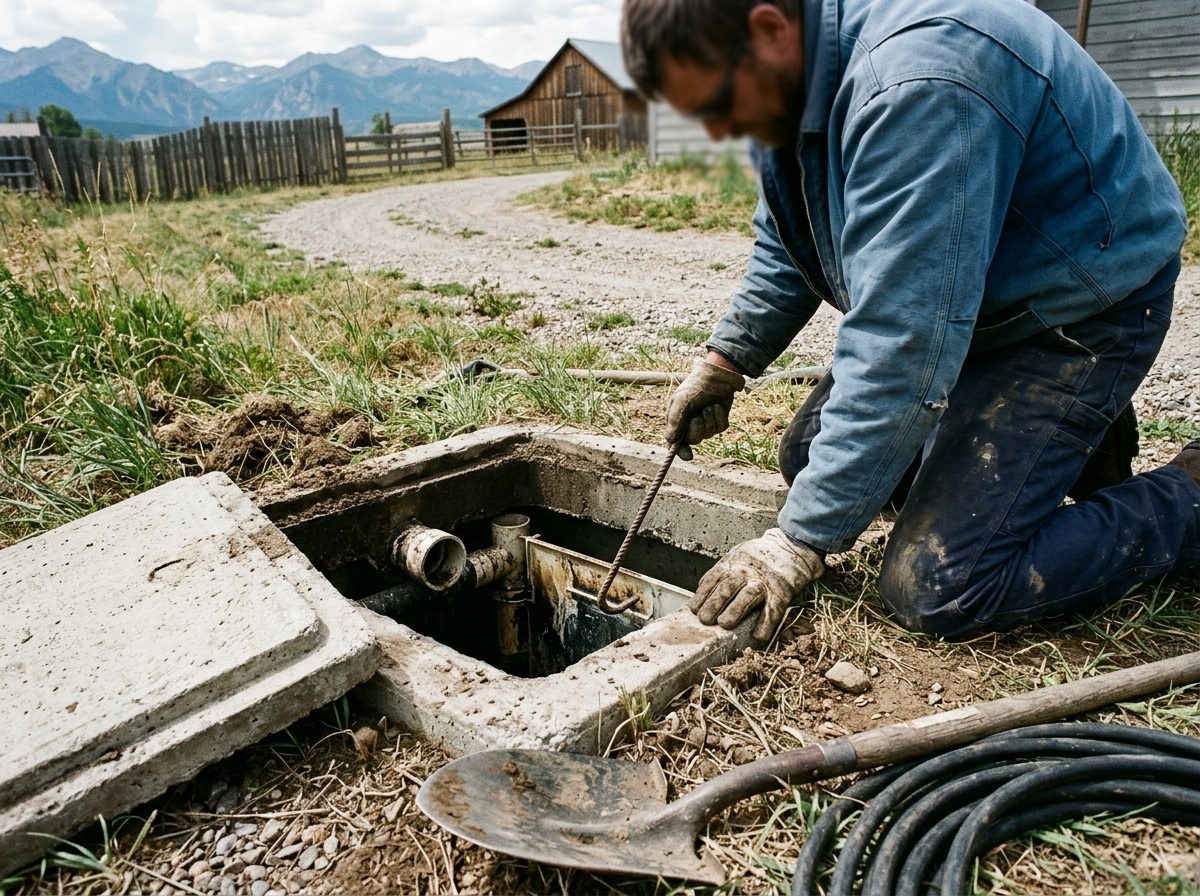
Buying or selling a septic property
This deserves its own section, because it is where the most money is at stake and the least is usually known.
Colorado counties generally require an inspection of an onsite wastewater treatment system at the point of transfer, and the specifics vary by county — the local health department is the authority. What that inspection covers is the tank and the field, and it is performed by a county-approved inspector rather than a plumber.
What it typically does not cover in detail is the building sewer between the house and the tank, which is exactly where an expensive surprise can hide. A camera inspection of that line before closing is inexpensive and worth doing, and it is the same argument we make about sewered properties on our camera inspection page.
Ask for the paperwork, and read it: the original permit, the system design and as-built showing tank and field location, the pumping history, and any repair records. A property with no records is not necessarily a problem, but it is an unknown, and unknowns on septic systems are expensive.
Two more things worth asking about before committing. Whether the system's capacity matches how you intend to use the house — a system permitted for a two-bedroom cabin used at weekends is not a system for a family of six working from home. And whether the field is where you plan to build anything, because relocating a field is a permitted design exercise, not a weekend project.
The paperwork to keep in one folder
The county permit and system design, the as-built drawing showing tank and drain field locations, the tank size, every pump-out receipt with dates, and any inspection or repair records. Add a note of where the cleanout and the tank access lids are — because the first thing anybody needs on a bad evening is to know where the tank is, and locating it in the dark with a probe adds an hour to a job nobody wants to be doing.
Buying a property on septic? Ask what the house-side inspection covers before you waive anything.
Ask Before You BuyWhat drives the price
We refer to independent contractors and cannot quote for them, and on septic properties the honest answer is that the price depends heavily on which side of the boundary the fault falls.
House-side plumbing is ordinary plumbing pricing. Clearing a building sewer blockage is a standard service call, more if it needs jetting or after-hours attendance. Camera inspection is modest and frequently the best money spent, because it prevents an expensive assumption. Building sewer repair is priced by length, depth and what is above it — driveways, mature trees and landscaping being the usual complications.
Septic-side work is priced by septic contractors: tank pumping is a routine and comparatively small recurring cost, tank or baffle repair is larger, and drain field replacement is the big one — a permitted design, excavation and construction project, sometimes with soil testing involved. That gap between pumping cost and field replacement cost is the entire argument for maintaining the system on schedule.
Access and location matter on rural properties, in both directions: a tank under a paved area or a field a long way from the road costs more to work on, and winter access in the high country can determine when work happens more than what it costs.
- Camera the building sewer before assuming the tank is the problem
- Pump on schedule — it is a fraction of the cost of a ruined drain field
- Spread laundry across the week rather than one heavy day
- Nothing but waste and toilet paper — no wipes, however they are labelled
- Keep vehicles, structures and roof runoff off and away from the field
- Keep permit, as-built, tank location and pumping receipts in one folder
Buying a property on septic? The county inspection covers the tank and field. Camera the line from the house before you close — that part is on you.
Book a line inspectionHouse side, tank side
Septic system questions
A camera inspection of the building sewer settles it. If the line from the house to the tank is clear and properly sloped, the problem is at the tank or beyond and you need a septic contractor.
Stop using water in the house — no laundry, no dishwasher, minimal flushing. Every gallon added makes the backup worse. Keep people and pets away from the affected area, and get it diagnosed rather than repeatedly plunged.
It depends on tank size and household size, and commonly falls in the range of every few years — a septic contractor familiar with your system will give you the right interval.
No, whatever the packaging says. They do not break down the way toilet paper does, they accumulate in the tank and they are a leading cause of pump failures and blockages.
You can, but it comes at a cost. Food solids increase sludge accumulation and shorten the pumping interval noticeably, and some septic authorities discourage disposals entirely.
It is one of the clearest signs of a field that is not accepting effluent properly, and it needs a septic contractor rather than a plumber.
The products sold as a replacement for pumping do not replace pumping. A tank develops the bacterial population it needs from ordinary household waste.
No. Vehicles and heavy equipment compact the soil and can crush the distribution piping, and both kinds of damage are permanent. Patios, sheds and decks over a field prevent the evaporation and access the system needs.
Diagnose before you dig or pump.
House-side plumbing on septic properties across rural Colorado — and an honest answer when it is not ours.
(833) 621-2904 — answered 24/7, statewide.