Trenchless repair earns its reputation on one thing: it replaces the pipe without removing what is on top of it. On a Colorado lot where the sewer lateral runs under a concrete driveway, a forty-year-old silver maple and a strip of city street, that distinction is most of the invoice.
It is not magic, and it is not always the cheaper option per foot. Two methods do the work — lining and bursting — and each has a specific set of conditions it needs.
What trenchless actually means
It means the new pipe is installed through the path of the old one instead of into an open trench. Access is dug at two points — usually a pit at each end of the affected run, sometimes only one if there is a usable cleanout — and everything between those two points is worked on from inside the pipe.
The consequence is that the ground in between is not disturbed. Not the driveway, not the root plate of the tree, not the patio slab, not the finished basement floor, not the sidewalk and street that would otherwise require a separate excavation permit, traffic control and pavement restoration to a municipal standard.
That is the entire value proposition, and it is a real one. It also means trenchless is worth most where the surface is worth most.
Cured-in-place lining
A flexible liner saturated with thermoset resin is pulled or inverted into the existing pipe, inflated against the inside wall, and cured — with hot water, steam or ultraviolet light depending on the system.
That jointlessness is the point for Colorado. Our two biggest lateral killers are root intrusion at joints and joint separation caused by expansive clay soil moving seasonally.
The trade-off is diameter. A liner consumes some internal bore — a few millimetres of wall thickness, which on a four-inch lateral is a modest loss and on an already marginal line is a real consideration.
Good candidate
Root intrusion at joints
Clay lateral, sound geometry, roots entering at the bell joints. Lining seals every joint at once.
Good candidate
Cracks and small offsets
Longitudinal cracking or minor joint offsets in pipe that is otherwise round and correctly graded.
Not a candidate
Bellies and sags
A run that has lost its fall needs regrading. Lining preserves the sag and the standing water in it.
Not a candidate
Collapse or deformation
Crushed sections and oval Orangeburg leave nothing to line against. That is bursting or open cut.
Pipe bursting
A conical bursting head is winched through the old pipe on a cable or pushed by a hydraulic rod. It fractures the host pipe outward into the surrounding soil and simultaneously tows a new fused HDPE pipe into the space it has just created.
Bursting answers the case lining cannot: a line that is collapsed, crushed, deformed, or so far gone that there is no coherent host left.
What it needs is room and certainty. The old pipe has to be fractured outward, which requires soil that will accept the displacement — dense rock, a concrete encasement or a very shallow run can rule it out.
Lining works with the old pipe. Bursting destroys it and takes its place. Choosing between them is a question about the pipe, not about the price list.
A quote for full open-cut replacement and no camera footage? That combination is worth a second opinion before you sign anything.
Get a second lookMature trees over the line? That is exactly when trenchless earns its premium. Worth asking.
Ask If Yours QualifiesWhether your line qualifies
This is settled by a camera survey, not by a phone call, and it is the reason a camera inspection comes first on every honest sewer job. Four things in the footage decide it.
Continuity. Is there a continuous path from access point to the main, or is the line blocked or collapsed to the point that nothing can be pulled through? Bursting can sometimes work through a collapse; lining cannot.
Geometry. Is the pipe round and correctly graded, or is there a belly, a severe offset or a joint that has dropped? Grade defects rule out both methods for that section, because neither one changes where the pipe sits.
Material and condition. Vitrified clay and cast iron line well. Orangeburg fibre pipe that has already gone oval does not — if the camera finds Orangeburg, expect bursting or replacement, and be sceptical of anyone offering to line it.
Connections. Every branch tying into the lateral inside the lined length has to be reinstated after curing, usually with a robotic cutter. On a house with a basement bathroom teeing in halfway along the run, that is a step someone has to plan for and price.
What the days actually look like
Less dramatic than an excavation, and not silent. Expect the following shape, though the specifics vary by system and by contractor.
First the line is cleaned. A liner cannot bond to a wall coated in scale, grease and root hair, so the run is usually hydro jetted and sometimes mechanically cut, then re-cameraed to confirm the wall is clean and the measurements are right. Skipping or rushing this step is the single most common cause of a liner that fails early.
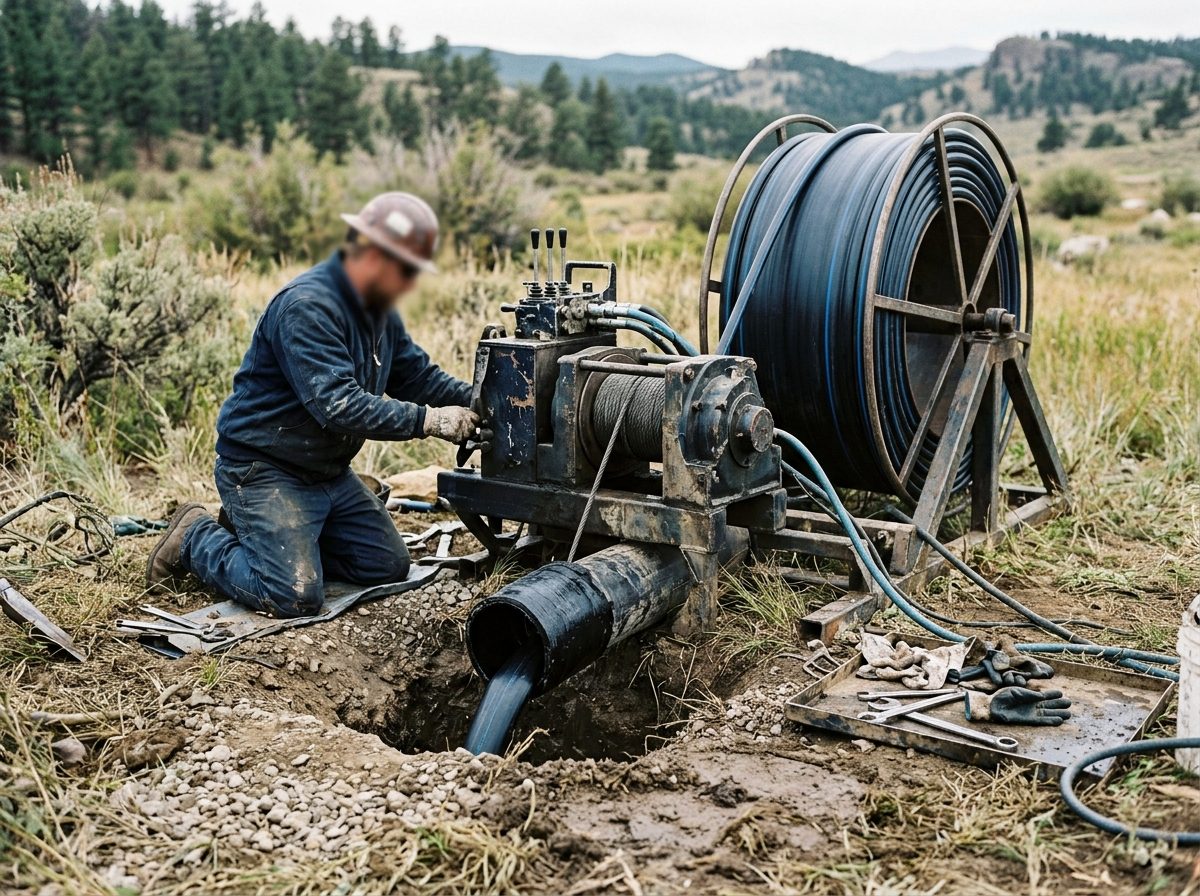
Then the access pits go in — commonly one at the house end and one near the property line or at the connection, each a few feet square. Equipment arrives: a reel, a boiler or steam unit or UV train, hose, a winch. Curing takes a few hours depending on the method and the pipe diameter.
Water is off the lateral while the work is live, which in practice means no flushing, no showers and no laundry for most of a working day. Plan for that. Branch connections are reinstated, a final camera pass records the finished pipe, and the pits are backfilled and restored.
A single-run lining job on a residential lateral is frequently one to two days on site. Bursting is comparable. The long pole is almost always the permit, particularly where the work reaches into the public right of way.
Ask for the post-lining footage
A camera pass before and a camera pass after, both handed to you. The before pass justified the work; the after pass proves it was done, shows the reinstated branches, and is the document you will want at resale or if anything goes wrong inside the warranty.
Where trenchless is the wrong answer
Worth saying plainly, because the marketing rarely does. Trenchless is not universally better and there are cases where a trench is the correct, cheaper and more durable choice.
A shallow run under open lawn, where restoration means seed and sod rather than concrete and asphalt, often costs less to dig than to line. Multiple unrelated defects along a long lateral can add up to more liner than a full replacement would cost in pipe. Any grade correction — a belly, a reversed fall, a section that has dropped — requires the pipe to be reset, which requires digging. A lateral that is badly undersized for the building may warrant replacement with larger pipe on a proper bed rather than a liner that narrows it further.
And there are site conditions that simply exclude it: severe utility congestion in the pipe path, rock, concrete encasement, or a run so shallow that bursting would heave the surface above it.
- Camera footage before, showing the defect, its location and its depth
- Written scope naming the method, the linear footage and the liner or pipe spec
- Cleaning and branch reinstatement included, not billed as surprises
- Permit, inspection and post-work camera pass named in the quote
- Warranty terms in writing, with what voids them stated
Told trenchless is impossible? Sometimes true, sometimes not. The camera footage decides, not the quote.
Get a Second ReadWhat drives the price
We refer to independent contractors and cannot quote for them, and any statewide site giving you a firm trenchless number without seeing your pipe is guessing. What is reliable is the shape of the estimate.
Linear footage and pipe diameter set the base. Depth matters less for trenchless than for open cut, which is exactly why deep lines are where trenchless saves the most. Access is a real variable: two clean pits in soft ground is one price, and cutting an access pit through a garage slab is another.
Cleaning is a separate line item and should be. Branch reinstatement is priced per connection. Permits and right-of-way work add cost and, more painfully, time. And restoration — while dramatically smaller than an open-cut job — still exists at the pit locations.
Per foot, trenchless typically prices above open-cut. Total delivered cost is where it wins or loses, because that is where the driveway, the tree and the street enter the arithmetic. Get both quotes from the same camera footage and compare the bottom line, not the unit rate. Our page on sewer line repair sets out all four repair methods side by side.
Want to know if your lateral is a lining candidate? Call and describe what the camera found. We will tell you which methods are still on the table.
Talk it throughBefore you choose a method
Trenchless sewer repair questions
Per foot, usually not — trenchless typically costs more per linear foot than open-cut pipe replacement. Total delivered cost is a different question.
Manufacturers generally rate the resin systems at around fifty years, and warranties in the range of ten to fifty years are common depending on the contractor and the system.
No. Lining needs a continuous host pipe with sound geometry. A collapsed section, a severe offset, a belly that holds water, or Orangeburg fibre pipe that has already deformed all rule it out.
Slightly, yes — the liner has wall thickness and it sits inside the existing bore. On a standard four-inch residential lateral the loss is modest and generally has no practical effect on capacity, particularly since the new surface is smoother than the scaled clay or corroded iron it replaced.
Lining installs a new pipe inside the old one, which stays in the ground as the host. Bursting destroys the old pipe, fracturing it outward into the soil while towing new HDPE into the space.
Yes. Sewer work is permitted work throughout Colorado regardless of method, and an inspection follows. Where the repair extends into the public right of way you will also need a separate excavation or street-cut permit even for access pits, with the municipality applying its own rules on traffic control, working hours and restoration.
Substantially less, but not nothing. Expect two access pits a few feet square, a truck and equipment on the driveway or street, and pumps or a boiler running for several hours.
They have to be reinstated. Curing a liner seals the whole length, including the openings where branches tie in, so each connection inside the lined run is reopened afterwards with a robotic cutter.
For the lined length, effectively yes. Roots enter through joints and cracks, and a cured liner has neither along its run — it is one continuous pipe.
Yes, and both should be based on the same camera footage so you are comparing methods rather than diagnoses. Compare total delivered cost including restoration, permits and right-of-way work, not the per-foot rate.
Find out what your pipe allows.
Camera first, method second. One number for 135 Colorado communities.
(833) 621-2904 — answered 24/7, statewide.