The sewer lateral is the one pipe on your property that nobody thinks about until it fails, and then thinks about very intensely. It is also, on most Colorado lots, the single most expensive piece of plumbing you own.
If sewage is coming up right now
Stop using water in the house — every flush and every wash adds to what is already backing up. Keep people and pets out of the affected area, and call (833) 621-2904. Basement backups covers what happens next.
How a failing lateral announces itself
Rarely all at once. The early signals are easy to attribute to something else, which is why most people meet their sewer line at the point of failure rather than before it.
Multiple drains slowing at the same time is the headline sign, particularly when the lowest fixtures in the house are worst.
Then there are the outdoor signs, which are more specific than people realise. An unexplained lush green stripe across the lawn following the line of the pipe.
And the pattern that should trigger a camera rather than another cabling: the same blockage returning on a schedule.
Inside
Multiple slow drains
Lowest fixtures worst, gurgling when other fixtures run, toilet levels moving on their own.
Outside
The green stripe
A band of lawn thriving over the pipe run, soft ground, a depression, or an odour near the cleanout.
Over time
Clockwork blockages
Cleared and re-blocked at a predictable interval. A defect, not a habit.
At the worst
Backup
Sewage at the lowest fixture. Stop running water and treat it as urgent, not as a slow drain.
Why laterals fail in Colorado
Age and material set the baseline. Pre-1950s housing across Denver, Pueblo and the older Front Range towns frequently still has vitrified clay laterals in bell-and-spigot sections with mortar joints — durable in the ground, but jointed every few feet, and every joint is a potential root entry.
Onto that, Colorado adds soil. Expansive bentonite clay across much of the metro and southern Front Range swells when wet and shrinks when dry, and it does this seasonally, every year, for the life of the pipe.
Then trees. Mature cottonwoods, elms, silver maples and willows in established neighbourhoods are magnificent and they are actively hunting for water.
Freeze-thaw cycling near the surface, ground settlement around older excavations, and heavy vehicle loading over a shallow run finish the list.
In a dry state, your sewer lateral is the wettest thing in the garden. The trees have noticed.
Drains slow and the yard has a soft spot? Those two together are worth a camera this week rather than next season.
Get the line inspectedRoots come back every spring? Repeat root intrusion means an open joint. Cabling buys a season, not a fix.
Ask About a Permanent FixDiagnosis before digging
Nobody should quote a sewer repair without having seen the pipe. The camera survey is the whole basis of the decision, and it produces three things you need: what is wrong, where it is, and how deep.
The camera goes in through a cleanout and runs the length of the lateral to the connection at the main. A locator transmitter in the camera head lets the operator mark the position and depth of any defect on the surface above it, which is what turns "there is a break somewhere in your line" into a spray-painted X on the driveway with a depth written next to it. That single piece of information moves an excavation quote from guesswork to arithmetic.
What the survey distinguishes between matters, because the remedies are wildly different in cost. Roots at an otherwise sound joint may be cleaned and lined. A single cracked section in good pipe is a spot repair. A belly is a re-lay of that section, because lining a sag preserves the sag. A collapse or deformed Orangeburg is replacement. Heavy scale in cast iron may be a jetting job rather than a repair at all.
Ask for the footage and the locate marks. You are paying for information, and it should leave with you — see camera inspection for what to look for in it.
The options, honestly compared
There are four, and the camera decides which apply.
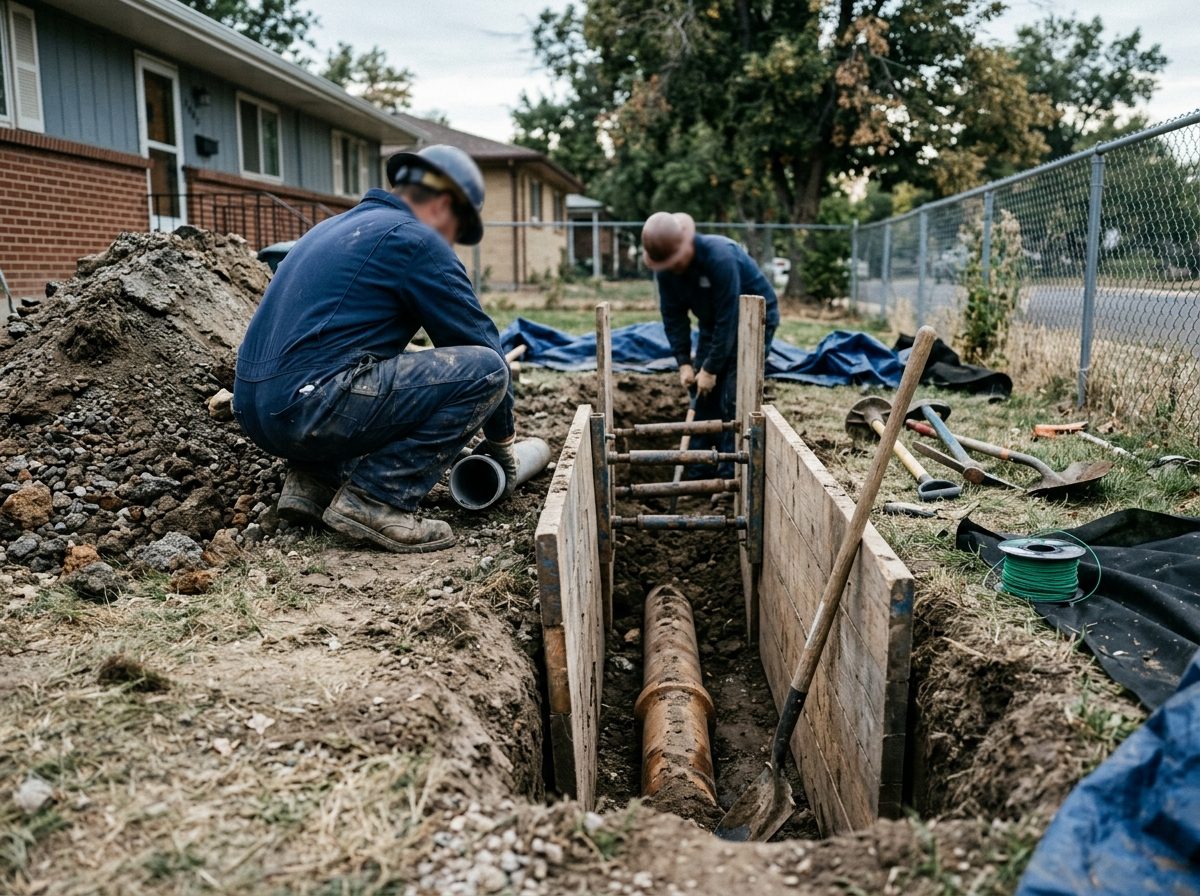
Spot repair. Excavate at the located defect, cut out the failed section, install new pipe, backfill and restore. Appropriate when the rest of the lateral is sound and the defect is one place. Cheapest, fastest, and the correct answer more often than the industry sometimes suggests — a single break in an otherwise good clay line does not require replacing eighty feet of pipe.
Cured-in-place lining. A resin-saturated liner is pulled or inverted into the existing pipe and cured, forming a jointless new pipe inside the old one. It needs only access pits rather than a full trench, which is why it is the answer when the run crosses a driveway, a mature tree, a patio or a finished basement floor. It requires a host pipe with intact geometry — no collapse, no severe offset, no belly — and it costs some internal diameter, which on an already narrow line is a consideration.
Pipe bursting. A bursting head is pulled through the old pipe, fracturing it outward while towing new HDPE in behind. Two pits, no trench, and it can increase the diameter rather than reduce it. The right answer for a fully collapsed or deformed line where lining is impossible. It needs room around the pipe and clear knowledge of other buried utilities in the path.
Open-cut replacement. Trench the run, replace the pipe, backfill, restore the surface. Still the answer when the line has multiple unrelated defects, when depth or utility congestion rules out trenchless methods, or when the geometry has to be corrected — you cannot fix a belly without regrading the pipe, and regrading means digging. Trenchless repair covers the first two methods in more detail.
The question that saves money
"Which of the four options does the camera rule out, and why?" A contractor who can answer that in specifics has diagnosed your pipe. One who arrives at full replacement without narrowing the field has diagnosed their calendar.
Who owns which part of the line
This catches people out and it is worth knowing before the quotes arrive. In most Colorado municipalities the property owner is responsible for the lateral from the building all the way to the connection at the public main — including the portion running under the sidewalk, the tree lawn and, frequently, the street itself. The utility owns the main; you own the pipe that reaches it.
There are exceptions and they matter. A few jurisdictions take responsibility at the property line or at the curb, some sanitation districts have their own rules that differ from the city's, and shared laterals serving more than one property exist in older neighbourhoods and create genuinely complicated situations. Denver, Colorado Springs, Boulder, Aurora and the various metro sanitation districts do not all handle this identically.
Find out which applies to you before agreeing to work, and get it in writing from the utility if the failure is anywhere near the boundary. It is a phone call that occasionally saves five figures.
Permits, streets and putting it back
Sewer work is permitted work everywhere in Colorado. The contractor pulls it, an inspection follows, and the permit is what protects you at resale — unpermitted sewer work surfaces during a transaction at the worst possible moment.
Where the repair extends into the public right of way, a separate excavation or street-cut permit is required, and cities apply their own rules about traffic control, working hours, backfill compaction and pavement restoration. Some require the contractor to hold a separate permit for street work. This is where timelines stretch: the plumbing may be a day and the permitting a week.
Restoration is the line item people forget to ask about. Trenching removes lawn, concrete, asphalt, sprinkler lines and sometimes a tree. Get explicit written scope on what comes back and to what standard — "backfilled and seeded" and "sod replaced to match" are very different promises, and the difference is real money.
- Camera survey with located, marked and depth-noted defects
- Written scope naming the method and the length of pipe affected
- Permit and inspection included and identified in the quote
- Surface restoration specified — lawn, concrete, asphalt, irrigation
Two very different quotes? Usually they are pricing two different repairs. We will explain the difference.
Compare the OptionsWhat drives the price
We cannot quote for the independent contractors we refer to, and any statewide site giving you a firm number for a sewer repair is guessing. What we can do is tell you what the number is made of, so you can read a quote properly.
Length and depth dominate. A lateral four feet down and twenty feet long is a fundamentally different job from one twelve feet down and eighty feet long, and depth drives it harder than length because of shoring requirements and spoil volume.
Then surface: open lawn is the cheap case, and a run under a concrete driveway, a mature tree, a patio or a city street each add substantially. Utility congestion adds locating time and hand digging. Method matters — trenchless usually costs more per foot and less overall once restoration is counted, which is exactly why it exists. Permits, traffic control and inspection are real costs on right-of-way work.
And the last one is who else has quoted. Sewer replacement is the plumbing job with the widest legitimate spread in bids, and on anything approaching full replacement, two or three quotes based on the same camera footage is simply prudence.
Holding a repair quote you are unsure about? Call and read us what it says. Knowing what to ask before you sign is free.
Talk it throughBefore you agree to dig
Sewer line questions, answered plainly
Several drains slowing at once, with the lowest fixtures in the house affected worst. Gurgling from a tub or floor drain when another fixture runs, and toilet water levels that move on their own, both indicate a line that cannot move air past an obstruction.
Three factors stack up. Expansive clay soils across much of the Front Range swell and shrink seasonally, opening joints and creating offsets and bellies.
Yes, and you should decline to proceed without one. The survey identifies what the defect is, marks its position on the surface and records its depth, which is what turns a vague quote into a costed job.
Cured-in-place lining installs a resin liner inside the existing pipe, forming a jointless new pipe with only access pits needed — good when the host pipe is intact but cracked or root-infiltrated.
In most Colorado municipalities, yes. Property owners are typically responsible for the lateral from the building to the connection at the public main, including the sections under the sidewalk, tree lawn and street.
The physical work on a spot repair is often one day. A trenchless lining or bursting job on a full lateral is commonly one to three days.
Often, at least for a period. Cabling cuts the roots at the joint and hydro jetting removes the fine growth along the pipe as well, which extends the interval considerably.
Standard policies generally exclude the buried service line itself, treating failure as wear rather than a sudden event, though the resulting water or sewage damage inside the house may be covered.
Know what the pipe is doing.
Camera, locate, then a decision. One number for 135 Colorado communities.
(833) 621-2904 — answered 24/7, statewide.