Most people calling this page are standing in something. Water is moving, it is dark, and the question is not which plumber has the nicest van — it is what to turn off and how long until someone is here. This page answers both, in that order.
If water is running right now
Shut the main off before you finish reading. It is usually where the supply enters the house — basement wall facing the street, a crawlspace, or a mechanical closet. Turn it clockwise until it stops. Then call (833) 621-2904.
What counts as an emergency, and what does not
An emergency is water arriving where it should not, water leaving when you need it, or anything involving sewage or gas. In practice, the calls that genuinely cannot wait until morning fall into a short list: a supply line that has split, a sewer lateral backing up into a basement fixture, a water heater weeping from the tank body, no water at all in freezing weather, a sump pump silent while the pit is filling, and the smell of gas near an appliance.
Plenty of things feel urgent at 11pm and genuinely are not. A dripping faucet, a running toilet, a slow shower drain, a garbage disposal that hums — these cost you nothing overnight and considerably less at nine in the morning.
The dividing line
Ask yourself whether water is still moving and whether it is soaking into something structural — subfloor, drywall, insulation, framing, or the area around an electrical panel. If the answer to both is yes, it is tonight.
The first five minutes matter more than the plumber
Damage in a plumbing failure is a function of time and volume. A half-inch line at typical residential pressure moves a startling amount of water in ten minutes, and none of it is coming back out of your subfloor. Whatever else happens, the water needs to stop.
Isolate the fixture
If the trouble is one toilet, sink or heater, use its own stop valve. Old valves seize; if it will not move, do not force it into a second failure — go to the main.
Shut the main
Where the supply enters the house. Ball valves turn a quarter turn; gate valves need several full turns clockwise. Then open a low faucet to drain the standing pressure.
Kill power if water is near it
If water is running toward a panel, an outlet or a furnace, shut the relevant breakers from a dry standing position. If you cannot reach the panel dry, leave it and say so on the phone.
Photograph everything
Before you mop. Wide shots and close shots, the source and the damage. Ten seconds now is worth an afternoon of argument with an adjuster later.
One thing worth doing on a calm evening: find your main shutoff, label it, and make sure it actually turns. A valve that has not moved since 1994 is a valve you will discover at the worst possible moment.
Not sure what you are looking at? Describe the pipe, the sound and where the water is. We have heard it before and can usually name it in a minute.
Describe it to usWhat we ask you on the phone
The questions are not a script for its own sake; they decide who we send and what is on the truck. Expect roughly this:
- Where is the water coming from, and is it hot or cold?
- Have you shut anything off, and did it stop?
- Is it clean water or sewage?
- What is the address, and is the road passable tonight?
- How old is the house, and do you know what the pipes are?
- Are you on city water and sewer, or a well and septic?
That last pair matters more here than people expect. Outside municipal boundaries, a lot of Colorado is on wells and septic systems, and the fix for no water at a well house is a different visit from the fix for no water on a city meter.
Not sure if this counts as an emergency? Describe it and we will tell you straight, including when it can safely wait until morning.
Ask If It Can WaitResponse time is mostly geography
We would rather give you an honest window than a flattering one. Colorado is not one service area; it is a metro corridor, a set of canyons, a high-country string of towns and a very large stretch of plains.
Front Range metro
Usually hours, not days
Denver metro, Colorado Springs, Fort Collins, Greeley, Pueblo and Boulder have the densest coverage. Emergency calls are commonly within a couple of hours; routine work is often same or next day.
Foothills & canyons
Depends on the road
Evergreen, Conifer, Nederland, Woodland Park and the canyon communities are close on a map and far in a snowstorm. We tell you which way the pro is coming and what the drive looks like tonight.
Mountain towns
Plan for a window
Summit, Eagle, Grand and Chaffee county addresses have fewer pros covering more ground, and passes close. Winter emergencies here often start with instructions to protect the house while you wait.
Eastern plains
Distance is the constraint
From Limon out to Akron, Wray and Holyoke the drive is the job. We are straight about it, and we prioritise getting your water shut down safely before anything else.
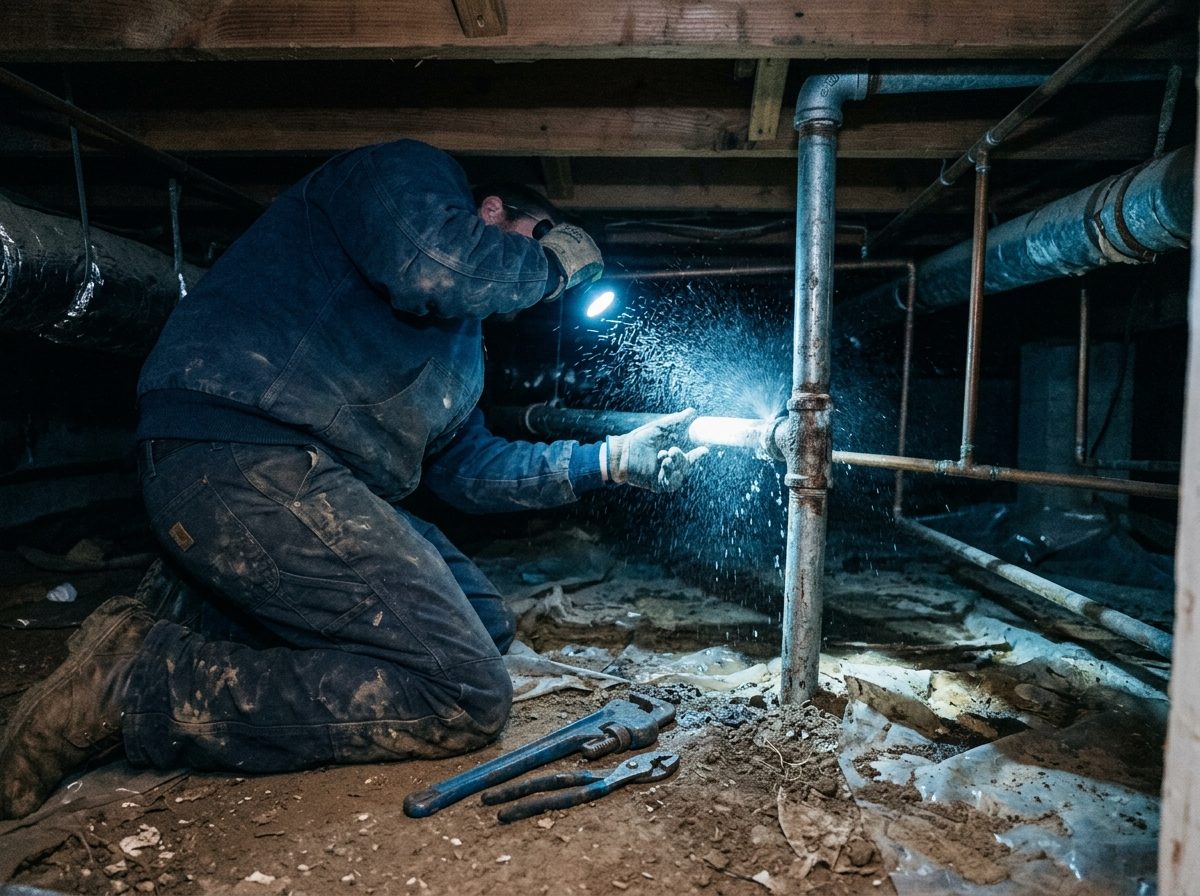
Winter emergencies are a category of their own
From roughly November to April, the overnight call mix changes completely. It stops being clogs and starts being freezes. Colorado is unusually good at producing them: dry cold, big daily temperature swings, wind that finds the one uninsulated rim joist, and a lot of housing stock with plumbing run through unheated crawlspaces because it never gets that cold — until the week it does.
The pattern that catches people is the thaw, not the freeze. Ice does not usually split a pipe where the ice is; pressure builds between the blockage and a closed faucet, and the pipe fails at its weakest point.
The freeze is the injury. The thaw is when you find out about it.
If you have been away — a second home in the high country, a rental between guests — assume nothing about the water until you have walked the house with the main off and watched the meter. See frozen pipe repair for what a thaw-and-repair visit actually involves, and burst pipe repair if it has already let go.
How the money works, and what we will not do
We do not quote repair prices on the phone. Nobody can honestly price a repair they have not seen, and an estimate given blind is either padded to be safe or revised upward on arrival. What we will tell you is the call-out structure and whether the hour of day changes it, so you can decide before anyone drives anywhere.
The pro who arrives gives you a price before work starts. You approve the number, then the work happens. If the job opens up into something larger — a wall that has to come out, a line that turns out to be corroded end to end — that is a new conversation and a new number, not a surprise on the invoice.
Worth knowing
After-hours rates are real, and so is the cost of waiting. A visit tonight to stop water hitting a finished basement ceiling is frequently the cheapest option on the table, even at the overnight rate. When it is not, we say so.
Middle of the night? The line is answered anyway. That is the whole point of it.
Call Any HourAfter the water stops
The plumbing repair is the beginning. Wet building materials are their own problem, and Colorado's dryness cuts both ways: things dry faster here than at sea level, but a saturated subfloor under a finished floor still needs air moving through it, and mould does not care about the humidity outside.
Get water out fast, get air moving, pull soaked carpet padding, and open up what needs opening. Keep the photographs and the invoice together for your insurer. And ask the pro the diagnostic question while they are still standing there: was this an event, or a symptom? A single failed fitting is an event. Two pinhole leaks in a year on the same galvanised system is a system telling you something, and the honest answer may be repiping rather than another patch.
If your emergency was a backup rather than a leak, the follow-up question is different: what does the inside of the line look like? A camera inspection answers whether you had bad luck or have a root intrusion that will be back next spring.
Water still moving? Do not read further. Call and we will walk you to the shutoff on the phone.
Get help nowStraight answers
Questions we get at 2am
Anything that is putting water where it does not belong, taking away water you need in freezing weather, or involves sewage or gas. A split supply line, a sewer backing up into a basement fixture, a water heater leaking from the tank body, no water at all during a hard freeze, or the smell of gas near an appliance are all worth a call at 3am.
Shut the water off. For one fixture, the stop valve under or behind it. For anything bigger, the main shutoff where the supply enters the house, usually in the basement, a crawlspace or a mechanical closet on the wall facing the street.
On the Front Range, an emergency call is often within a couple of hours and frequently same-day. In the foothills and mountain towns it depends on the canyon, the pass and the weather that night; in a storm the honest answer is sometimes longer than you want to hear.
After-hours work usually does cost more than the same job at 10am on a Tuesday, because someone is getting out of bed to do it. The pro tells you the rate before starting, so you decide with the number in front of you.
Sometimes, and we will say so. If the water is off and contained and nothing is soaking into the structure, morning is often fine and cheaper. If water is still moving, if it is running into a finished ceiling or an electrical panel area, or if sewage is involved, waiting costs far more than the after-hours rate.
It depends where it is leaking from. Water from a fitting or the drain valve is usually manageable: shut the cold inlet and call in the morning. Water seeping from the bottom of the tank body itself means the tank has failed and it will not get better; shut off the cold inlet, shut off the gas or breaker, and call.
That is almost always the sewer lateral, not the drain. Something downstream is blocked, so the lowest opening in the house becomes the overflow. Stop using water everywhere in the house immediately, including washing machines and dishwashers, and keep people off the wet area.
Leave the building first, taking everyone with you, and do not flip switches or use anything with a spark on your way out. From outside, call your gas utility or 911 — they come free and they come fast.
One number, any hour, anywhere in Colorado
Tell us what is happening and we will tell you what to shut off, then get a pro moving toward you.
(833) 621-2904 — answered 24/7, statewide.