If you can smell gas, stop reading. Leave the building, take everyone with you, do not touch light switches or garage doors, and call from outside — the gas utility first, then a plumber.
Everything else on this page is about the ordinary, unglamorous side of gas work: running a line to a new range or a fire pit, upsizing a supply for a tankless water heater, capping a line properly during a remodel, and testing a system that somebody suspects is leaking.
If you smell gas
Natural gas is odourless, so utilities add a sulphur compound to it — the rotten-egg or skunk smell most people recognise. Propane is odorised the same way, and being heavier than air it pools low, in basements and crawlspaces.
Leave immediately. Get everyone out of the building, including pets. Do not stop to gather things.
Do not operate anything electrical. No light switches, no thermostats, no appliances, no garage door opener, no phone use inside the building. Any of them can produce a spark.
Do not light anything, obviously, and do not attempt to find the leak yourself.
If the gas meter shutoff is outside and you can reach it safely, and you know how to operate it, closing it is reasonable.
Two other symptoms worth knowing. A hissing sound near a gas appliance or line is a leak until proven otherwise. And headaches, nausea, dizziness or drowsiness affecting several people in the house, particularly when the heating is running, suggests carbon monoxide rather than a gas leak — leave, get fresh air, call emergency services, and have every combustion appliance checked.
Nobody has ever regretted evacuating a house over a gas smell that turned out to be nothing. The utility will not charge you and will not judge you for calling.
The work itself
New appliance lines. Ranges and cooktops converting from electric, gas dryers, outdoor grills, fire pits and patio heaters, garage and shop heaters, generators, pool and spa heaters.
Upsizing an existing supply. The most common reason is a tankless water heater, whose peak input is far higher than the tank it replaces. Undersized gas piping produces appliances that cannot reach rated output, modulate badly or drop out under simultaneous load — and it is a common finding in tankless conversions.
Leak testing and repair. Pressure testing a system, locating leaks with electronic detectors and approved solutions, and repairing joints, corroded sections or failed connectors.
Capping and relocating. Removing an old appliance leaves a live line that must be properly capped, not just closed at the valve.
Right now
Gas smell or hissing
Leave the building. No switches, no phones inside. Call the utility from outside.
Right now
CO alarm sounding
Get out and get fresh air. Carbon monoxide has no smell — the alarm is the only warning.
Permitted work
New lines and upsizing
Sized by calculation, pressure tested, inspected. Never a same-afternoon informal job.
Do not skip
Capping removed lines
A dead appliance leaves a live pipe. It gets capped properly, not just valved off.
Sizing, and why it is a calculation
Gas pipe sizing is not a matter of matching what is already there. It is a calculation, and understanding roughly how it works makes it much easier to tell a real quote from a guess.
Every appliance has a rated input. The pipe must deliver the total input of everything that could run at once, at adequate pressure, over the actual length of the run, accounting for every fitting and elbow along the way. Longer runs and more fittings mean more pressure loss, so a longer run needs a larger pipe for the same load. The system is then sized from the meter outward, branch by branch.
In Colorado there is an additional term: altitude. Appliances are de-rated at elevation because thinner air supports less combustion, and that affects both the appliance's delivered output and how the system should be specified. Our high-altitude sizing page covers the principle in detail — it applies to every gas appliance in the house, not just water heaters.
The practical consequence is that adding a single appliance can require work well back toward the meter, because the existing trunk was never sized for the new total. That is a legitimate and unavoidable cost, not an upsell, and a good contractor will show you the load calculation that justifies it. If nobody mentions a calculation, ask.
Adding a range, a grill or a tankless heater? The load calculation comes before the shopping. Call and we will get someone to look at what the existing system can carry.
Ask about gas sizingMaterials, permits and inspection
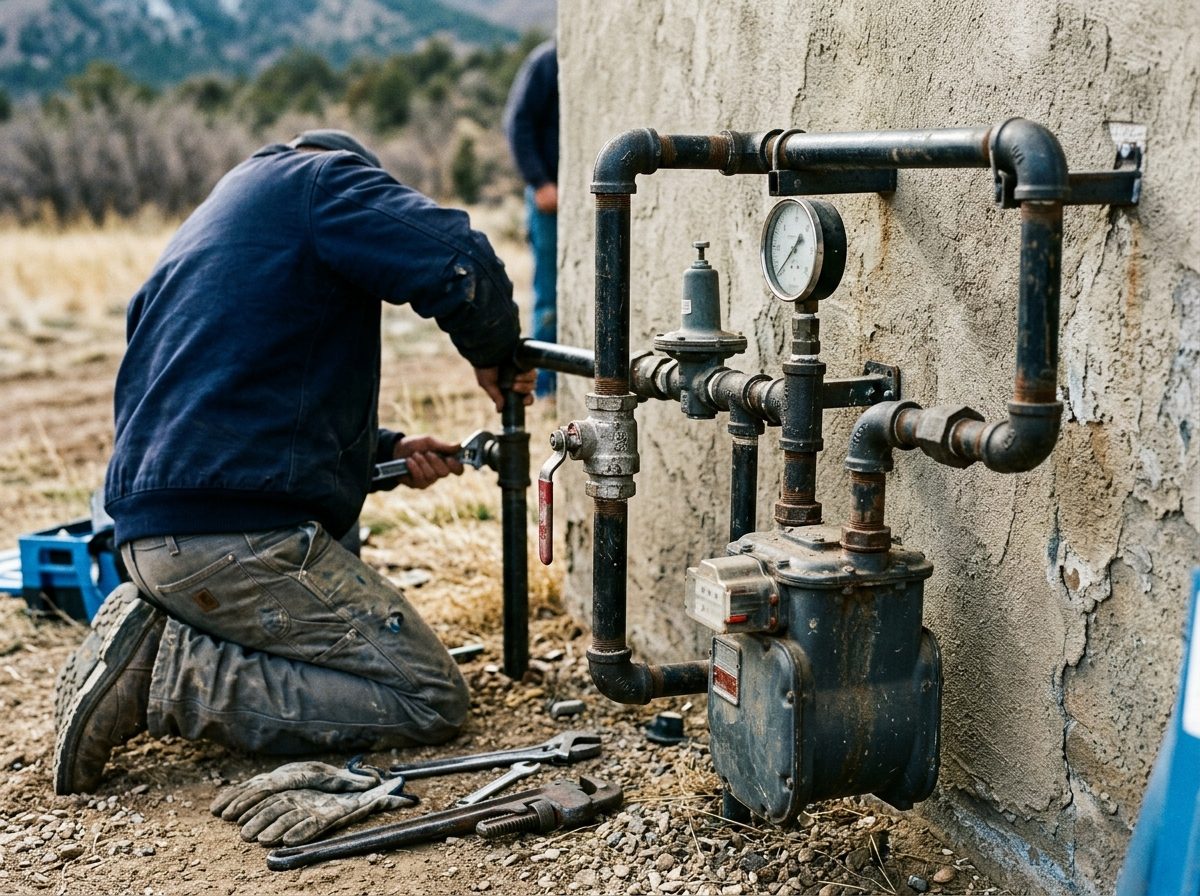
Black steel pipe is the traditional and still very common material for interior gas piping — threaded, robust, and long-lived where it is dry. It corrodes where it is damp or in contact with soil, which is why buried and exposed applications have different requirements.
Corrugated stainless tubing (CSST) is flexible, fast to install and widely used in newer construction. It has specific requirements around bonding and protection from physical damage and from lightning-induced arcing, and those requirements are not optional details — they are the reason CSST installations get looked at closely by inspectors.
Appliance connectors are the flexible link between the rigid pipe and the appliance. They are not a substitute for correctly run pipe, they have length limits, and they must not pass through walls or cabinets.
Shutoff valves at each appliance, accessible, so that any single appliance can be isolated without shutting off the whole house.
Gas work is permitted and inspected in essentially every Colorado jurisdiction, and that is a feature rather than an obstacle. The permit brings an independent pressure test and inspection, it creates a record for insurance and for the eventual sale of the house, and it is the mechanism that catches the mistake nobody intended to make. Unpermitted gas work is the one category of DIY plumbing we will not encourage under any circumstances — not because it is difficult, but because the failure mode is an explosion or a poisoning rather than a puddle.
The appliance side
Gas work rarely ends at the pipe, and the associated items are worth anticipating.
Venting and combustion air. Any appliance that burns gas indoors needs both, and both are affected by elevation. Adding a large appliance to a small mechanical space can turn adequate combustion air into inadequate combustion air, which shows up as nuisance flame failures and, at worst, spillage of combustion products into the house.
Conversions. Moving from electric to gas cooking means the gas line, the electrical arrangement for the ignition, and often a change in ventilation over the range. Moving from a tank water heater to tankless brings gas, venting and condensate together — see the tankless page.
Outdoor features. Fire pits and grills need buried line, correct depth and material, tracer wire, and consideration of whether the feature can be isolated for winter. In snow country, the position of the shutoff relative to where snow accumulates is worth thinking about before it is installed.
Generators. Popular where winter outages are a genuine risk, and a significant load — often the appliance that triggers upsizing back toward the meter.
Detectors, plainly
Carbon monoxide alarms on every level of the house and near sleeping areas, tested twice a year and replaced at their end-of-life date — they expire, and an expired alarm gives no warning at all. Natural gas or propane detectors are worth adding where there are many gas appliances, in a basement, or on propane, since propane pools low where a nose at standing height may not find it. Both are inexpensive. Neither is a substitute for having the gas system tested properly.
What drives the price
We refer to independent contractors and cannot quote for them, but gas work costs are driven by a short list of things.
Run length and route difficulty dominate. A short run through an open basement is straightforward; the same length through finished walls, a crawlspace or a joist bay full of ductwork is not. Whether the existing system can carry the new load is next — if it cannot, the work extends back toward the meter and the cost grows accordingly. Material choice, the number of appliances involved, and whether any part of the run is buried all add.
Then permit and inspection fees, the pressure test, and utility involvement where the meter itself needs review or upsizing — which is the utility's process and their timescale rather than the plumber's.
Leak testing and repair depends on how much of the system has to be isolated and tested to find the fault, and on access to the failed section. Capping a line during a remodel is a small job. Relocating one is a moderate one.
What is not worth economising on: the load calculation, the permit, and the pressure test. Those three are the cheapest parts of the invoice and the entire reason the rest of it is safe.
- Gas smell — leave first, call the utility from outside, no switches or phones inside
- CO alarms on every level, tested twice a year, replaced at their expiry date
- Ask to see the load calculation before new gas work is priced
- Permit and inspection on every gas job, without exception
- Accessible shutoff valve at each appliance
- Removed appliances leave capped pipe, not just a closed valve
Line to cap, move or test? All permitted work, all worth doing properly the first time. Call and we will line up someone qualified for it.
Book gas line workSafety first, then the pipe
Gas line questions
Leave the building with everyone in it. Do not touch light switches, thermostats, appliances, the garage door or your phone while inside — any of them can spark.
Treat it as a leak until proven otherwise, even with no smell. Leave, and call the utility from outside. Hissing at a connector, a valve stem or a joint is exactly what a leak sounds like, and the cost of being wrong about it is not comparable to the inconvenience of an unnecessary call.
Get everyone out into fresh air and call emergency services. Carbon monoxide is completely odourless, so the alarm is the only warning you will get, and symptoms — headache, nausea, dizziness, drowsiness affecting several people at once — are easy to mistake for illness.
This is the one category of plumbing where we will not encourage it. It is permitted, inspected work in essentially every Colorado jurisdiction, and the failure mode is fire, explosion or carbon monoxide poisoning rather than a puddle.
Because gas pipe is sized for the total input of everything that can run at once, over the actual run length with all its fittings.
Yes, in essentially every Colorado jurisdiction, and it is worth wanting. The permit brings an independent pressure test and inspection, creates a documented record for insurance and for the sale of the house, and catches the mistake nobody intended to make.
It does. Thinner air supports less combustion, so appliances are de-rated at elevation and must be altitude-rated or configured with the manufacturer adjustment applied.
Corrugated stainless steel tubing — flexible gas tubing widely used in newer construction, fast to install and entirely acceptable when installed to its requirements.
Gas work, done to the permit.
Load calculated, pressure tested, inspected — new runs, upsizing and leak repair across Colorado.
(833) 621-2904 — answered 24/7, statewide.