Tankless water heaters are a genuinely good technology that gets installed badly in Colorado more often than almost anywhere, for one reason: our incoming water is cold, and the numbers on the box assume it is not.
Get the sizing right and a tankless unit is excellent — endless hot water, a fraction of the floor space, no standby losses and a working life that comfortably outlasts two tanks.
How they work, and where the limit sits
There is no stored hot water. When a tap opens, a flow sensor detects it, the burner or elements fire, and water is heated as it passes through a heat exchanger.
The consequences are all downstream of that. No standby loss, because nothing is being kept hot.
But the limit changes character entirely. A tank heater has a volume limit: you can draw a lot at once, until it runs out.
So the question shifts from "how much hot water do we use in a morning" to "how many fixtures run simultaneously".
A tank runs out of hot water. A tankless unit runs out of hot water per minute. Sizing the second one like the first is how people end up disappointed.
Sizing for Colorado water, not brochure water
Here is the arithmetic that matters, and it is not complicated.
A tankless unit's capacity is quoted as gallons per minute at a stated temperature rise — how many degrees it can lift the water.
Now the Colorado part. Incoming groundwater temperature here is low. Front Range mains water in winter runs cold, and in the mountain communities colder still — meaningfully below the national figures manufacturers commonly quote against.
Which means a unit advertised at a flow rate that sounds ample is delivering roughly half of it here in February.
So the correct sizing conversation has four inputs: the coldest incoming water temperature at your address, the outlet temperature you want, the number of fixtures likely to run at once and their combined flow, and — critically — the unit's rated output at your rise rather than the headline figure.
Winter rise
70 degrees or more
Cold Colorado mains to 120°F outlet. Brochure figures usually assume far less.
The real constraint
Simultaneous fixtures
Two showers and a dishwasher is a rate problem, not a volume problem.
Elevation
Input de-rating
Gas units lose rated capacity with altitude. Mountain installs need the correction applied.
Hard water
Annual descaling
Not optional here. Scale in the heat exchanger is what kills tankless units early.
Comparing tankless quotes? Ask each one what elevation they sized for. The answers vary more than you would expect.
Ask What They Sized ForAltitude, combustion and de-rating
Second Colorado-specific factor, and it compounds the first. Less oxygen is available at elevation, so a gas appliance cannot burn its rated input the way it would at sea level. Manufacturers publish de-rating requirements and altitude-rated configurations, and installations above a certain elevation need either an altitude-specific model or a documented adjustment.
The practical effect is that a unit already working hard against a 70-degree rise is also delivering less input than its nameplate at 7,000 feet. Two reductions stacking on the same appliance.
This does not make tankless unsuitable at altitude — plenty of mountain homes run them well. It means the sizing has to account for both effects, and the installer needs to be someone who does this at elevation regularly rather than someone applying sea-level numbers. Our high-altitude sizing page covers the wider issue for all gas water heating.
Building or renovating in the high country? Tankless can work beautifully up there, with the altitude correction applied. Call before the gas line is sized.
Talk to someone who works at altitudeGas, venting, and the cost that is not the unit
The most common surprise in a tankless conversion is that the appliance is a minority of the invoice.
Gas supply. A tankless unit's peak input is far higher than a tank's, because it does in minutes what a tank does over an hour. The existing gas line, sized for a tank, is frequently too small — and an undersized supply produces a unit that cannot reach rated output, modulates poorly, or will not run reliably at all. Upsizing may mean a new run from the meter, and sometimes the meter itself needs review. This is not an optional upgrade. Gas line work covers it.
Venting. A tankless unit does not use the old flue. Condensing models need sealed direct venting in appropriate material, routed to a compliant termination, and the route through the building is a real construction question in a finished basement. Non-condensing models need different venting again, in stainless, and cannot use the old chimney either.
Condensate. Condensing units produce acidic condensate that needs a drain and, in many jurisdictions, neutralisation before it enters the drainage system.
Water connections and isolation valves. A proper installation includes isolation valves with service ports specifically so descaling can be performed without dismantling anything. If the quote does not include them, the first descale will cost more than the valves would have.
Add a recirculation loop or a small buffer tank if the household is intolerant of the brief delay before hot water arrives — a genuine complaint on long pipe runs, and one worth deciding on at installation rather than later.
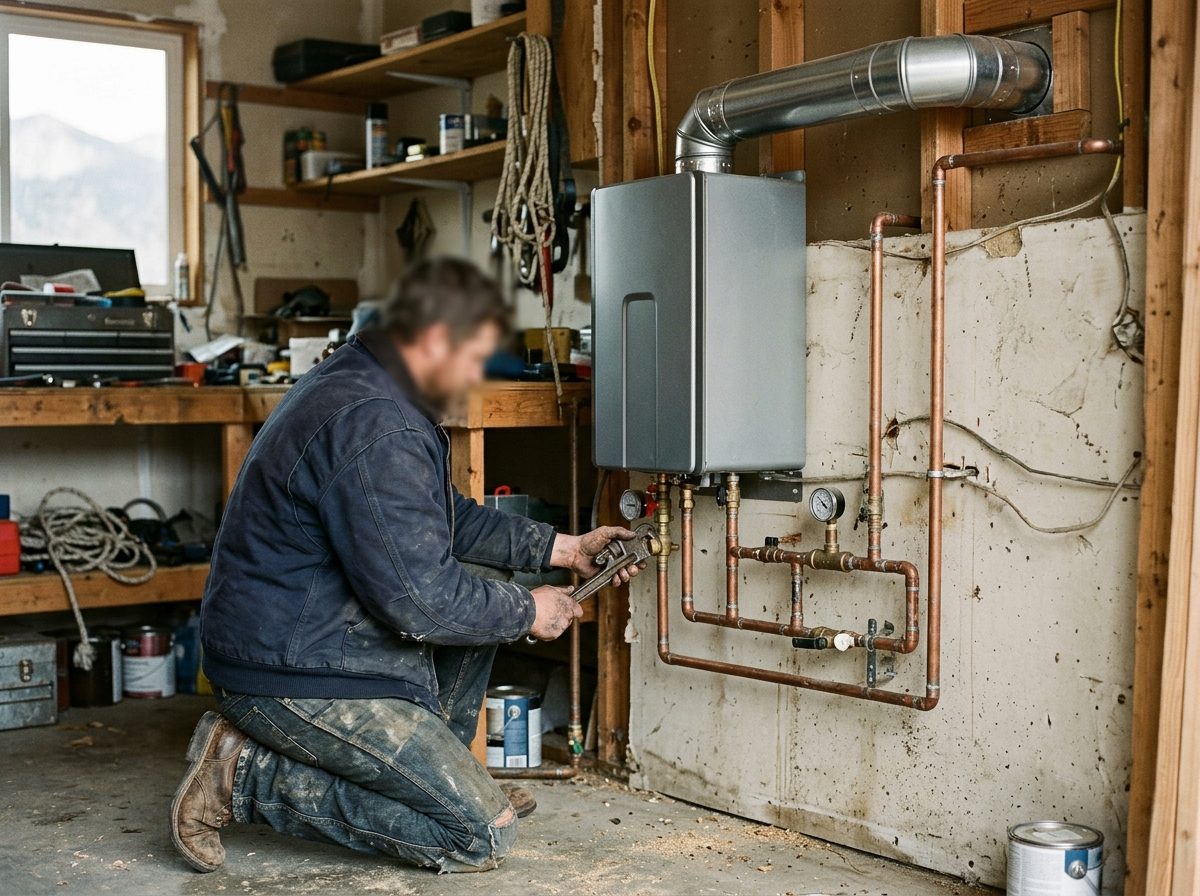
Hard water and the maintenance that is not optional
This is where tankless units in Colorado are most often let down, and it is entirely a maintenance issue rather than a technology one.
Water passes through a narrow heat exchanger and gets heated hard and fast. In hard water — which describes most of this state — minerals precipitate out onto the exchanger surface. Scale insulates, restricts flow, forces the unit to work harder, triggers fault codes, and eventually damages the exchanger. Warranty terms frequently require documented descaling, and a claim on a scaled exchanger with no maintenance record is a difficult conversation.
Descaling means circulating a descaling solution through the exchanger via the isolation valves — an hour or two, annually, more often on very hard water. It can be done as a service call or by a competent homeowner with a pump kit.
The alternative worth considering is treating the water instead: a softener or a scale-inhibition system upstream substantially extends the descaling interval and protects every other fixture and appliance too. Where hardness is high, that combination is usually the better long-run economics.
Be clear-eyed about this before choosing tankless. A tank heater that is never flushed simply dies a few years early. A tankless unit that is never descaled fails sooner and less gracefully, and it is the reason for most of the negative experiences you will hear about.
Three things to insist on in the quote
Isolation valves with service ports, so descaling is straightforward. The gas supply calculation, showing the existing line is adequate or naming the upsize. And the flow rate at your winter temperature rise, in writing. Those three items are what separate a tankless installation that people love from one they regret.
When a tank is genuinely the better answer
Worth stating clearly, because tankless is often presented as an unambiguous upgrade and it is not.
A tank is usually better when the budget is the binding constraint and the existing venting and gas line suit a tank replacement. When the household's pattern is short bursts of very high simultaneous demand rather than long duration — several fixtures at once, briefly, is exactly what a tank handles well and a tankless unit struggles with. When the mechanical space cannot accommodate new venting without significant construction. When nobody in the household will realistically keep up annual descaling. And when the water is very hard and no treatment is being installed.
A heat pump water heater is also worth comparing against tankless rather than being forgotten. In an unfinished Colorado basement with air volume and a drain, it often beats both on running cost — see water heater installation for the comparison.
And if the existing unit is being replaced in an emergency, a tank is frequently the right call simply because a tankless conversion done in a hurry is a tankless conversion done badly. Fit a tank now, plan properly, convert at the end of its life if it still appeals.
- Flow rate stated at your winter temperature rise, not the headline figure
- Altitude de-rating applied and the model confirmed suitable for elevation
- Gas supply sizing calculated, with any upsize priced in the quote
- Venting route, condensate drain and neutraliser specified
- Isolation service valves fitted, and a descaling plan agreed
Hard water at your address? Descaling is part of the real running cost. We will be straight about it.
Talk Through Running CostsWhat drives the price
We refer to independent contractors and cannot quote for them. But the structure of a tankless quote is worth understanding, because it differs from a tank replacement in an important way: the unit is often less than half of it.
The appliance varies by capacity, condensing versus non-condensing, and altitude rating. Then the upgrades, which is where quotes diverge most: gas line upsizing and its route, new venting and how far it has to travel through finished space, condensate drain and neutraliser, an electrical receptacle if none exists, and isolation valves.
Then optional additions that are genuinely worth costing: a recirculation pump or buffer tank if pipe runs are long, and water treatment if hardness is high.
Then permit and inspection, and removal of the old unit. And ongoing: annual descaling as a service call, which is a real running cost that belongs in the comparison against a tank rather than being discovered in year two.
Where a tankless conversion competes closely with a tank on total cost, it usually wins on space, duration and lifespan. Where the gas and venting upgrades are extensive, run the arithmetic honestly — including the descaling — before committing.
Weighing tankless against a tank? Call and we will run the sizing and the upgrade list with you. It is usually a clearer decision than it looks.
Compare them properlyBefore you commit to on-demand
Tankless water heater questions
Because our incoming water is cold. A tankless unit is rated as gallons per minute at a stated temperature rise, and rise and flow trade off directly.
Endless in duration, yes — there is no tank to empty, so a long shower is no different from a short one.
Usually, when converting from a tank. A tankless unit’s peak input is far higher because it does in minutes what a tank does over an hour, and the existing pipe was sized for the tank.
No. Tankless units require their own venting — condensing models need sealed direct venting in appropriate material with a compliant termination, and non-condensing models need stainless venting of a different specification.
Annually in most of Colorado, and more often where water is very hard. Water is heated hard and fast through a narrow exchanger, so minerals precipitate onto the surface, insulating it, restricting flow and eventually damaging it.
Yes. Less oxygen is available for combustion at elevation, so gas units must either be altitude-rated models or be configured with the manufacturer’s de-rating applied.
No. Gas tankless units need electricity for their controls and fan, so they stop when the power does.
There is a brief delay while the unit fires and the heated water travels to the fixture, and on long pipe runs it can be noticeable enough to annoy.
Endless hot water, sized for February.
Cold ground water, altitude and hard water, all accounted for. One number for 135 Colorado communities.
(833) 621-2904 — answered 24/7, statewide.