You choose a water heater roughly four times in your adult life, usually in a hurry, usually because the old one has just failed. That combination is why so many houses end up with the same unit that was there before — which is sometimes right and frequently not.
Half an hour of thinking at replacement time sets the next twelve years of energy bills, hot water capacity and mechanical room space.
Tank, tankless or heat pump
Three real options, each genuinely better than the others in specific circumstances.
Conventional tank. A cylinder of water kept hot, gas-fired or electric. Cheapest to buy and install, simple to service, understood by every plumber in the state, and it delivers a large volume quickly — several fixtures at once is no problem until the tank runs out.
Tankless. Water heated on demand as it flows through a heat exchanger. No standby loss, no tank to fail, endless hot water, and a fraction of the floor space — often wall-mounted, which is worth real money in a small utility room. Our tankless page covers it in depth.
Heat pump water heater. An electric unit that moves heat from the surrounding air into the water instead of generating it, at roughly a third of the energy of a resistance element.
Default choice
Gas or electric tank
Lowest cost, simplest service, high delivery rate. Right for most like-for-like replacements.
Space and endurance
Tankless
Wall-mounted, no standby loss, no volume limit. Needs gas upsizing, new venting and descaling.
Lowest running cost
Heat pump
A third of the energy of an electric element. Needs air volume, a condensate drain and tolerance for noise.
Already have hydronic heat
Indirect off the boiler
A storage tank heated by the existing boiler. Efficient where a good boiler is already installed.
Sizing it properly, which almost nobody does
The default approach is to read the label on the old heater and order the same number.
For a tank heater, the number that matters is not the tank volume but the first-hour rating — how much hot water the unit can actually deliver in the first hour of heavy use, combining stored volume with recovery rate.
Work from real peak demand. Not average daily use — peak. The relevant question is what happens on the worst morning: two showers overlapping, the dishwasher running, laundry going.
For tankless, the constraint is different and this is the mistake people make when switching.
And at elevation, gas units lose rated input capacity. Both sizing and configuration have to account for it — see high-altitude sizing.
Ask for the sizing arithmetic
"What first-hour rating are you specifying, and what peak demand did you calculate it from?" — or for tankless, "what flow rate at what temperature rise, using what incoming water temperature?" An installer who can answer has sized your system.
Replacing a heater that never quite kept up? Do not repeat it. Call and we will work out what the house actually needs.
Get it sized properlyGas, electric, and what the house will allow
Switching fuel type at replacement is possible and sometimes worthwhile, but the constraints live in the building rather than in the appliance.
Going from electric to gas needs a gas line to the location with adequate capacity, and appropriate venting — which in a house without existing gas appliances nearby is a significant addition, not a detail. Gas line work covers what is involved.
Going from gas to electric needs sufficient electrical capacity: a conventional electric tank heater draws a substantial dedicated circuit, and an older panel may not have room.
Going from gas tank to gas tankless usually needs the gas supply upsized, because a tankless unit's peak input is far higher than a tank's, and the existing pipe was sized for the tank.
Then there is venting, which is where the real money often sits. An atmospheric gas heater sharing a masonry chimney with a furnace is a common older arrangement, and if the furnace has since been replaced with a high-efficiency unit that vents separately, the water heater may now be orphaned in an oversized flue — a genuine safety issue that needs correcting regardless of what you install.
Code, and the things that get skipped
A water heater replacement is permitted work in Colorado jurisdictions, and the inspection exists to catch a specific list of items that are cheap to do correctly and expensive to discover later.
Temperature and pressure relief valve, correctly piped. Discharge routed to a safe location, full size, no reduction, no valve in the line, terminating where a discharge would be visible.
Thermal expansion control. Where the house has a pressure regulator or a check valve on the supply — which most Colorado houses do — the plumbing is a closed system, and heated water has nowhere to expand.
Seismic or structural strapping where required, and correct clearances to combustibles.
Combustion air. A gas heater in a small closet needs a supply of air to burn. Sealing up a utility room during a basement finish is a common way to create a combustion problem that did not exist before.
Also: gas heaters in garages need the ignition source elevated, and a heater in a bedroom or bathroom is restricted.
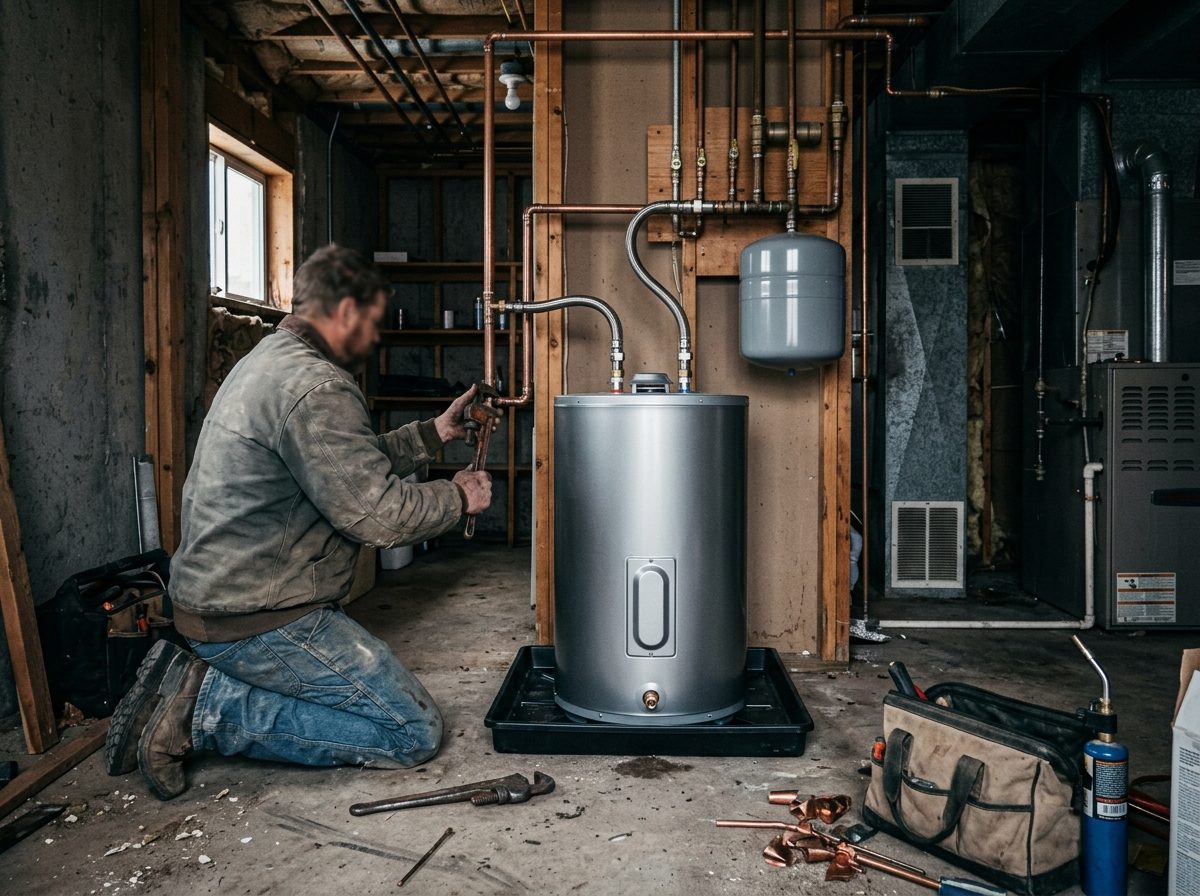
What installation day looks like
A straightforward tank-for-tank replacement is a half-day job. Expect: water and fuel isolated, the old tank drained — which takes time on a 50-gallon unit and longer if it is full of sediment — the old heater disconnected and removed, the new one set, connected, filled, purged of air, and fired. Then commissioning, temperature setting, and a walk-through.
Longer if any of the following apply: venting has to be reworked, gas supply upsized, a new circuit run, the unit will not fit through the door of the space it lives in, or the old heater is in an attic or crawlspace. A tankless conversion is usually a full day or more. A heat pump installation adds condensate routing.
Three things to insist on at handover. The old unit removed and disposed of, stated in the quote. The temperature set sensibly — commonly around 120°F, high enough for comfort and low enough to reduce scald risk and slow scale formation, with the caveat that lower settings in a large tank have their own considerations worth discussing. And the permit and inspection completed, with documentation you keep.
Ask to be shown the shut-off valves — cold supply, gas or breaker — and the drain valve, before the technician leaves. It is two minutes and it is the information you will want at an inconvenient hour.
Making it last in Colorado water
Most Colorado supplies are moderately to very hard, and hardness is what determines whether your new heater reaches its rated life or falls short by four years.
Two maintenance tasks matter, as covered on our repair page: flush the tank annually to clear sediment before it forms a hard insulating layer, and check the anode rod every three years, replacing it when more than half consumed. Both are inexpensive; together they are the difference between one replacement and two.
If hardness is high, a water softener protects the heater along with every fixture and appliance in the house — though note that softened water consumes anode rods faster, so the inspection interval matters more, not less.
One last suggestion for anyone installing in a finished space or above living area: a leak sensor at the drain pan, connected to something that will alert a phone. A water heater failure discovered on day one is a mopping job. Discovered on day four is a restoration project.
- Sizing arithmetic shown — first-hour rating, or flow at a real temperature rise
- Venting assessed and any orphaned-flue problem identified before the day
- Expansion tank included where the system is closed
- Relief valve discharge piped correctly, drain pan where damage is possible
- Permit, inspection, old unit removal and warranty terms all in writing
Running out of hot water every morning? That is a sizing conversation, not a repair one.
Size It ProperlyWhat drives the price
We refer to independent contractors and cannot quote for them. The components of an installation quote, though, are consistent.
The unit itself, which varies widely by type, capacity and efficiency — and where efficiency rebates exist, they are worth checking before choosing, because they can change the ranking of the options.
Then labour and access: an open basement with a floor drain nearby is the cheap case, and an attic, a crawlspace, a tight closet or a heater that has to be carried up a finished staircase all cost more.
Then the work that is not the heater: venting modification, gas supply upsizing, a new electrical circuit, condensate routing, adding an expansion tank, replacing old shut-offs and flex connectors that should not be reused, and correcting anything the inspector will look at anyway.
Then permit and inspection fees, and emergency or after-hours premium if the tank has already failed. Which is the argument for replacing a twelve-year-old heater on your schedule: the same job costs less on a Tuesday morning than at 9pm on a holiday weekend, and you get to choose the unit rather than accept what is on the truck.
Old heater still working but past ten years? That is the best moment to replace one — you choose the unit and you pay weekday rates.
Plan a replacementOnce every twelve years
Water heater installation questions
Size from peak demand, not average use, and look at the first-hour rating rather than tank gallons — it combines stored volume with recovery rate, which is why a 40-gallon gas unit can out-deliver a 50-gallon electric.
Sometimes clearly, sometimes not. It wins on floor space, standby losses and unlimited duration, and it lasts longer than a tank.
An electric unit that moves heat from surrounding air into the water rather than generating it, using roughly a third of the energy of a resistance element.
Yes, in Colorado jurisdictions this is permitted, inspected work. The inspection checks a specific list — relief valve discharge piping, thermal expansion control, clearances, combustion air, venting and strapping — all of which are cheap to do right and expensive to discover later.
A small tank that gives heated water somewhere to expand. If your house has a pressure regulator or a check valve on the incoming supply — as most Colorado houses do — the plumbing is a closed system and thermal expansion has nowhere to go.
Yes, but the constraints are in the building rather than the appliance. Electric to gas needs a gas line with adequate capacity plus appropriate venting, which is substantial work if there is no gas nearby.
Around 120°F suits most households — hot enough for comfort, low enough to reduce scald risk and slow scale formation, which matters in hard Colorado water.
A straightforward tank-for-tank replacement is typically a half day, including draining the old unit, which takes longer if it is full of sediment.
Choose it once. Choose it right.
Sizing, venting and code, before the truck arrives. One number for 135 Colorado communities.
(833) 621-2904 — answered 24/7, statewide.