Colorado water is hard almost everywhere, but how hard depends entirely on which district serves your street — and that is why softener sizing here has to follow a test rather than a guess.
Two houses fifteen minutes apart can have genuinely different water. Some Front Range districts blend surface water that is only moderately hard.
What hardness is, and what it costs you
Hardness is dissolved calcium and magnesium, picked up as water moves through rock. It is not a health problem — hard water is perfectly safe to drink, and mineral content is part of why some water tastes good.
Every time hard water is heated or evaporates, those minerals come out of solution and stay behind.
The consequences are cumulative rather than dramatic. Water heaters lose efficiency and life. Fixtures need descaling. Cartridges and valves fail sooner.
Put in plain terms: hardness does not break anything today, but it quietly shortens the life of most of the water-using equipment in the house.
Hardness varies district to district in this state, sometimes street to street on wells. Anyone quoting a softener without a water test is guessing with your money.
Test first, always
A softener is sized on two numbers: how hard the water is, and how much of it the household uses.
Hardness is measured in grains per gallon. A simple test strip gives you a rough figure in a minute, which is enough to know whether treatment is worth discussing.
Water use is straightforward: number of people, fixtures, and habits. It is usually estimated per person per day and then checked against your actual meter readings if you have them.
Multiply hardness by daily use and you get the grains of hardness the unit must remove per day.
If you are on a well, test before anything else. Municipal districts publish annual water quality reports that give you hardness ranges for free; a well gives you nothing unless you look. See well pump and water system service for the wider picture on private supplies.
Step one
Test the water
Grains per gallon, plus iron and pH. Strips for a rough figure, a lab test before you buy.
Step two
Size on your numbers
Hardness multiplied by household use sets the resin volume. Not the showroom recommendation.
Step three
Metered, not timed
Demand-initiated regeneration uses salt and water only when the capacity is actually spent.
Step four
Bypass and drain
A proper install has a bypass, an air-gapped drain and an untreated line to the outside taps.
Water heater failed early? Hardness is usually the reason, and it will do it again to the new one.
Ask Why It Failed EarlySofteners, and the things sold alongside them
The category is muddier than it should be, because several quite different products get marketed with the same language.
Ion exchange softener. The real thing, and the only one that actually removes hardness. Water passes through a bed of resin that swaps calcium and magnesium for sodium or potassium. When the resin is spent, it regenerates by flushing with brine from the salt tank and rinsing to drain. Reliable, well understood, and effective. Requires salt, a drain and some floor space.
Metered versus timed regeneration. Worth understanding because it affects running cost every week. A timed unit regenerates on a schedule whether or not the capacity has been used. A metered — demand-initiated — unit measures actual throughput and regenerates when it needs to. Metered costs slightly more up front and less thereafter, and it handles variable occupancy far better, which matters for second homes.
Twin-tank systems. Two resin tanks alternating, so softened water is always available even during regeneration. Worth it for large households or where hardness is very high; unnecessary for most.
Salt-free conditioners. These do not soften. They alter how minerals crystallise so scale is less likely to adhere to surfaces, which is genuinely useful for protecting a water heater and does not add sodium or need a drain. But the hardness is still in the water: you will still see spotting, soap will still behave like soap in hard water, and a hardness test after the unit will read the same as before. They are a legitimate option where a drain is impossible or sodium is a concern — as long as they are sold honestly as scale control rather than softening.
What a proper installation includes
Softener installation is not complicated work, but the details separate a unit that behaves for fifteen years from one that annoys its owner monthly.
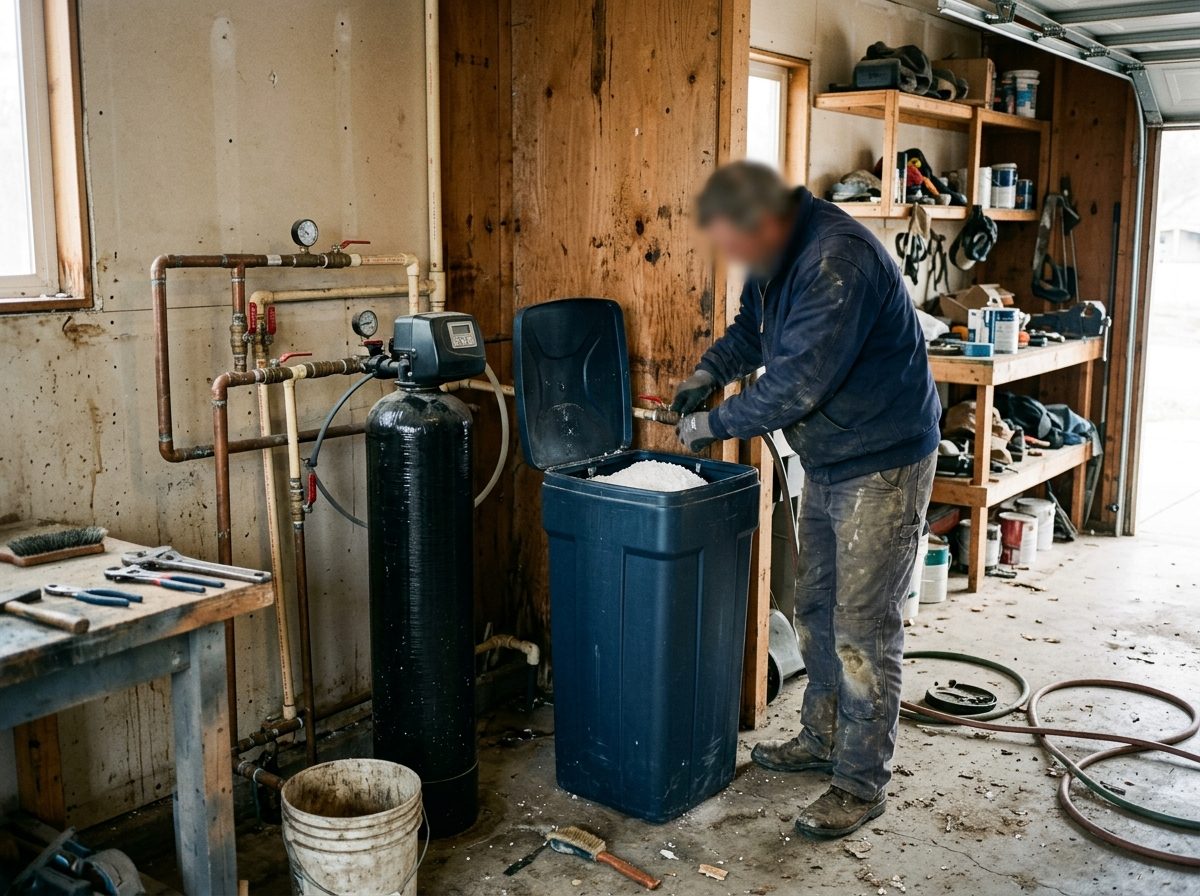
Location. Near the point where water enters the house, ahead of the water heater, with room to lift a salt bag comfortably and access to a drain and a receptacle. In Colorado, one more constraint: not anywhere that freezes. Garages are a common choice and a common mistake — an unheated garage in the high country will freeze a softener solid and crack the tank or valve body.
Bypass valve. Non-negotiable. It lets the softener be isolated for service without shutting off water to the house, and lets you bypass it entirely if the unit ever fails.
Untreated outside taps. Hose bibs, irrigation and any dedicated drinking tap should ideally stay on untreated water. Softened water is no good for lawns and gardens, and there is no reason to spend salt and capacity on it.
Drain connection with an air gap. The regeneration discharge must reach a drain with a proper air gap so nothing can siphon back into the softener. This is a code requirement, not a nicety, and it is the item most often done badly in DIY installations.
Permits vary by jurisdiction, and there may be cross-connection or discharge requirements depending on your district. That is worth asking about locally rather than assuming, because a small number of Colorado jurisdictions have restricted or discouraged self-regenerating softeners over brine discharge to wastewater treatment.
Living with a softener
Ongoing maintenance is minimal, but not zero.
Keep the salt tank topped up, roughly a third to half full, checking it monthly. Use a clean salt — pellets or solar salt rather than rock salt, which carries more insoluble material. Watch for a salt bridge, where a hard crust forms above an empty space and the unit stops drawing brine while the tank looks full; if softness suddenly disappears and the tank looks fine, break the crust and check.
Once a year, look at the resin bed and the venturi and injector in the control valve, which is where the small blockages happen. On well water, expect to change the sediment pre-filter regularly and to keep an eye on iron. Resin itself lasts a decade or more in reasonable conditions and much less if it is fouled by iron or chlorine, which is a good argument for pre-treatment where either is present.
Two things people notice after installation. Softened water feels slippery, and soap lathers so much more readily that most households cut detergent use significantly — genuinely, use less than you think. And if anyone in the house is on a sodium-restricted diet, either set the softener to potassium chloride or keep one unsoftened tap for drinking and cooking. A filtration system or a small reverse osmosis unit at the kitchen sink is the usual answer where taste or drinking water quality is the concern rather than scale.
Softener or filter — they solve different problems
A softener removes hardness. It does not improve taste, remove chlorine, deal with sediment or address contaminants. A filter improves what the water is like to drink and use, and does nothing about scale. Plenty of Colorado homes want both, in that order — softener for the appliances, filtration for the tap — and the two are usually installed together at the same entry point.
Do not know your hardness? Test first. Any pro who sizes a softener without one is guessing.
Start With a Hardness TestWhat drives the price
We refer to independent contractors and cannot quote for them, but the variables in a softener quote are easy to name.
The equipment scales with resin volume, so it follows your hardness and household size. Metered regeneration costs a little more than timed and is worth it. Twin-tank systems cost meaningfully more and are only justified at high hardness or high demand. Salt-free conditioners occupy a similar price band with a different job.
Installation cost depends mostly on what is already there. A house plumbed with a softener loop and a nearby drain is a short job. A house needing new pipework rerouted to the entry point, a drain run added, an electrical receptacle, or a freeze-protected enclosure costs more. Well water adds pre-treatment — sediment filtration and iron removal where needed — which is a separate line item and not optional if you want the resin to survive.
Then running cost, which is small but real: salt, the water used in regeneration, and a negligible amount of electricity. A correctly sized metered unit minimises all three. An oversized timed unit on a schedule nobody adjusted is where salt bills get silly.
Against that, weigh what hardness is costing you now. Where water is genuinely hard, a softener typically pays for itself through water heater longevity and fixture life alone. Where it is only moderately hard, scale control or nothing at all may be the right answer — and a good contractor will tell you that.
Got a hardness number already? Call with it and we will tell you what size unit that implies for your household before anyone comes out.
Size a softener properlyHard water, measured not guessed
Water softener questions
It varies enormously by district, and that is the important part. Some Front Range systems blending surface water are only moderately hard; other areas, particularly where groundwater dominates, are hard enough to scale a shower head within a season.
It depends on your hardness number and what you care about. Where water is genuinely hard, a softener usually pays for itself in water heater life and fixture longevity alone, and the difference in laundry and glassware is obvious.
Yes, for most people. Ion exchange swaps calcium and magnesium for a small amount of sodium, and the quantity is modest, but anyone on a sodium-restricted diet should either use potassium chloride in the softener or keep one unsoftened tap for drinking and cooking.
Multiply your hardness in grains per gallon by your household daily water use to get grains of hardness per day, then size the resin volume for that load with a sensible regeneration interval.
A timed unit regenerates on a fixed schedule regardless of how much water was used. A metered, demand-initiated unit measures actual throughput and regenerates only when the capacity is spent.
They do something real, but they do not soften. They change how minerals crystallise so scale is less inclined to stick to surfaces, which genuinely helps protect a water heater, and they need no salt and no drain.
Only if the garage does not freeze, which rules out a lot of Colorado garages. A frozen softener cracks tanks and control valves.
Less than most people expect if the unit is metered and correctly sized, because it only regenerates when the capacity is actually spent.
Hardness varies by district. Sizing should follow the test.
Softeners, scale control and the honest difference between them — across 135 Colorado communities.
(833) 621-2904 — answered 24/7, statewide.