Whole-house filtration is worth doing when you know what you are filtering for. Bought blind, it is an expensive way to change cartridges — so the first question is always what is actually in your water.
Colorado water arrives from very different places. Front Range municipal systems draw largely from mountain snowmelt through reservoirs and treatment plants, and it is generally good water treated to a published standard.
What people are actually trying to fix
Filtration is a category, not a product. Naming the complaint precisely is most of the work, because each one has a different answer.
Sediment. Visible grit, cloudiness, or silt that clogs aerators and fills toilet tanks. Common on wells, after a main break, and in areas affected by post-fire runoff.
Chlorine taste and smell. Municipal systems disinfect, and some people are much more sensitive to it than others. Carbon removes it easily and it is one of the most reliably satisfying upgrades there is.
Iron and manganese. Orange or black staining in fixtures and laundry, metallic taste. A well problem overwhelmingly. Needs dedicated treatment — and needs handling before a softener, which it will otherwise foul.
Sulphur smell. The rotten-egg smell, usually hydrogen sulphide, sometimes from the water and sometimes generated inside the water heater by bacteria reacting with the anode rod.
Every honest filtration conversation starts the same way: what does your water test say? Without that number, a whole-house system is decoration with a maintenance schedule.
Test before you buy anything
If you are on a municipal system, your district publishes an annual water quality report. It is free, it is detailed, and it tells you what is in the water leaving the plant.
If you are on a well, nobody is testing your water but you. The sensible baseline is bacteria and nitrates annually, and a broader panel every few years — hardness, iron, manganese, pH, total dissolved solids, plus anything known to be an issue locally.
The reason to insist on this is simple. Filtration equipment is selected by contaminant, capacity and flow rate. A carbon filter that transforms chlorinated city water does nothing for nitrates.
City water
Read the district report
Published annually, free, and detailed. Usually enough to decide whether anything is needed.
Well water
Bacteria and nitrates yearly
Nobody else is testing it. A broader panel every few years, and after any flooding or well work.
Then
Match equipment to result
Carbon, sediment, iron removal, UV and RO all do different jobs. The test says which.
And plan for
Cartridge changes
Every filter has a service interval. A neglected filter is worse than no filter at all.
Water tastes or smells wrong? Describe it precisely — taste and smell narrow the cause faster than anything.
Describe the TasteThe equipment, and what each one does
Sediment filtration. A cartridge or backwashing filter that mechanically strains particles, rated in microns. Cheap, simple, and the right first stage ahead of almost everything else — it protects the equipment downstream. On dirty well water a larger backwashing sediment filter beats a cartridge you would otherwise be changing constantly.
Carbon filtration. Activated carbon, either as large cartridges or a backwashing tank. Removes chlorine, chloramine with the right media, tastes, odours and a range of organic compounds. This is what most people mean when they say the water tastes better. Media life is finite and depends on volume treated.
Iron and manganese removal. Various approaches depending on the form the iron is in — oxidising filters, air injection systems, or chemical feed with filtration. This is where a real water analysis earns its keep, because the wrong approach on the wrong form of iron simply does not work. Always installed ahead of a softener.
UV disinfection. Ultraviolet light inactivates bacteria and viruses without chemicals. The standard answer for a well with a bacteria result, and often fitted as ongoing insurance on any private supply. Requires clear water to work, so it always sits behind sediment filtration, and the lamp is replaced annually whether or not it still glows.
Installation that will not annoy you later
Whole-house treatment goes in where the water enters, before it branches, and the practical details are much the same as for a softener.
Order of operations. Sediment first, then iron removal if needed, then softening, then carbon, then UV last if fitted. Getting the sequence wrong wastes media and shortens equipment life — carbon ahead of sediment fouls quickly, UV ahead of filtration is ineffective, a softener ahead of iron removal is a resin replacement waiting to happen.
Bypass valves. Around each stage where practical, and certainly around the whole assembly. You want to be able to service or isolate a stage without shutting off water to the house.
Pressure and flow. Every filter costs you some pressure, and several in series cost more. This is where a filtration system and an existing marginal pressure problem meet unhappily, so incoming pressure should be measured before the design is settled. If pressure is already low, that needs addressing first — see pressure regulator work. Filters also have a flow rating; undersized filters throttle the whole house.
Space, drain and power. Backwashing filters need a drain with an air gap and a receptacle. UV needs power and enough straight length for the chamber. Cartridge housings need clearance beneath them to drop the sump, which is the detail most often forgotten in a tight mechanical closet.
Freeze protection. Same rule as everything else in Colorado. Not in an unheated garage, not in a crawlspace that drops below freezing, not on an exterior wall in the high country.
Maintenance is the whole deal
This is the part that decides whether filtration was a good decision, so it deserves saying bluntly: a filter you do not maintain is worse than no filter.
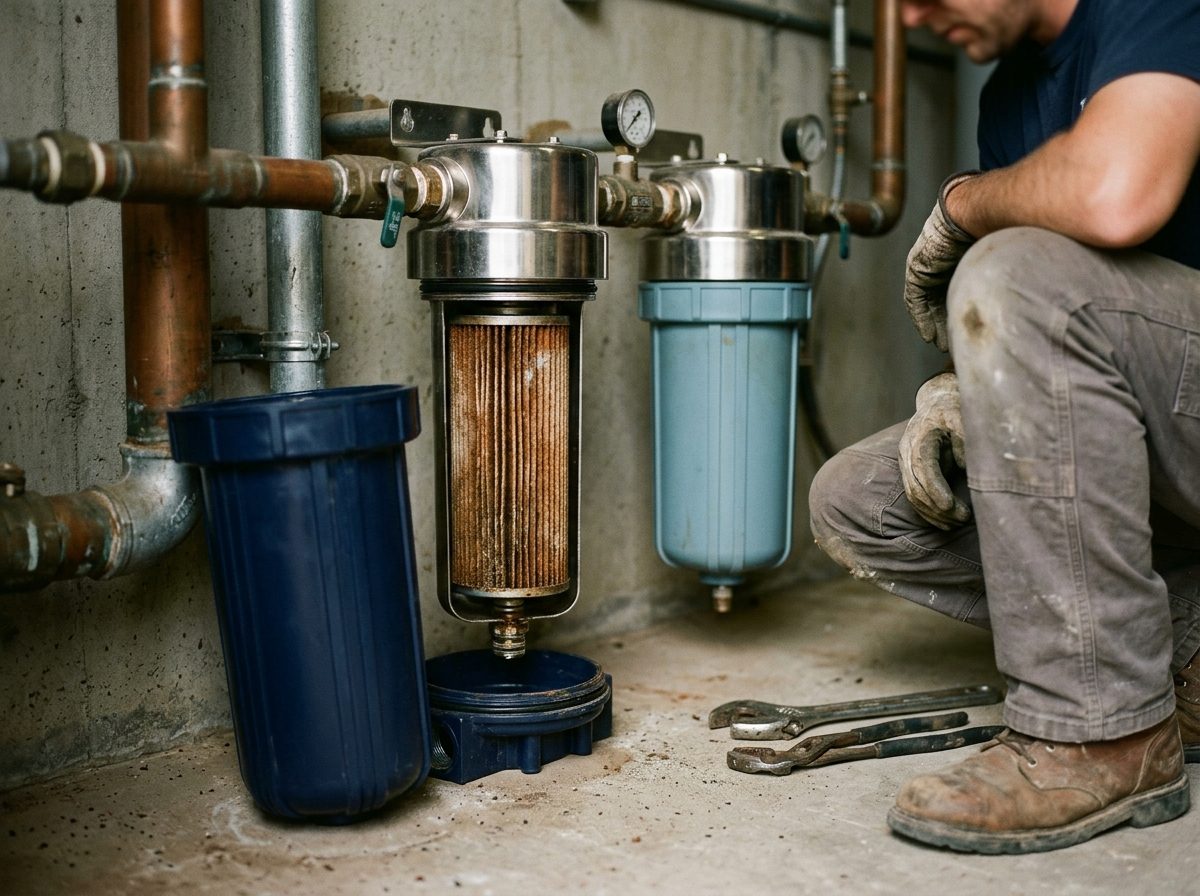
Sediment cartridges load up and restrict flow, and a badly clogged one can drop household pressure noticeably. Carbon media exhausts, and once exhausted it stops removing what you bought it for while looking exactly the same. Worse, spent cartridges left in place for years become somewhere for bacteria to grow. UV lamps lose output long before they stop lighting, so they are replaced on schedule rather than on failure, and the quartz sleeve needs cleaning. RO membranes and pre-filters have their own intervals.
So the right way to buy filtration is with the running cost visible. Ask what each stage costs to service, how often, and whether you can do it yourself. A system with two annual cartridge changes you handle in ten minutes is a system that will actually stay effective. A system with five proprietary stages on a schedule nobody explained is a system that will be neglected by year three.
A pressure gauge before and after the filter bank is a small, cheap addition that makes maintenance obvious: when the difference across the filters grows, it is time. Fit them.
Whole-house or point-of-use?
Whole-house treatment makes sense for anything that affects the whole plumbing system or every fixture — sediment, iron staining, chlorine, bacteria on a well, corrosive low pH. Point-of-use makes sense when the concern is drinking and cooking water specifically, where a small reverse osmosis unit under the kitchen sink delivers more thorough treatment for far less money than treating every gallon that flushes a toilet. Many households are best served by both: modest whole-house treatment plus RO at the tap.
On a private well? Testing comes first, always. Treating an unknown is how money gets wasted.
Ask What to Test ForWhat drives the price
We refer to independent contractors and cannot quote for them, but the cost of filtration is unusually easy to reason about because it scales with the number of problems you are solving.
A single sediment or carbon cartridge housing at the entry point is a modest job. A backwashing carbon or iron filter is a larger piece of equipment needing a drain and power. UV adds a chamber and annual lamps. Iron removal on difficult well water can be the most expensive stage of all, and it is very much specification-dependent. Under-sink RO is inexpensive by comparison and does the most for drinking water.
Installation depends on the mechanical space: existing pipework and valving, whether a drain and receptacle are already there, whether the assembly fits without rerouting, and whether freeze protection is needed. Well systems generally cost more because there are more stages and the water is more variable — well system service covers the supply side.
Then the ongoing cost, which belongs in the decision rather than being discovered later: cartridges, media replacement every several years on tank-based systems, annual UV lamps, RO membranes, and the water used by backwashing units.
The best value in this whole category remains the same: test first, treat only what the test found, and keep the system simple enough that it will actually be maintained.
On a well and never tested it? That is the place to start, and it costs very little. Call and we will tell you what panel to ask for.
Ask what to test forTreat what the test found
Water filtration questions
Often not, and it is worth being honest about that. Front Range municipal water is generally good water treated to a published standard, and your district publishes an annual report showing what is in it.
Bacteria and nitrates annually as the baseline, and a broader panel every few years covering hardness, iron, manganese, pH and total dissolved solids, plus anything known to be a local issue such as arsenic or uranium.
No. Hardness is dissolved calcium and magnesium and ordinary filtration does not remove it, so scale will keep forming regardless of how good the filter is.
Usually hydrogen sulphide, and the important question is where it comes from. If the smell is only on hot water, it is often bacteria in the water heater reacting with the anode rod, and changing the rod type fixes it.
Every filter costs some pressure, and several in series cost more — which is why incoming pressure should be measured before a system is designed.
It depends on the stage and on how dirty the water is. Sediment cartridges may need changing every few months on well water and much less often on clean city supply.
For drinking and cooking water, frequently yes — it removes a wider range of dissolved contaminants than anything else practical in a home, and an under-sink unit is inexpensive.
If a test has shown bacteria, yes — UV is the standard answer, and it works without adding chemicals. Many well owners fit it as ongoing insurance even after a clean result, since well contamination can be intermittent.
Sediment first, then iron removal if required, then softening, then carbon, and UV last. The sequence protects each stage from what would otherwise foul it.
Those are classic signs of low pH — corrosive water slowly attacking copper — and the answer is an acid neutralising filter rather than an ordinary one.
Filter what is actually in your water.
Sediment, chlorine, iron, bacteria or nothing at all — specified from a test, across 135 Colorado communities.
(833) 621-2904 — answered 24/7, statewide.