For a business, a plumbing problem is rarely just a plumbing problem. It is a closed dining room, a health inspection, a day of lost trade, or a tenant on the phone — and that is why commercial work is judged on response and scheduling as much as on the repair itself.
We refer to independent contractors who work on commercial premises across Colorado: restaurants and cafés, retail, small offices, salons, gyms, clinics, breweries and taprooms, light industrial units, and small multi-family and mixed-use buildings.
What makes commercial different
Downtime is the real cost. A blocked drain in a house is an inconvenience. In a restaurant on a Friday evening it is the night's revenue.
Scheduling around the business. Most commercial work is better done at 5am or after closing than at midday. Good commercial contractors expect this and price it as normal rather than as an emergency premium.
Regulatory exposure. Food service premises are inspected, and plumbing features prominently: grease interception, backflow prevention, hand-wash provision, indirect waste connections, floor drains and mop sinks.
Heavier equipment and duty cycles. Commercial fixtures, flushometer valves, tankless and high-recovery water heaters, booster pumps, larger drainage, grease interceptors, backflow assemblies. Different parts, different tools, different knowledge.
On a commercial job the repair is rarely the hard part. Getting it done between closing and opening, without shutting the neighbouring tenant off, is the hard part.
Food service, specifically
Restaurants and bars generate more plumbing calls per square foot than anything else, and nearly all of it is predictable.
Grease. The dominant problem. Kitchen waste lines coat with grease from the inside until they close, and cabling punches a hole through it rather than restoring the pipe. Hydro jetting is what actually scours the wall clean, and on a busy kitchen line a scheduled jetting interval is far cheaper than emergency call-outs.
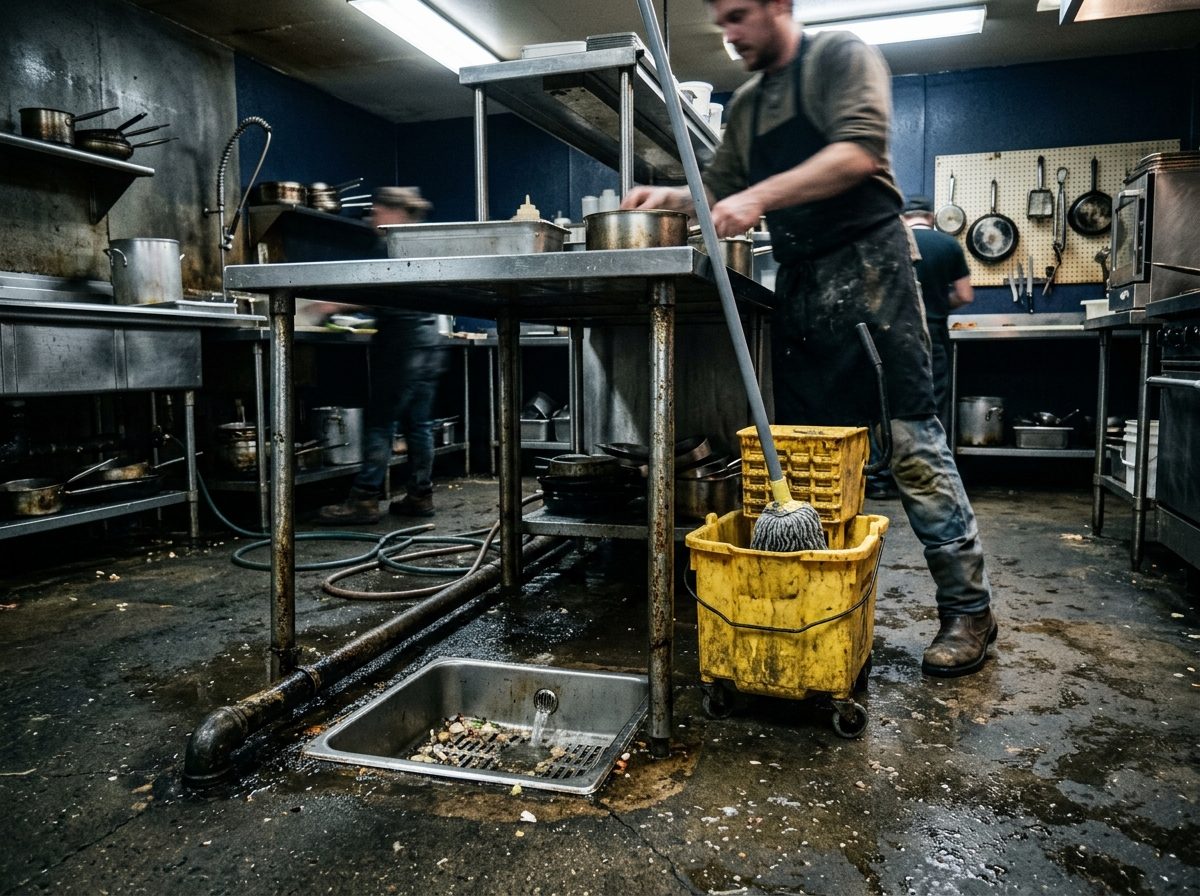
Floor drains and trench drains. They collect food solids and grease, they are what keeps a kitchen floor usable, and they need cleaning as routine rather than when they back up.
Hand-wash and dish stations. Required provision, and a hand sink that does not deliver hot water is an inspection finding. Dish machines need adequate hot water at temperature and correct indirect waste connections.
Hot water capacity. Frequently undersized, especially where a space has changed use. A high-recovery or tankless arrangement sized for the actual peak demand is the answer, and in Colorado that sizing has to account for cold incoming water and elevation — see high-altitude sizing.
Restaurants
Grease and drains
Scheduled jetting and interceptor service beats emergency call-outs on price and on trade lost.
Offices and retail
Restrooms and supply
Flushometers, ADA fixtures, water heaters and the isolation valves nobody has tested.
Multi-tenant
Isolation and access
Knowing what shuts off what, before an emergency forces you to find out.
Every premises
Annual backflow test
Approved tester, report filed with the district. It is a deadline, not a suggestion.
Offices, retail and multi-tenant buildings
Lower call volume, and different priorities.
Restrooms. Flushometer valves rather than tank toilets, sensor faucets, ADA-compliant fixture heights and clearances, and the constant low-level attrition of public use. Vandalism and misuse are ordinary maintenance realities rather than exceptions.
Water heating. Often small point-of-use heaters serving remote restrooms, which fail quietly and get discovered by a tenant complaint. Worth including in any planned maintenance rather than waiting.
Break rooms and kitchenettes. Small scale but the same issues in miniature: disposals, dishwashers, ice makers, filtration.
Isolation and shutoffs. The most valuable thing a multi-tenant building can have is a documented, tested set of isolation valves and a plan showing what each one controls. Discovering during a burst pipe that the only valve which closes is the one at the street is an expensive way to learn.
Emergency response, and what to have ready
When something floods or backs up in a commercial space, the first ten minutes matter more than they do at home, because there are staff, customers and often other tenants involved.
Know your shutoffs before you need them. Main water shutoff for the unit and for the building, water heater isolation, gas shutoff, and the isolation for anything with its own supply. Label them. Take a photograph. Make sure the closing manager knows, not just the owner.
Know your drainage layout. Where the cleanouts are, where the grease interceptor is, and whether a backup will surface in the kitchen or in the tenant next door.
Have the numbers to hand. Plumber, landlord or property manager, insurer, and the water district. On a bad evening nobody wants to be searching email for a phone number.
Sewage in a food premises is a stop-service event. That is a health matter as much as a plumbing one, and the answer is to stop, isolate, clean properly and get the cause found — see sewer backup. The same applies to any loss of hot water or hand-wash provision.
Planned maintenance, and why it pays here
In a house, deferred maintenance costs you a repair. In a business, it costs you a repair plus the trade you did not do while the repair was happening — which is what makes scheduled work a much easier calculation on commercial premises.
A sensible programme for a food premises: jetting the kitchen waste line on an interval set by how quickly it actually fouls, interceptor service on a documented schedule, floor and trench drain cleaning, annual backflow testing with reports filed, water heater service including flushing and anode inspection, and a walk-through of fixtures, valves and connections to catch the small failures before they become closures.
For offices and retail: restroom fixture and flushometer servicing, water heater checks, isolation valve exercise and documentation, and an annual look at supply piping condition in older buildings.
Two arguments make the case better than any pitch. First, scheduled work happens at 6am on a Tuesday; emergency work happens at 7pm on a Saturday at a premium, with the dining room closed. Second, the paperwork exists — which matters when an inspector, an insurer or a prospective buyer asks.
The single sheet worth having on the wall
Location of the main water shutoff, gas shutoff, water heater isolation and each cleanout. Location and service date of the grease interceptor. Date of the last backflow test and when the next is due. Plumber, property manager and insurer phone numbers. Laminate it, put it in the back of house, and make sure whoever locks up at night knows where it is. It costs nothing and it has saved more commercial kitchens than any piece of equipment on this page.
Planning ahead instead of reacting? Scheduled work costs less and rarely happens at 2am.
Set Up Planned WorkWhat drives the price
We refer to independent contractors and cannot quote for them, but commercial pricing has some structural differences worth knowing.
Labour rates for commercial work are generally higher than residential, reflecting the equipment involved, the additional requirements of working on commercial premises, and the specialist training the work calls for in things like backflow testing. Out-of-hours scheduling — the 5am start or the after-closing visit — is normal in commercial work and usually priced as scheduled rather than emergency time, which is one of the advantages of having a contractor who knows your site.
Jetting a kitchen line is priced by access and length, and scheduled intervals cost less per visit than emergency response. Interceptor service is priced by size and by disposal. Backflow testing is a fixed annual item per assembly, with the report included. Fixture and valve repairs are straightforward, though commercial parts can require ordering.
Larger projects — tenant improvements, changes of use, repiping, water heating replacement — are priced as projects: design, permit, rough-in, fixtures, inspection, and phased so the business can keep trading where possible. Phasing usually costs a little more in labour and saves considerably more in revenue.
The economics of prevention are simply better on commercial premises than anywhere else, which is why the contractors worth working with will push you toward a schedule rather than waiting for the call.
- Label and photograph every shutoff, and tell the closing manager
- Set a jetting interval for kitchen lines rather than waiting for a blockage
- Keep grease interceptor service records where an inspector can see them
- Diary the annual backflow test and file the report with the district
- Run water into floor drains weekly so traps do not dry out
- Book non-urgent work for before opening, not during service
Want work done before you open? Early mornings and after closing are normal for commercial jobs. Call and we will schedule around your hours.
Schedule around tradingDowntime is the real cost
Commercial plumbing questions
Yes, and for most commercial jobs it should be. Early mornings before opening and evenings after closing are normal scheduling in commercial plumbing rather than an emergency premium, and it is one of the main reasons to use a contractor who works on commercial premises regularly.
Grease. Kitchen waste lines coat from the inside until they close, and cabling punches a hole through the blockage rather than removing the coating — which is why the problem returns on a predictable cycle.
It depends on the size of the unit and the volume of the kitchen, and local requirements often set a minimum. What matters as much as the interval is the documentation: inspectors ask for service records, and a neglected interceptor is both a compliance finding and a blockage waiting to happen.
If your premises has backflow prevention assemblies — and most commercial premises do, particularly food service with carbonators, dish machines and beverage lines — then yes, testing by an approved backflow tester with a report filed to the water district is typically required annually.
Stop service in the affected area, stop running water, and keep staff and customers away from it. In a food premises this is a health matter as much as a plumbing one, so it needs proper cleaning as well as a repair, and the cause needs finding rather than the symptom relieved.
Usually the water heating was sized for a different use of the space, or never sized for the peak at all. Commercial demand is spiky and dish machines need water at temperature.
It depends entirely on the lease, and it is worth reading before you need to know. Typically the tenant covers fixtures and equipment within the demised premises and the landlord covers building systems and common services, but the boundary varies and grease interceptors in particular are often argued about.
Yes, and the time to involve a plumber is before the layout is fixed. Adding a kitchen or restrooms to a shell space means supply, drainage, venting, grease interception, backflow protection and water heating capacity — and drainage is the constraint that most often forces a layout to change.
Treat it like an unoccupied house, because at 2am that is what it is. Do not set the heat back so far that perimeter pipes are at risk, keep exterior and roof drainage clear of ice, insulate anything running through unheated space, and have a plan for who checks the premises in a cold snap.
Fixed before you open, not during service.
Restaurants, retail, offices and small multi-tenant buildings — across 135 Colorado communities.
(833) 621-2904 — answered 24/7, statewide.