Everything in your house that uses water arrives through a single buried pipe running from the municipal main, past the meter, to the point where it enters the building. When that pipe fails there is no partial service and no workaround — and unlike a sewer line, it is under pressure the entire time.
Which is why a service line leak is a different kind of urgent from most plumbing.
If water is surfacing in the yard or the pressure has collapsed
Find your main shut-off — usually where the line enters the basement or crawlspace, sometimes at a curb stop under a metal lid near the street — and close it. Then call (833) 621-2904.
How a service line leak announces itself
Sometimes dramatically, with water surfacing in the yard or the driveway. More often it starts quietly, and the quiet version is the one worth learning to spot.
The meter test. Turn off every fixture and appliance in the house, including ice makers and irrigation, then look at the meter.
Pressure loss. Gradual across the whole house, not one fixture. A single weak shower is a fixture problem or a pressure regulator issue; every tap in the building losing force together points at the service.
Bill increases with no change in habits. A service line leak on the customer side of the meter is metered water.
Wet ground, or unseasonably green ground. A soft patch, a persistent damp line across the lawn, or a stripe of grass thriving in August along the run from the street to the house.
Check first
The meter
Everything off, indicator still moving. Definitive, free, and takes two minutes.
Whole house
Pressure dropping
Every fixture weaker together, not one. Supply-side, not fixture-side.
Outdoors
Wet or green stripe
Damp ground, a sinking patch, or grass thriving over the pipe run in a dry month.
Winter
Bare ground in snow
A clear strip where snow melts over a leaking line, or the opposite — no water at all, a frozen service.
Why service lines fail in Colorado
Material history first. Housing from the 1930s through the 1950s often has galvanised steel service lines, which corrode from the inside out, lose bore to rust scale and eventually pinhole.
Then soil. Expansive bentonite clay across much of the Front Range and the metro area swells and shrinks with moisture content, and it does so every year.
Depth and frost are the third factor, and they are why Colorado differs from warmer states.
Finally: pressure. Parts of Colorado, especially where a distribution system serves varying elevations, deliver high street pressure.
A sewer line failing is inconvenient. A pressurised water line failing is inconvenient at several gallons a minute, continuously, until someone closes a valve.
Utility sent you a high-usage notice? That is usually a real leak, and it is usually on the customer side. Call before the next billing cycle.
Get the line checkedWet patch in the yard in February? That is not snowmelt. Buried service leaks surface in the strangest weather.
Ask About a Wet PatchFinding it before anyone digs
Locating the leak is the whole difference between a small excavation and a trench across the front garden. The tools are different from sewer work, because the pipe is pressurised and full of water rather than empty and inspectable.
Acoustic listening comes first: pressurised water escaping a pipe makes a characteristic sound that ground microphones and listening sticks can follow along the run to a fairly tight position. Pressure testing isolates the service from the house plumbing so the leak can be confirmed as being outside the building rather than under the slab. Tracer gas is used on difficult cases, where an inert gas is introduced and detected at the surface where it escapes.
Line tracing establishes the pipe path and depth, which matters because service lines do not always run where the homeowner assumes — old lines take odd routes, and a line laid in 1948 may not follow the driveway. See leak detection for how these methods combine.
A quote that skips locating and proposes trenching the entire run is a quote for the contractor's convenience.
Repair the spot, or replace the run
Both are legitimate. Which one is right depends less on the leak and more on the pipe it is in.
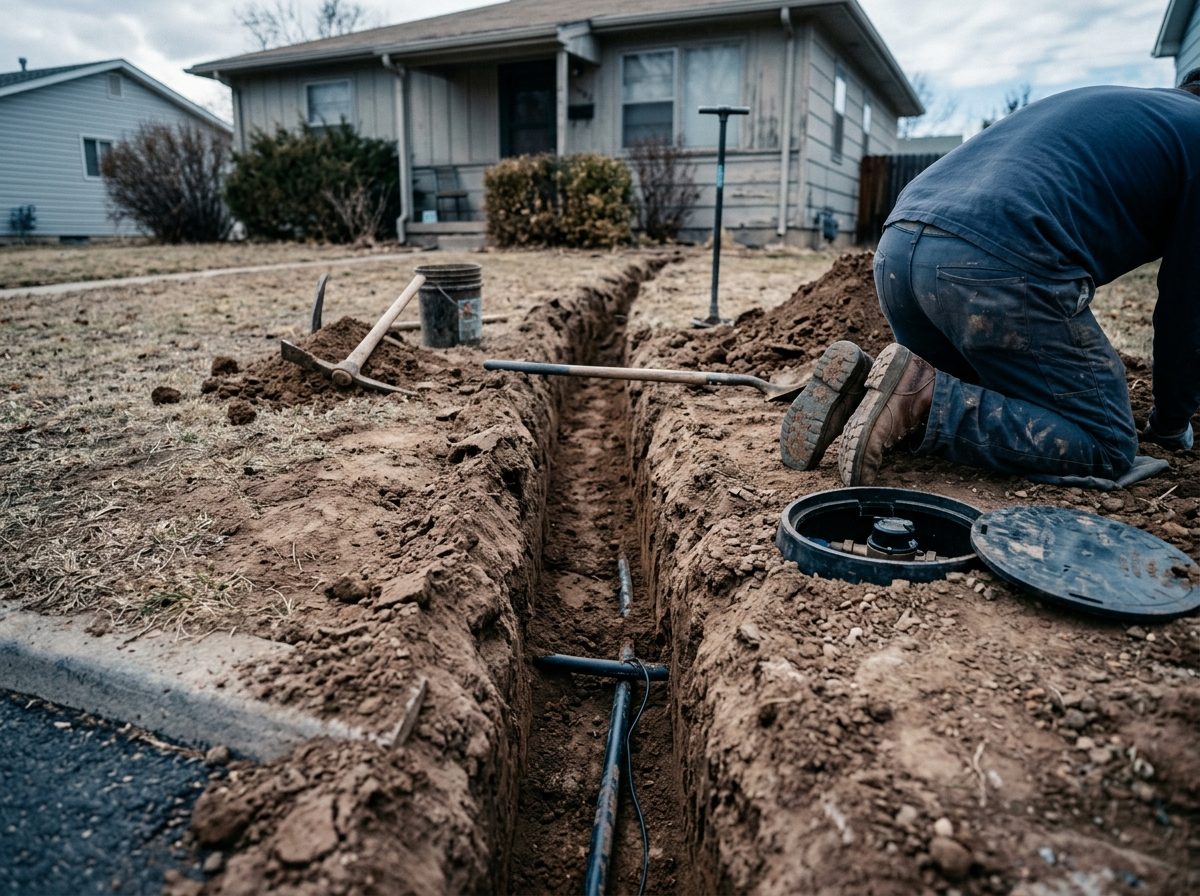
Spot repair. Excavate at the located leak, cut out the failed section, sleeve or splice in new pipe, pressure test, backfill and restore.
Full replacement. Install a new service line, typically HDPE or copper, from the meter to the building entry.
Trenchless replacement. On the water side this generally means pulling a new HDPE line through the path of the old one from pits at each end, or directional boring a new path. It preserves the driveway, the mature landscaping and the street, and its economics work the same way as on the sewer side — higher per foot, frequently lower delivered. Trenchless methods are described in more detail on that page.
And one thing worth raising unprompted: if the service line is being replaced and the interior supply piping is the same vintage galvanised or polybutylene, ask about doing both. The trench is already open and the water is already off. Whole-home repiping covers that case.
The question that decides it
"What material is my service line, and what condition is the rest of it in?" A leak in sound copper is a repair.
Who owns which section
The dividing line is usually the meter, but not always, and getting this wrong is expensive in both directions — paying for the utility's pipe, or waiting for a utility that was never going to come.
The common arrangement in Colorado municipalities is that the utility owns and maintains the main and the tap, plus the section up to and including the meter, while the property owner owns the service line from the meter to the building. Where the meter sits inside the house, as it often does in older Colorado properties, the ownership boundary is typically the curb stop or the property line rather than the meter itself — meaning you may own pipe running under the sidewalk and the street.
Denver, Colorado Springs, Boulder, Aurora, Pueblo and the various metro water districts do not all apply identical rules, and special districts frequently differ from the city they sit inside. Before agreeing to work near the boundary, call the utility and get the answer in writing. It is one phone call and it occasionally saves a five-figure sum.
Two related points. Many utilities and insurers sell optional service line coverage, which is one of the few endorsements that is both cheap and genuinely relevant in Colorado — standard homeowners policies generally exclude the buried line as wear. And where a lead service line or a lead gooseneck is discovered, replacement programmes and specific regulatory requirements may apply; ask the utility directly rather than relying on a contractor's summary.
Frozen service lines
A separate failure mode with the same symptom — no water — and a different response. If the whole house loses supply during a cold snap and the meter shows no flow at all, the service may be frozen rather than broken.
Do not attempt to thaw a buried line yourself, and do not use any open flame anywhere near it. Thawing a buried service is specialist work involving either electrical thawing, hot water jetting through the line, or excavation, and it needs to be matched to the pipe material — electrical methods do not work on plastic pipe and can damage things if applied carelessly.
Where a service has frozen once, it will freeze again unless the underlying cause changes: the line is too shallow, the ground cover has been altered, or an unheated crawlspace section is exposed. Ask what the fix is, not just what the thaw costs. Pipe thawing and frozen pipe repair cover the interior version of this problem.
- Leak located and depth marked before any excavation is priced
- Existing pipe material identified, and its condition assessed
- Ownership boundary confirmed with the utility in writing
- Permit, pressure test and inspection named in the quote
- Restoration specified — lawn, concrete, asphalt, irrigation
Not sure whose pipe it is? Worth establishing before anyone digs. We will explain where the line usually divides.
Find Out Who Owns ItWhat drives the price
We refer to independent contractors and cannot quote for them. What we can do is explain the components, so a quote reads as arithmetic rather than a number.
Length and depth dominate, and in Colorado depth is driven by frost requirements as well as by where the main sits — a service line here is buried deeper than the same line in a mild climate, and depth drives shoring, spoil volume and time.
Surface is the next factor and often the largest single swing. Open lawn is the cheap case. A concrete driveway, a paver patio, a mature tree, a sidewalk or a city street each add substantially, and right-of-way work brings its own permit, traffic control and restoration standard.
Then method and material — trenchless pulling or boring versus open trench, HDPE versus copper — followed by whether the interior entry point needs work, whether a new curb stop or meter setter is required, and whether the utility charges for a shut-off or reconnection.
Emergency and after-hours response carries a premium everywhere. And where the job is heading toward full replacement, two or three quotes based on the same locate is straightforward prudence.
No water at all, or water everywhere? Either way it is the same phone number, and either way it is today rather than tomorrow.
Call nowBefore the digging starts
Main water line questions
Run the meter test: turn off every water-using fixture and appliance in the house, including ice makers and irrigation, then check whether the low-flow indicator on the meter is still moving.
Most commonly inside, where the service line enters the basement or crawlspace, often near the meter and usually within a few feet of the wall it comes through.
Usually the utility owns the main, the tap and the meter, and the property owner owns the service line from the meter to the building.
Yes, when the pipe is sound material in good condition and the failure is isolated — a nicked copper line or a single failed fitting is a spot repair.
It depends on when the house was built. Galvanised steel is common in 1930s to 1950s properties and corrodes internally until it pinholes.
The physical work on a residential service replacement is often one to two days, sometimes three for a long, deep or obstructed run.
Standard policies generally exclude the buried service line itself, treating failure as wear rather than a sudden event, though resulting damage inside the house may be covered.
It may be a frozen service line rather than a break, particularly if the meter shows no flow at all and nothing is wet.
One pipe supplies the whole house.
Locate it, then decide. One number for 135 Colorado communities, 24/7.
(833) 621-2904 — answered 24/7, statewide.