Plumber in Broomfield, CO — 24/7 by phone
Home / Areas / Denver Metro / Broomfield
Broomfield is mostly a modern city, and that changes the plumbing conversation. There is comparatively little century-old pipe here. What there is instead is a large stock of houses built within a few decades of each other, which means the failures are about components, specification and timing rather than about material decay.
A newer city with newer problems
In newer construction the pipe itself is rarely the issue. The recurring items are the parts that were chosen quickly during construction and never revisited: pressure regulators, water heater fittings, angle stops, supply lines to fixtures, and expansion tanks. All of them have service lives shorter than the house.
Because whole streets were built together, they also fail together. A neighbour replacing a water heater is genuinely useful information about your own — planned replacement in a finished basement costs far less than an emergency one, and the mess is a fraction.
Tankless installations are common enough here to be worth a note. Their output is a temperature rise across a flow rate, so a unit that satisfies a household in September can fall short in January when incoming water is coldest. Sizing for winter rather than for average conditions is the difference.
Considering tankless? Size it for January, not for average conditions.
Ask about tankless sizing
Pressure and the parts it kills
High static pressure is one of the most under-diagnosed problems in newer housing. A regulator that has drifted or failed passes street pressure straight through to fixtures that were never designed for it, and the damage arrives as a scatter of small failures rather than one obvious event: toilets that run, taps that drip, a washing machine hose that lets go, a heater relief valve that discharges periodically.
A gauge on an outdoor spigot costs very little and settles it in a minute. If the reading is high, replacing the regulator is far cheaper than replacing fixtures one at a time — and it protects everything downstream of it.
Basements, pumps and storms
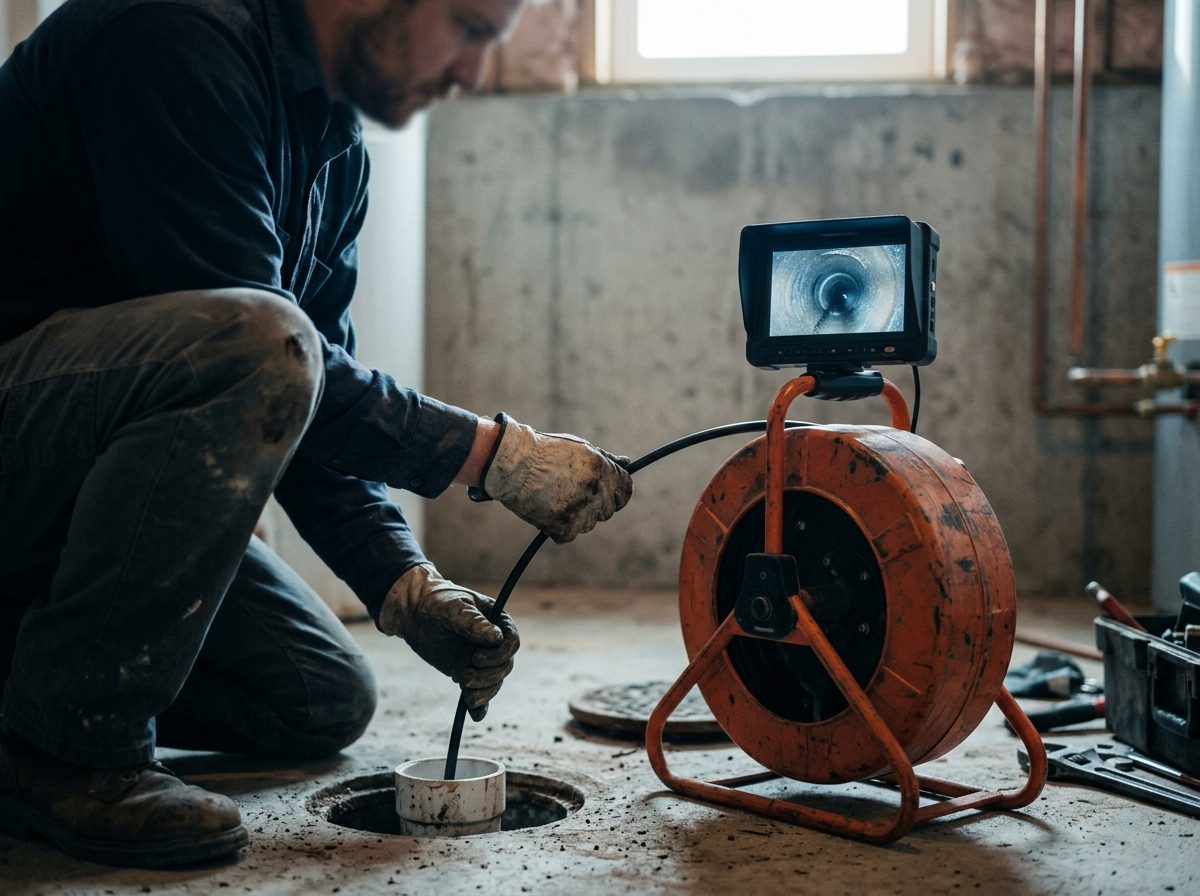
Full basements are standard and many are finished. The sump pump is therefore one of the more consequential appliances in the house, and the one least likely to have been tested since it was installed.
The test takes five minutes: pour two or three buckets into the pit, and confirm the pump starts, clears the water and shuts off cleanly without cycling. If the basement is finished, a battery backup or a second pump is inexpensive against the cost of replacing flooring after a fast melt or a summer downpour.
Finished basement? A tested pump and a backup cost less than new flooring.
Ask about sump pumpsCold snap forecast? Hoses off and cabinet doors open prevent most of it.
Ask about freeze protectionWhere the freeze finds you
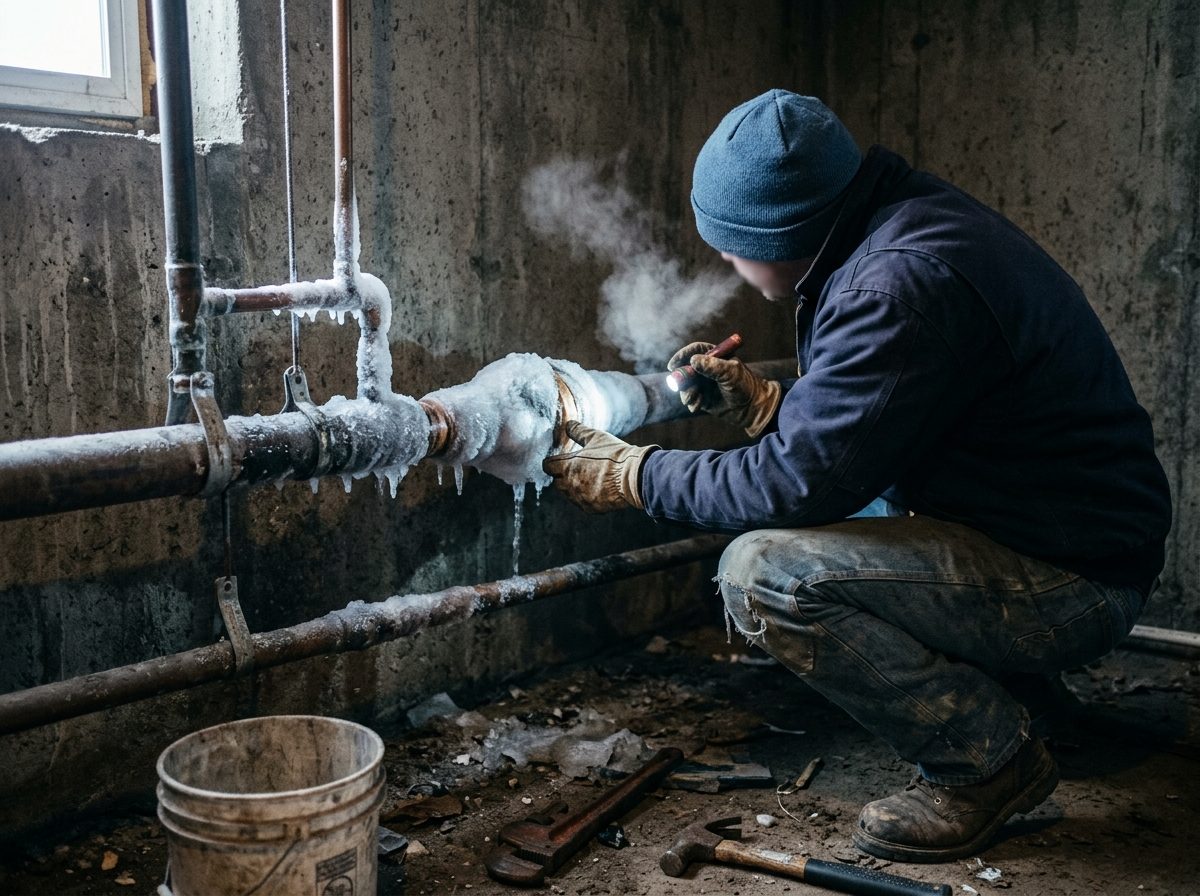
Freezes here are short, sharp and often windy, and the vulnerable spots are predictable: a hose bib with a hose still attached, pipes in a garage wall, a crawlspace vent left open from summer, and lines running through an outside wall on a north or west face.
Disconnect hoses in October, because a connected hose holds water against the bib and defeats the frost protection built into it. On the coldest nights, open cabinet doors under sinks on exterior walls so household heat reaches the pipe. And if a fixture stops flowing on a cold night, get the exposure fixed even after flow returns — ice can crack a pipe without releasing water until the thaw.
If a line stops flowing
Close the main shutoff before thawing anything. If the pipe has already split, thawing simply reveals it, and with the water off you get a controlled repair instead of a flood.
The valve you have never turned
The single most useful piece of plumbing knowledge in any house is where the main shutoff is and whether it actually works. In most houses here it is where the supply enters, commonly in the basement on the street-facing wall, often within a few feet of the meter. In a townhome it may be in a cupboard or a shared riser closet, and it is frequently not where the owner assumes.
A valve that has not been moved in twenty years can seize, and the moment it is discovered is almost always the moment it is needed. Turning it once on a dry afternoon is therefore worth doing deliberately: closed, then open again, then a tap run to confirm flow has returned. If it will not move, do not force it — a seized gate valve can break off in the hand, at which point a dry problem becomes a wet one. Have it replaced as planned work while the water can still be shut off at the street.
Two things are worth adding while the subject is open. Locate the street valve as well, because it is the fallback if the interior one fails, and its position is not obvious under snow. And fit isolation valves at the fixtures that do not have them — a toilet, a basin or a washing machine that can be shut off individually turns a household emergency into a single room out of service. None of this is expensive; all of it is only useful before it is needed.
Nearby communities
Broomfield sits at the join of four counties, with Westminster, Louisville, Lafayette and Erie all a few minutes away.
Broomfield, Colorado
Broomfield plumbing questions answered
Buy an inexpensive gauge and screw it onto an outdoor spigot. Readings above the normal working range shorten the life of every valve, hose, fixture and appliance in the building. The early symptoms are unglamorous — running toilets, dripping taps, a heater relief valve that discharges. If it reads high, the regulator is the part to address.
It can be, provided it is sized for winter. Output is a temperature rise across a flow rate, and incoming water is much colder in January than in September, so a unit chosen on average conditions can disappoint exactly when you need it. Gas supply, venting and combustion air all belong in the same conversation, before purchase.
Pour two or three buckets of water into the pit and watch. The float should lift, the pump should start, move the water out and shut off cleanly without short-cycling. If it hums without pumping, runs continuously or does nothing at all, deal with it now rather than during a melt. Test in early spring and before storm season.
Probably worth checking, yes. Houses built in the same year get the same appliances fitted by the same crews, so they age and fail together. A planned replacement is cheaper than an emergency one and far less messy in a finished basement, so treat a neighbour’s failure as a prompt rather than a coincidence.
Same-day is normal and a couple of hours is common for urgent problems, since the city sits in the middle of a dense service area. During a metro-wide cold snap every plumber is busy simultaneously, so you may get a next-morning window along with instructions on what to shut off in the meantime.
It absorbs the pressure increase created when water heats and expands in a closed system. When the bladder inside fails, that pressure has nowhere to go, which is a common cause of a relief valve discharging periodically and of fittings weeping. It is an inexpensive part and worth checking whenever pressure symptoms appear.
Start with the angle stops and supply lines, which are the parts most likely to weep in newer housing, then check the drain connections and the disposal body if there is one. Dry everything, lay paper down and run water for a minute at a time to see where it reappears. If nothing shows, the leak may be behind the cabinet and worth locating properly.
Hardness is moderate rather than extreme, so most households manage without treatment. Flushing the water heater annually and cleaning aerators when flow drops at one tap covers most of it. If you want a decision based on evidence, a water test is inexpensive and tells you what you are actually dealing with.
Stop turning it. A seized valve can break under force, and then the water cannot be stopped at all. Have it replaced as planned work, which is a straightforward job while the supply can still be closed at the street. In the meantime, find the street valve and confirm you could get to it, particularly in winter when it may be under snow.
Broomfield, around the clock
Broomfield, Westminster, Louisville, Lafayette and Erie, answered 24 hours a day.
(833) 621-2904 — answered 24/7, statewide.