Plumber in Rollinsville, CO — one call, any hour
Home / Areas / Mountain Communities / Rollinsville
Hydronic heat — boilers feeding radiators or pipe embedded in floors — is far more common up here than in valley subdivisions, for good reasons. It also fails in ways that are completely unfamiliar to anyone who has only lived with forced air, which is why so many calls from this area start with somebody describing symptoms they have no vocabulary for.
Why hydronic heat suits it here
Water carries far more heat per unit volume than air, and it delivers it steadily rather than in blasts. In a building that is cold for most of the year, that produces a more even result and avoids the draughts a forced-air system creates every time it cycles. Radiant floors in particular suit stone and tile floors in mountain houses, where a warm surface is worth more than warm air.
The trade-off is complexity. A hydronic system is a closed loop under pressure, with a heat source, a circulator, an expansion vessel, zone controls and a relief valve, and each of those is a thing that can fail. Understanding roughly what each does makes an enormous difference to how quickly a fault gets diagnosed.
New to hydronic heat? Ask what the parts do — it makes every future call quicker.
Ask about your heating system
Pressure, expansion and the relief valve
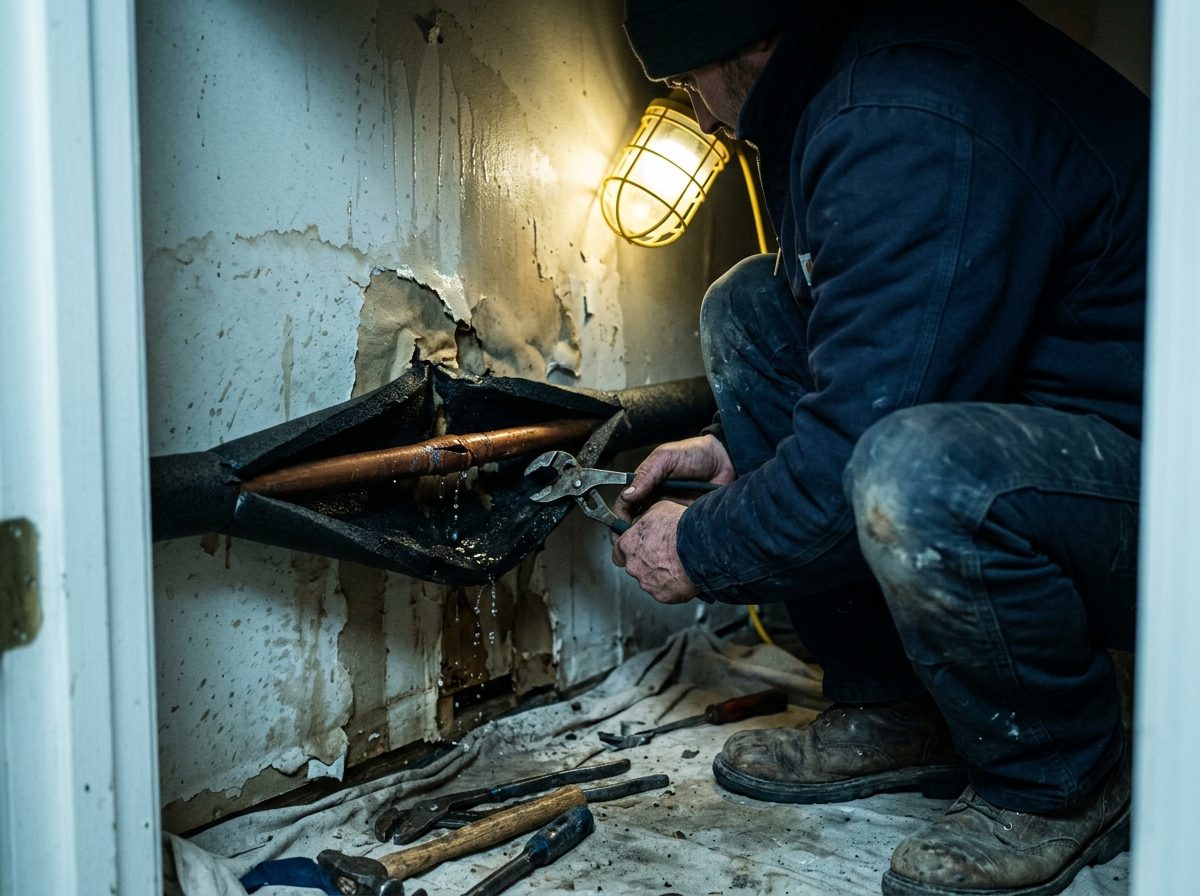
The single most common alarming symptom is water discharging from a pipe near the floor. That is the pressure relief valve doing exactly its job: system pressure has gone too high and the valve is protecting the boiler by letting some out.
It is not something to cap, plug or ignore. The causes are usually one of three: the expansion vessel has failed, so there is nowhere for water to go as it heats and expands; the fill valve is not closing, so the system keeps being topped up; or the system is overheating. The diagnostic that separates them is simple and something an owner can report — watch the boiler pressure gauge as the system heats up. Pressure that climbs steadily with temperature points at expansion. Pressure that is high even when cold points at the fill valve.
That one observation frequently determines what parts come out on the visit, which matters at this distance.
When one zone goes cold
A single cold zone while the rest of the house heats is a different problem from no heat at all, and it is usually less serious. The candidates are air trapped in that circuit, a zone valve that has stopped opening, or a circulator that is not moving water through that loop.
Air is the commonest and the easiest. Water carries dissolved air, and it collects at high points in the system where it blocks flow — which is why bleed points exist and why they are at the tops of circuits. A system that needs bleeding repeatedly, though, is telling you something else: air is getting in, usually through a small leak that draws air when the system cools, and chasing the air rather than the leak is a long-running frustration.
Zone valves fail electrically or mechanically and generally need replacing rather than adjusting. Reporting which zones work and which do not, and whether the boiler itself is firing, narrows this substantially before anyone arrives.
One zone cold, the rest fine? Say which zones work — it narrows the fault quickly.
Ask about a cold zoneGlycol, freeze protection and testing
At this elevation many hydronic systems are charged with a glycol mix rather than plain water, so the loop does not freeze if the heat fails while a building is empty. That is sensible, and it introduces a maintenance item most owners never hear about.
Glycol degrades over time. As it does, it becomes acidic and turns from a protective fluid into something that corrodes the system from the inside — and its freeze protection weakens. Testing the mix periodically, and changing it when the test says so, is genuinely part of owning a glycol system rather than an optional extra. A system charged fifteen years ago and never tested may have neither the freeze protection nor the corrosion inhibition its owner assumes.
Worth knowing too: glycol reduces the heat-carrying capacity of the fluid slightly, so a system designed for water and later charged with glycol can underperform. If a system has never quite kept up since it was converted, that is a plausible reason.
Glycol never tested? It degrades — and stops protecting the system.
Ask about testing the loopThe one observation worth making
What the boiler pressure gauge reads cold, and what it reads once the system is hot. Those two numbers separate most hydronic faults before anyone opens anything.
Make-up water, and the leak you cannot see
A hydronic system holds a fixed volume of water and should need almost none added across a winter. Most are fitted with an automatic fill valve that quietly tops the system up whenever pressure drops, which is convenient and also hides the thing you most want to know about.
A slow leak on a buried or concealed loop therefore never announces itself as low pressure. It announces itself years later as corrosion, because every gallon of make-up water brings fresh oxygen and fresh minerals into a system that was designed to circulate the same water indefinitely. If your boiler pressure never falls but the system has been topped up repeatedly, that is worth investigating rather than filing as normal.
Nearby communities
Rollinsville sits below the divide in Gilpin County, with Pinecliffe, Nederland, Black Hawk and Central City nearby.
Rollinsville
Hydronic heating questions answered
That is the pressure relief valve doing its job — system pressure has gone too high and the valve is protecting the boiler. It is not something to cap or plug. The usual causes are a failed expansion vessel, a fill valve that is not closing, or the system overheating.
Watch the boiler pressure gauge as the system heats up. Pressure that climbs steadily with temperature points at the expansion vessel, because there is nowhere for the expanding water to go. Pressure that is already high when the system is cold points at the fill valve instead.
Usually air trapped in that circuit, a zone valve that has stopped opening, or a circulator not moving water through that loop. Air is the commonest and the easiest to deal with. Reporting which zones work and whether the boiler is firing narrows it considerably before anyone arrives.
Because air is getting in, and that usually means a small leak that draws air when the system cools and pressure drops. Bleeding treats the symptom. Finding the leak is what stops the cycle, and repeated bleeding also introduces fresh water and oxygen, which is hard on the system.
Freeze protection. At this elevation a system charged with a glycol mix will not freeze if the heat fails while a building is empty, which is a real risk here. It is the sensible choice for a property that is not occupied continuously through winter.
Yes, and this is the part most owners never hear. Glycol degrades over time, becoming acidic — it stops protecting the system and starts corroding it from inside, while its freeze protection weakens. Testing the mix periodically and changing it when required is part of owning the system.
That is a plausible complaint rather than imagination. Glycol carries slightly less heat than plain water, so a system designed and sized for water can underperform after conversion. It is worth having the sizing reviewed rather than assuming the boiler is at fault.
Access and weather decide it more than distance. What speeds it up is the gauge reading and knowing which zones are affected, because that determines what parts come on the truck — and at this distance a second trip for a part is the expensive outcome.
Below the divide, any hour
Rollinsville, Pinecliffe, Nederland, Black Hawk and Central City.
(833) 621-2904 — answered 24/7, statewide.