Plumber in Ward, CO — 24/7 by phone
Home / Areas / Boulder County / Ward
Ward sits at around nine thousand feet on the Peak to Peak highway, and it is among the coldest and most exposed communities in Boulder County. Everything about plumbing here follows from altitude and winter length: the freeze season runs most of the year, and any assumption carried up from the valley needs rechecking.
Nine thousand feet on the Peak to Peak
At this elevation, freezing is not an event but the ambient condition for much of the year. Any pipe outside heated space needs either active protection or to be out of service, and there is very little margin for improvisation.
Housing is largely old cabins, extended over decades by different hands. Plumbing that grew that way tends to have long runs in awkward places and fittings in walls nobody recorded, so diagnosis is a genuine part of the job. The most useful thing an owner can offer is the building's history.
Old cabin with layered plumbing? Its history is the most useful thing you can tell us.
Ask about tracing a system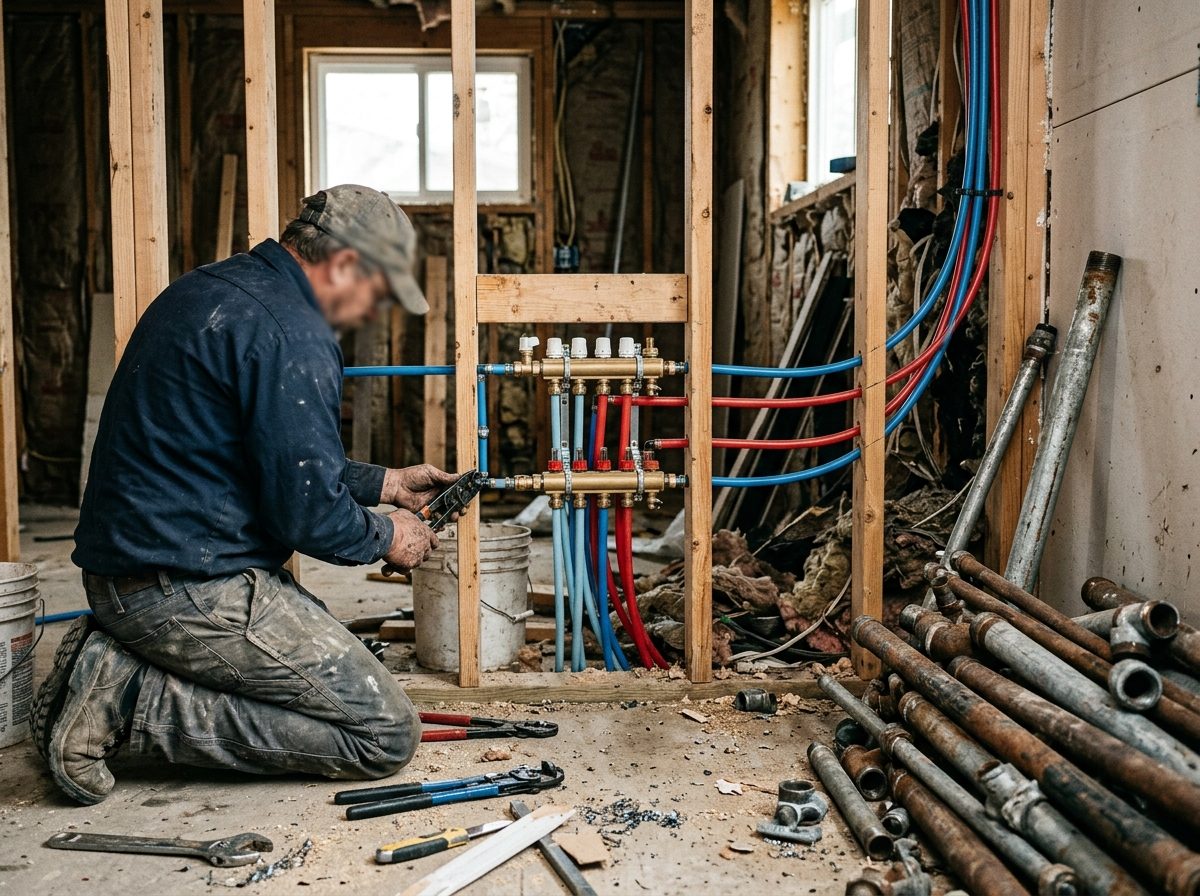
Draining is the only reliable answer
For a building standing empty at this elevation, draining is the only genuinely dependable strategy. Water off at the source, the system drained from its lowest point, taps opened so air can replace water, the heater and anything else holding water dealt with, and antifreeze rated for plumbing in traps and toilet bowls. Never automotive antifreeze.
Done thoroughly, the building can sit at any temperature without freeze risk — which is a far better position than relying on a heat source all winter in a place that is hard to reach. Done partially it is worse than it looks, because water left in low points is exactly what splits.
Boilers, heat tape and appliances
Hydronic heat is common up here because it suits cold buildings, and its failure modes are unfamiliar to anyone used to forced air: no heat at all, one zone cold, or a relief valve discharging near the floor because system pressure is climbing. What the boiler gauge reads when the system is hot is the single most useful thing to report on the phone.
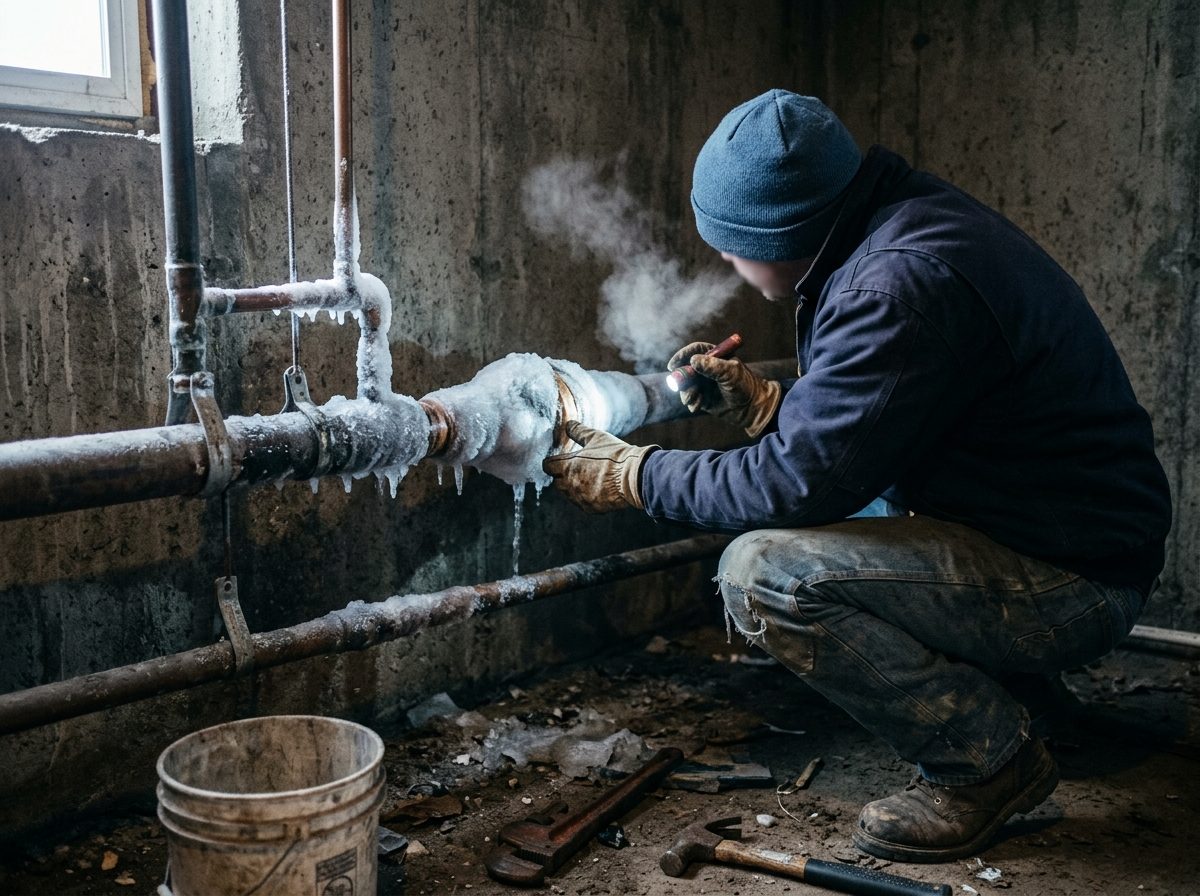
Combustion appliances also produce less than their labels suggest at this elevation, and incoming water in midwinter is close to freezing — so a water heater specified on average conditions will fall short exactly when it matters. And heat tape, which carries much of the freeze protection, fails silently through age, rodent damage or having been unplugged.
Boiler discharging or a zone cold? Note what the gauge reads before you call.
Ask about a boiler problemWeather decides everything
Access rather than distance determines response here. Snow, ice, unplowed drives and steep last stretches all decide whether a vehicle reaches a property, and in a storm the honest answer can be several days.
Given that, what an owner knows and does matters more than anywhere. Know where the main shutoff is and confirm it turns. If something lets go, close it, drain from the lowest fixture, move what matters, and photograph before cleanup. That sequence determines the size of the problem.
Snowed in with a burst line? Shut the water off and drain the lowest tap while you wait.
Ask what to do right nowArriving at a cold building
Close the main shutoff before applying heat anywhere, then check the lowest ceiling and the crawlspace for damp. A split line starts leaking the moment it thaws.
Where the water comes from up here
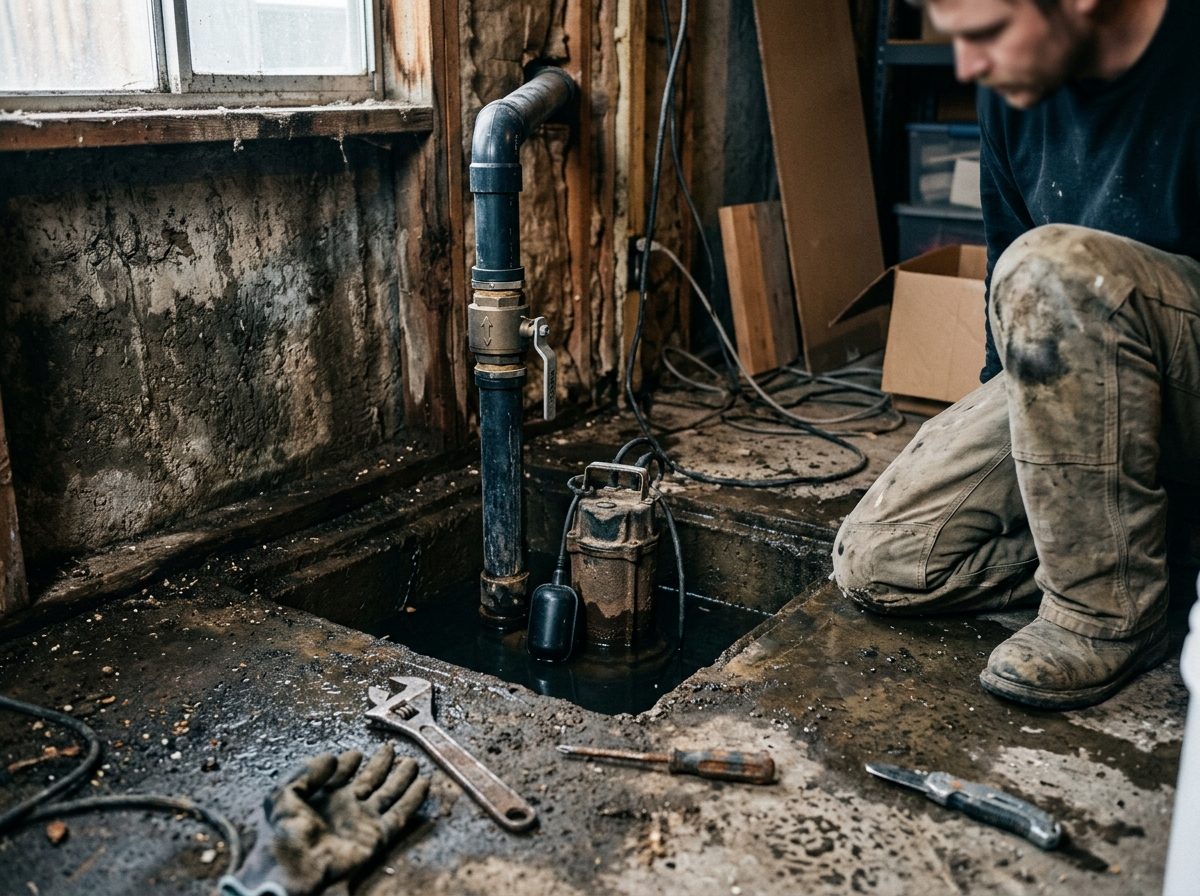
Supply at this elevation is its own subject. Wells are drilled into fractured rock rather than into an aquifer with generous flow, so yield varies enormously between neighbouring properties, and a bore that serves one household comfortably may struggle with a second bathroom. Some properties store water instead, in a cistern filled by a low-yield well over many hours or topped up by haulage, which turns the question from a supply problem into a storage and pumping problem.
Where there is storage, the components that matter are the ones people forget: a level control that actually works, an overflow that discharges somewhere sensible, a pressure pump sized for the house rather than for the tank, and a means of reading the level without climbing into anything. A cistern that runs dry does not announce itself gently — every fixture in the building stops at once, and the pump can be damaged in the process if it keeps trying to draw.
Water quality is the other half of it. Rock wells commonly carry sediment and iron, which is a nuisance at fixtures and a genuine problem for a pump seal and a water heater. Testing before buying equipment is worth insisting on, because sediment, iron and hardness each need different treatment and a softener bought on a guess addresses only one of them. Filtration also has to sit somewhere that will not freeze, which at this elevation narrows the options considerably.
Nearby communities
Ward sits at around nine thousand feet on the Peak to Peak highway, with Nederland, Jamestown and Allenspark nearby.
Ward, Colorado
High-altitude questions answered
Water off at the source, the system drained from its lowest point, taps opened so air can replace water, the heater and any appliance holding water dealt with, and antifreeze rated for plumbing in traps and toilet bowls. Never automotive antifreeze. Done thoroughly the building can sit unheated safely.
Not much, and it can be worse, because water left in low points is exactly what splits when it freezes — and it gives false reassurance. At this elevation it is worth having the job done properly once rather than approximated each autumn.
Two effects stack. Incoming water is far colder in January, so the same shower demands much more heat, and at nine thousand feet a gas appliance produces less than its rated output because there is less oxygen for combustion. A unit sized on average conditions falls short.
That is the pressure relief valve doing its job, which means system pressure is climbing too high — commonly a failed expansion tank, a fill valve that is not closing, or overheating. Do not cap it. Note whether the gauge climbs as the system heats, because that speeds the diagnosis.
Usually, with gentle even heat applied from the open end of the line toward the blockage so meltwater can escape. Never a torch or rapid heat — that is how pipes split and buildings catch fire. Shut the water off first, because if the pipe has cracked, thawing starts the leak.
Tape can look intact and be dead. Age, rodent damage and being unplugged during unrelated work are the usual causes, none visible at a glance. Test it before the freeze season and check the whole length of the run, since tape often covers less pipe than assumed.
Access and weather decide it rather than distance. In clear conditions same-day is realistic. In a storm it can be several days, and you will be told that plainly along with what to shut off and drain in the meantime, which is what actually limits damage.
Someone local who can physically check it, plus a remote temperature alarm you actually receive. At this elevation early warning matters more than any repair arrangement, because the difference between a small problem and a catastrophic one is how many days water runs unnoticed.
Usually storage rather than a bigger pump. A cistern lets a slow bore fill a tank over hours while the house draws from the tank at normal rates, which suits a low-yield well far better than pulling harder on it. Pump protection matters too — a control that shuts the pump down before it runs dry prevents the most expensive failure available up here.
It is common enough here to be routine rather than unusual. What makes it work is the installation around it: a cistern of sensible capacity, a fill point that stays accessible in snow, a readable level indicator, and a pressure pump matched to the building. What makes it fail is a fill point buried all winter and a level nobody checks until the taps stop.
The Peak to Peak, any hour
Ward, Nederland, Jamestown, Allenspark and Rollinsville.
(833) 621-2904 — answered 24/7, statewide.