Plumber in Johnstown, CO — one call, any hour
Home / Areas / Northern Colorado / Johnstown
Johnstown was a small farm town that has grown quickly into a commuter one, and most of its housing dates from that growth rather than from before it. The plumbing consequence is a stock of similar-aged houses where the components rather than the pipe are what fail — and where they fail on a predictable schedule.
Small town, fast growth
Subdivisions built in the same season received the same water heaters, pressure regulators, expansion tanks, angle stops and supply lines, fitted by the same crews. All of those have service lives far shorter than the house, so they arrive at the end of them together.
The useful consequence is that planning becomes possible. If neighbours are replacing heaters, yours is a candidate for inspection rather than a gamble, and a planned replacement costs a fraction of an emergency one — especially where the heater sits in a finished basement.
Heater over a decade old? Planned replacement costs far less than emergency replacement.
Ask about a heater check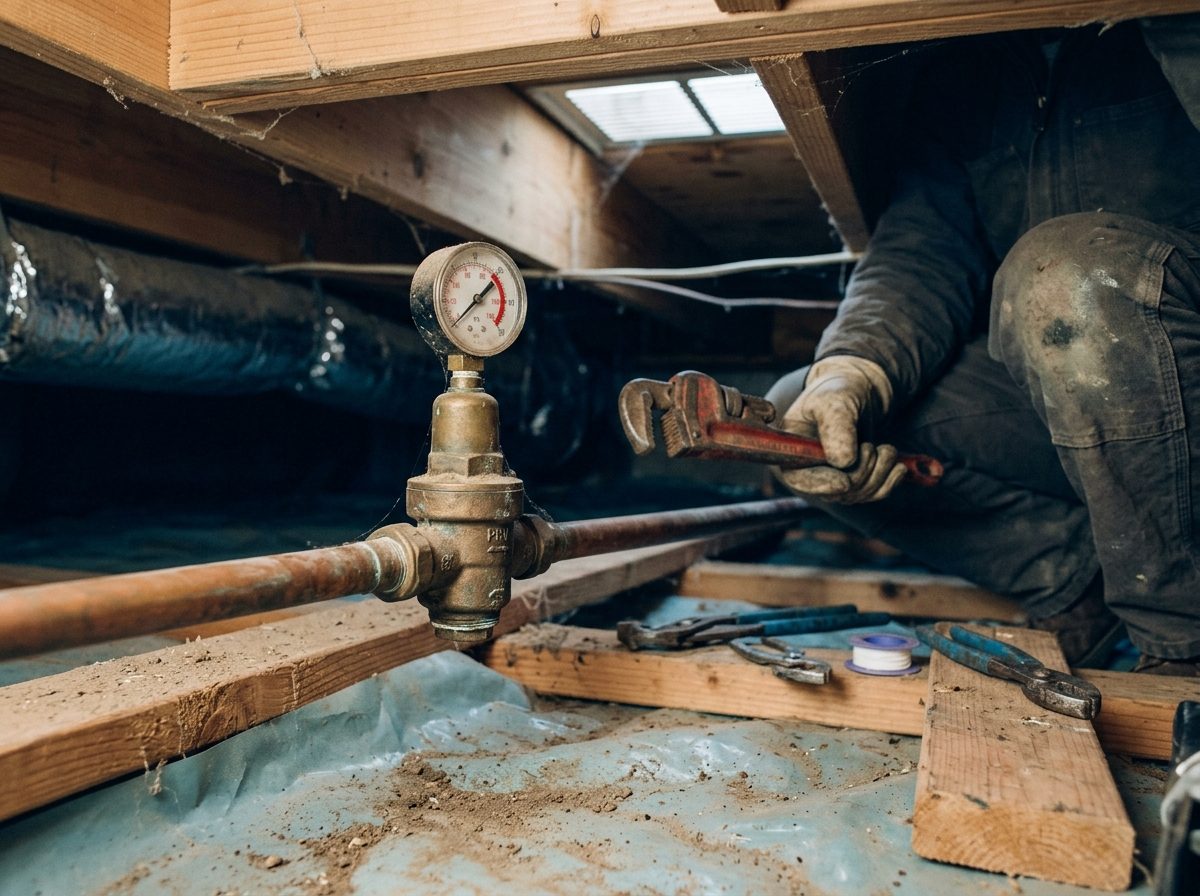
Pressure is the quiet destroyer
High static pressure is the most under-diagnosed problem in housing of this age, and its signature is a scatter of small failures rather than one obvious event. Toilets start running. Taps drip. A washing machine hose lets go. The heater relief valve discharges periodically. Individually each looks like a worn part; together they point at one cause.
An inexpensive gauge on an outdoor spigot answers it in a minute. If the reading sits above the range fixtures were designed for, replacing a drifted regulator is far cheaper than replacing fixtures one at a time — and it protects everything behind it, including the appliances.
Hard water and heater life
Water here carries a heavy mineral load. Scale settles in the bottom of the heater and insulates the burner from the water above it, so run times lengthen and the tank ages faster than its label suggests; on electric models the elements scale directly and fail early. Aerators block, shower heads clog, and fill valves stiffen until they weep.
Flushing the heater annually is the highest-return maintenance in the house. If you want treatment, test the water first so hardness is a real number, and size any softener to the household — oversized equipment costs more to buy and to run without doing more good.
Fixtures scaling up fast? Test the water before buying any treatment.
Ask about hard waterThe seasonal calendar
Plumbing here runs on a calendar worth knowing. Autumn is irrigation: systems not cleared with compressed air before the first hard freeze hold water at their low points and at the backflow device, and that is where the spring surprise appears. Winter brings frozen lines in unheated spaces — hose bibs with hoses attached, garage walls, crawlspaces vented in summer and never closed.
Spring is sump pumps, which sat idle all winter and are asked to work during a fast melt. Testing takes five minutes: pour a couple of buckets into the pit and confirm the pump starts, clears the water and shuts off cleanly. Summer brings the storms that prove whether the pump and the drainage around the house are adequate.
Pump not run since last spring? Test it with a bucket before the melt, not during it.
Ask about sump pumpsWaiting for hot water at the far tap
In houses where the bathrooms are a long way from the water heater, the wait for hot water at the furthest fixture is the most common daily annoyance in the building, and the water run off while waiting is a real cost rather than a trivial one. The cause is simply the volume of cooled water standing in the pipe between the heater and the tap, and that volume is fixed by the pipe rather than by the heater.
Which is why replacing the heater does not fix it, and why a bigger heater certainly does not. The options that do work address the pipe. A recirculation loop keeps hot water moving so it is already at the fixture, which solves the wait completely but adds standing heat loss and a pump — and left running continuously it costs more in energy than the water it saves, so a timer or a demand control is part of doing it properly rather than an upgrade. A dedicated small heater near a distant fixture is sometimes the simpler answer, particularly for a single remote bathroom.
The other option is to do nothing mechanical and improve the insulation on the hot run, which does not shorten the wait much but does keep the water hot longer between uses, so successive draws are quicker. It is worth being clear about which problem is being solved: insulation helps a household that uses a fixture repeatedly, while a loop helps the first draw of the morning. Those are different complaints and they have different answers.
Autumn short list
Irrigation cleared, hoses disconnected, heater flushed, static pressure measured, sump pump tested. One afternoon, and it removes most of what otherwise becomes a January emergency.
Nearby communities
Johnstown sits between Loveland, Milliken and Berthoud on the Weld and Larimer county line.
Johnstown, Colorado
Johnstown plumbing questions answered
Usually not — it is the signature of high static pressure. Above the range fixtures were designed for, every valve and seal in the building is under constant stress, so cheap parts fail years early and they fail together. Measure the pressure with a gauge before replacing anything else.
Buy an inexpensive gauge and screw it onto an outdoor spigot or a laundry connection with everything else off. It takes a minute. If the reading is above the normal working range, the pressure regulator is the part to address rather than the fixtures that have been failing.
Because they were all installed at once. Houses built in the same year get the same appliances fitted by the same crews, so they age and fail together. Treat a neighbour’s failure as a prompt to check yours: age, rust at the fittings, damp underneath and how fast hot water runs out.
For most households the return shows up in heater and appliance life rather than at the tap. Test first so hardness is a real number, then size the equipment to the household and confirm there is a practical place for the loop and a drain for the regeneration cycle.
Before the first hard freeze, which can arrive in October. Draining is not enough on most systems because low points and the backflow device hold water gravity cannot move — compressed air is what clears them. Booking early in the season also avoids the busiest week.
Pour two or three buckets of water into the pit. The float should lift, the pump should start, move the water out and shut off cleanly without cycling. If it hums without pumping, runs continuously or does nothing, deal with it before the melt rather than during it.
It absorbs the pressure rise created when water heats and expands in a closed system. When the internal bladder fails, that pressure has nowhere to go, which commonly appears as a relief valve discharging periodically or fittings weeping. It is inexpensive and worth checking whenever pressure symptoms show up.
Same-day is normal and a couple of hours is common for urgent problems, with Loveland, Greeley and Longmont all within reach. During a regional cold snap the whole corridor is busy at once, so expect an honest window plus advice for the wait.
No — the wait is the cooled water standing in the pipe between the heater and the tap, and that volume does not change with the heater. A recirculation loop on a timer or demand control solves it, a small dedicated heater near a remote fixture sometimes does it more simply, and insulating the hot run helps repeat draws rather than the first one.
Left running continuously, it costs more in standing heat loss and electricity than the water it saves, which is why a timer or a demand control is part of installing one properly rather than an optional extra. Set to the hours the household actually uses hot water, it is inexpensive. Insulating the hot run is worth doing at the same time.
On the county line, any hour
Johnstown, Milliken, Loveland, Berthoud and Mead.
(833) 621-2904 — answered 24/7, statewide.