Plumber in Peyton, CO — one call, any hour
Home / Areas / Colorado Springs & Pikes Peak / Peyton
East of the Springs, the plumbing question that matters most is not pressure but yield: how much water the well will actually give over time. A household can have perfectly good pressure and still run out, and confusing those two problems leads to money spent on the wrong equipment.
Yield is the number that matters
Pressure is what the system delivers at the moment you open a tap. Yield is how fast water enters the well from the surrounding ground. A well with modest yield can supply excellent pressure indefinitely, provided demand stays below what the ground replenishes — and can fail completely twenty minutes into filling a tank.
Groundwater out here is not uniform, so yield varies substantially from one property to the next and a neighbour's experience tells you relatively little. Knowing roughly what your well yields, and what your household draws at peak, turns a recurring frustration into an arithmetic problem with known solutions.
Not sure what your well yields? It is the number that explains most water complaints out here.
Ask about a well assessment
What a low-yield well feels like
The symptoms are distinctive once you know them. Pressure is fine for ordinary use but collapses during sustained draw — filling a bath, running irrigation, or several showers in succession. Recovery takes time: the system comes back after an hour or two of no use. And the problem is worse in late summer, when the water table is lower and demand is higher.
What it does not look like is the classic short-cycling fault, where a pressure tank has lost its air charge and the pump switches on and off every few seconds regardless of demand. Nor does it look like a failing pump, which tends to affect everything at all times rather than only sustained use. Describing when the problem occurs, and how long recovery takes, is what separates these on the phone.
Storage is the usual answer
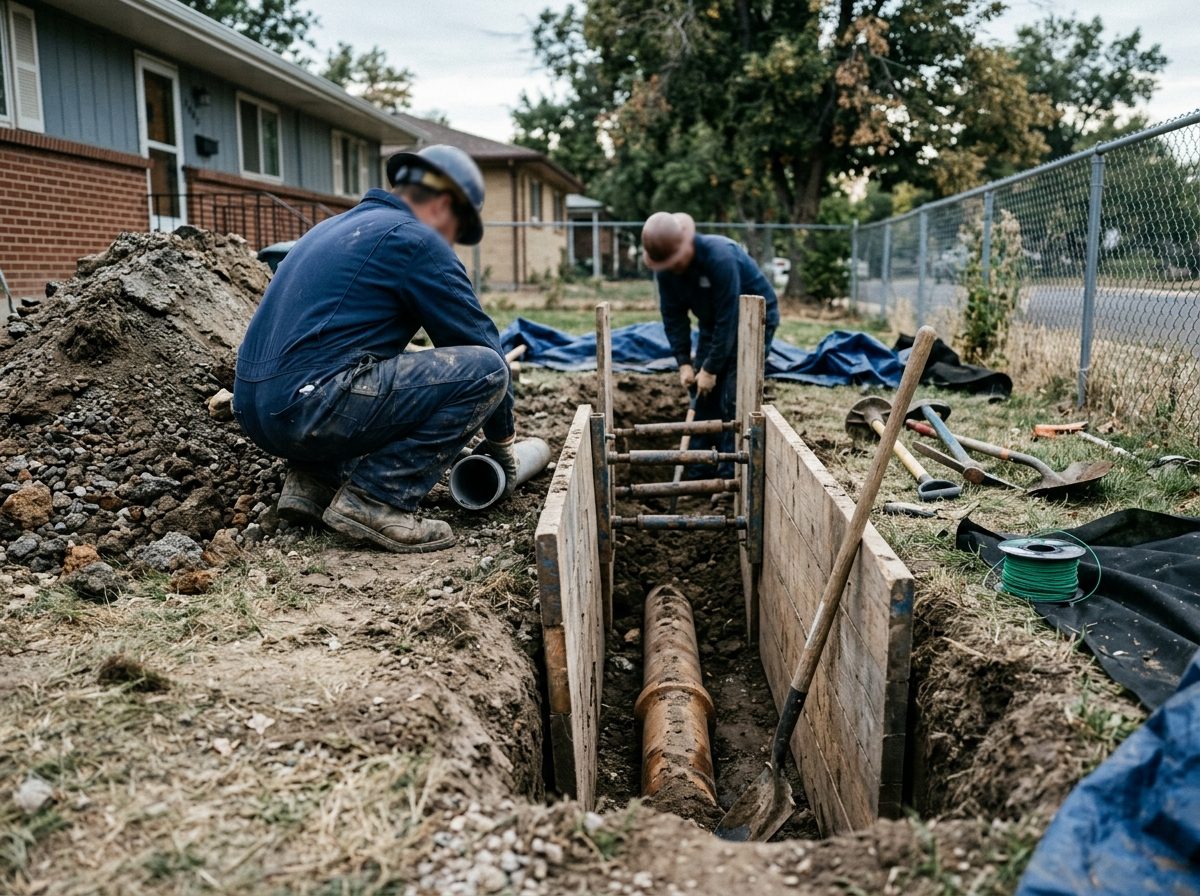
Where the well yields less than peak demand, the remedy is almost never a bigger pump — a pump can only deliver what the ground provides, and oversizing it risks drawing the level down to where the pump runs dry.
The remedy is storage. A holding tank filled slowly and steadily by the well, with a booster pump and pressure tank supplying the house from it, decouples what the household draws from what the ground yields. The household then experiences ordinary mains-like plumbing, and the well works at a rate it can sustain. Sizing the storage to cover peak days rather than average ones is the whole design question, and it is worth doing on real numbers rather than estimates.
Running out during sustained use? Storage rather than a bigger pump is usually the fix.
Ask about a storage systemProtecting the pump
On a well with limited yield, the pump is at real risk and the protections matter. A submersible pump relies on the water around it for cooling, so running dry damages it quickly — sometimes in minutes. Low-water cutouts and pump-protection devices exist precisely for this, and they are worth both having and testing, because a device nobody has checked in five years is not a safeguard.
Short-cycling is the other pump killer, and it has a different cause: a pressure tank that has lost its air charge, so the pump starts and stops every few seconds instead of running for minutes at a time. It is inexpensive to correct and expensive to ignore, and the two problems are worth distinguishing because the remedies are unrelated.
Given the distances out here, replacing a pump that is clearly ageing on a scheduled visit is more attractive than waiting for it to fail — a failure means no water at all, and pulling a pump needs equipment that has to be brought out.
Pump old, or running dry? Replacing it on a schedule beats losing water for days.
Ask about planned pump workFilling tubs, tanks and troughs safely
Any time a hose or a fill line can sit in standing water, the plumbing has a route for that water to travel backwards into the supply. It sounds unlikely until you consider what causes it: a drop in supply pressure — a main break, a hydrant opened, a pump cutting out on a well — creates suction, and a hose already submerged in a hot tub, a stock trough or a garden container is then drawn from rather than delivered to.
This is the reason hose bib vacuum breakers exist, and they are among the cheapest useful devices in plumbing. They thread onto an outdoor tap, cost very little, and prevent exactly this. On a property with animals, a hot tub, or any container that gets topped up with a hose left in it, fitting them to every outdoor tap is a sensible default rather than a precaution for special cases.
The same logic scales up. A hot tub or a water feature plumbed in permanently needs proper backflow protection rather than a hose arrangement. An irrigation system needs an assembly appropriate to it, usually subject to testing on a metered supply. And anywhere a fill line serves a tank or trough, an air gap — physical separation between the end of the line and the highest possible water level — is better than any device, because it cannot fail. The habit worth building is simpler than any of that: do not leave a hose end sitting in water, in anything, ever.
Three numbers worth knowing
What your well yields, what your household draws on a heavy day, and how much storage you have. Those three explain nearly every water complaint on an acreage property, and they turn guesswork into a decision.
Nearby communities
Peyton sits on the plains east of Colorado Springs, with Calhan, Ramah and the surrounding acreage nearby.
Peyton, Colorado
Well yield questions answered
Pressure is what the system delivers when you open a tap. Yield is how fast water enters the well from the surrounding ground. A modest-yield well can give excellent pressure indefinitely for ordinary use and still fail completely during sustained draw, which is why the two get confused.
Pressure is fine for normal use but collapses during sustained draw — filling a bath, running irrigation, several showers in succession — and recovers after an hour or two of no use. It is typically worse in late summer. That pattern is quite different from a pump or pressure tank fault.
Usually not, and it can make things worse. A pump can only deliver what the ground provides, and oversizing it risks drawing the water level down to where the pump runs dry — which damages the pump quickly. The constraint is the well, not the pump.
It decouples what the household draws from what the ground yields. The well fills a holding tank slowly and steadily; a booster pump and pressure tank then supply the house from that tank. The household gets ordinary mains-like plumbing, and the well works at a rate it can sustain.
Enough to cover peak days rather than average ones, which is why the sizing should be done on real numbers — your yield and your heavy-day demand — rather than estimates. Undersized storage simply moves the problem rather than solving it.
A submersible pump relies on the water around it for cooling, so running dry can damage it in minutes. Low-water cutouts and pump-protection devices prevent it, and they are worth testing rather than assuming — a device nobody has checked in years is not a safeguard.
No, that is short-cycling, and the usual cause is a pressure tank that has lost its air charge. It happens regardless of demand, whereas a yield problem only appears during sustained draw. It is inexpensive to correct and expensive to ignore, since it wears pumps out quickly.
Out here the case is strong. A failure means no water at all, and pulling a pump needs equipment that has to be brought to the property. A planned replacement happens on a scheduled visit at a predictable price rather than as an urgent long-distance callout.
It is the exact situation backflow protection exists for — if supply pressure drops, the submerged hose can be drawn from rather than delivered to. An inexpensive vacuum breaker on each outdoor tap prevents it, and not leaving a hose end sitting in water is the simpler habit. For anything plumbed in permanently, proper backflow protection is required.
East of the Springs
Peyton, Calhan, Ramah and the surrounding acreage.
(833) 621-2904 — answered 24/7, statewide.