Plumber in Galeton, CO — one call, any hour
Home / Areas / Northern Colorado / Galeton
On a private well in intensively farmed Weld County ground, what comes out of the tap is genuinely unknown until somebody measures it. Nobody tests it on your behalf, results vary from one property to the next, and the treatment industry is happy to sell equipment to people who have never had a test.
Testing is not optional out here
On municipal supply, someone else monitors the water and publishes the results. On a private well, that responsibility is entirely the owner's, and the water can change over time as land use, irrigation and groundwater levels shift.
Annual testing is a reasonable habit and it serves two different purposes. Some results matter for plumbing and appliances — hardness, iron, manganese, sediment — and determine what equipment protects the house. Others matter for the people drinking it, and those need a laboratory rather than a home kit. Both are inexpensive relative to what they tell you, and both are the only sound basis for spending money on treatment.
Never had the water tested? It is the only sound basis for buying treatment.
Ask about a water test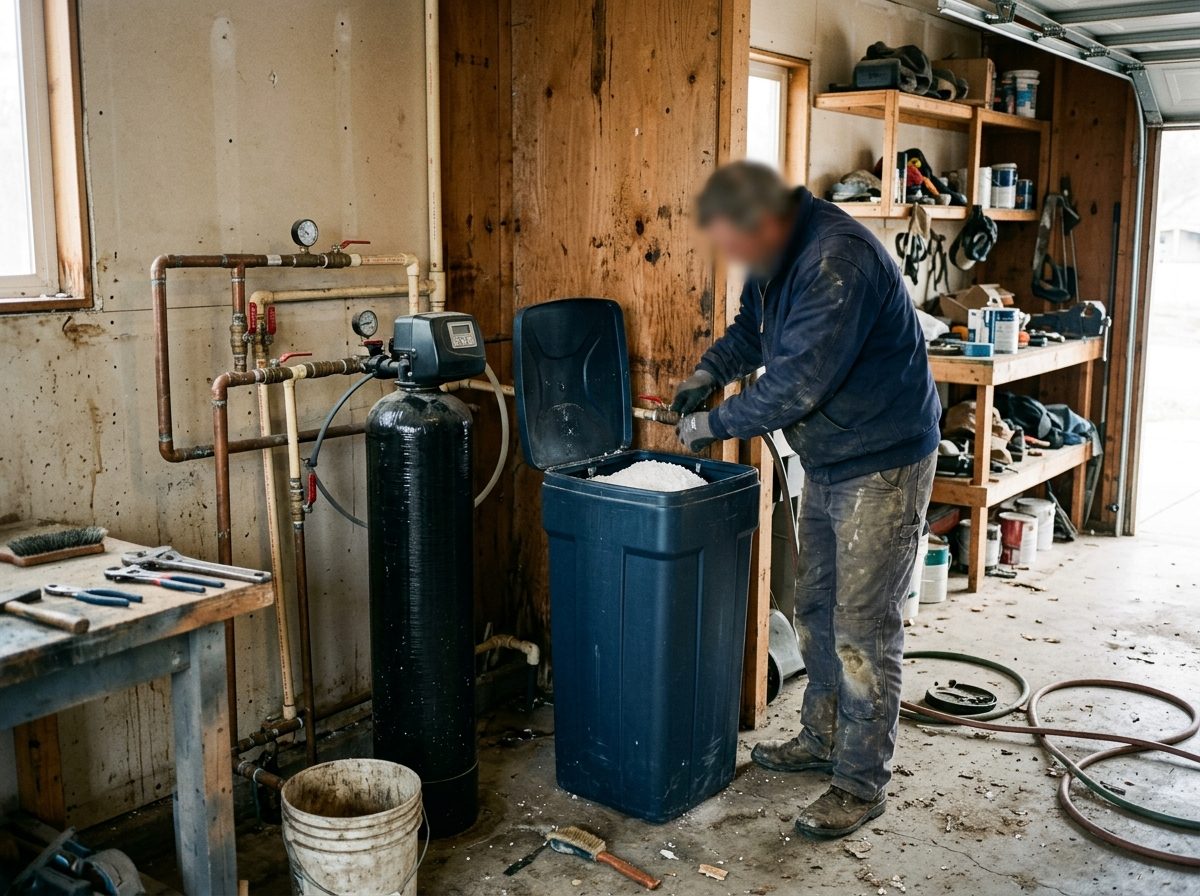
Iron is the visible problem
Iron is common in this ground and it is the result households notice most, because it is visible. It stains basins, baths and laundry a rust or orange colour, gives water a metallic taste, and leaves deposits in kettles and cisterns.
The complication is that iron comes in more than one form and they need different treatment. Dissolved iron is invisible in a fresh glass of water and turns orange as it oxidises on contact with air — so a glass that is clear at the tap and stained an hour later is diagnostic. Particulate iron is already oxidised and visible immediately. And iron bacteria produce a slimy reddish deposit and a distinctive smell, which is a different problem again.
Manganese often accompanies iron and produces black rather than orange staining. Which of those you have determines whether the answer is oxidation and filtration, a specific iron filter, softening, or shock treatment — and a softener installed against particulate iron will foul quickly and disappoint.
Rust or black staining in basins? The form of iron decides the treatment.
Ask about iron treatment
Nitrate and agricultural ground
In intensively farmed areas, nitrate is a result worth testing for specifically, because it is invisible, tasteless and not addressed by the treatment most households install for hardness or iron.
It matters most for infants and pregnant women, which is why it is worth knowing rather than assuming, and why a laboratory test is the right instrument. It is also worth retesting periodically rather than once, since levels can change with irrigation, rainfall and land use around the property.
The important practical point is that a softener does not remove nitrate, and neither does an ordinary sediment or carbon filter. Where a test shows a concern, the remedies are specific — and frequently applied at the kitchen tap rather than to the whole house, since drinking and cooking water is what matters. Anyone selling whole-house equipment as a nitrate solution should be asked exactly how it achieves that.
Getting the treatment order right
Where several results need addressing, the order of the stages matters as much as the choice of them, and getting it wrong is a common and expensive mistake.
Sediment removal comes first, because grit destroys what follows. Iron treatment generally comes before softening, because iron fouls softener resin and shortens its life dramatically. Softening then handles hardness. Carbon or specific media for taste, odour or particular results come after that. And point-of-use treatment at the kitchen tap handles drinking-water concerns without treating the whole house to that standard.
Two practical constraints decide what is actually installable: whether there is a sensible place on the incoming line, and whether there is a drain for backwashing or regeneration. A stage in an inaccessible position stops being maintained within a year, which makes it worse than not having it.
Several water problems at once? The order of treatment stages matters as much as the choice.
Ask about a treatment planLiving with filtration once it is installed
Treatment equipment is usually discussed as a purchase and then forgotten as an obligation, which is how a system that solved a problem becomes a problem of its own. Every cartridge filter has a finite capacity, and past it the filter does not stop working cleanly — it begins restricting flow, and eventually it becomes the thing holding back the pressure in the house.
The symptoms are mistaken for other faults with some regularity. Pressure that has fallen off gradually across the whole building, rather than at one fixture, is the classic sign of a filter nobody has changed. A filter that has gone much longer than that can also begin releasing what it captured, which is worse than not having it. Neither of those announces itself; both are on a schedule.
So the useful arrangement is practical rather than technical. Know what cartridges the system takes and keep spares on the property, because the moment you discover you need one is not the moment to start finding out which it is. Sequence the stages so a cheap sediment filter protects an expensive finer one rather than the other way round. Site the housings where they can actually be reached and where they will not freeze, which on many properties out here rules out the obvious location. And write the change dates somewhere on the housing itself, since that is the only record anybody reliably keeps.
The diagnostic glass
Fill a clear glass and leave it an hour. Clear at first and orange later means dissolved iron. Orange immediately means particulate. Black staining suggests manganese. That one observation narrows the treatment considerably.
Nearby communities
Galeton sits on the Weld County plains north-east of Greeley, with Gill, Lucerne, Eaton and Kersey nearby.
Galeton, Colorado
Well water quality questions answered
Because the results that matter most are invisible, and nobody monitors a private well on your behalf. Some results affect plumbing and appliances; others affect the people drinking it. The water can also change over time as land use, irrigation and groundwater levels shift.
Fill a clear glass and leave it an hour. Water clear at the tap that turns orange as it stands is dissolved iron oxidising on contact with air. Water already orange at the tap is particulate iron. A slimy reddish deposit with a distinctive smell suggests iron bacteria, which is a different problem.
Because the treatments differ. Dissolved iron generally needs oxidation followed by filtration; particulate iron needs filtration sized for it; iron bacteria need shock treatment. A softener installed against particulate iron fouls quickly and disappoints, which is a common and expensive mistake.
Usually manganese, which often accompanies iron in this kind of ground. It needs to be identified separately because the treatment and the dosing differ, and a system set up purely for iron may not address it adequately.
In intensively farmed ground, yes. Nitrate is invisible and tasteless, and it is not removed by the treatment most households install for hardness or iron. It matters most for infants and pregnant women, which is why knowing rather than assuming is worth the laboratory test.
No, and neither will an ordinary sediment or carbon filter. Where a test shows a concern the remedies are specific, and they are frequently applied at the kitchen tap rather than to the whole house since drinking and cooking water is what matters. Ask exactly how any equipment claims to address it.
Sediment removal first, because grit destroys what follows. Iron treatment before softening, because iron fouls softener resin and shortens its life dramatically. Then softening for hardness, then carbon or specific media, and point-of-use treatment at the kitchen tap for drinking-water concerns.
Two practical things: whether there is a sensible place on the incoming line, and whether there is a drain available for backwashing or regeneration. A stage installed somewhere inaccessible stops being maintained within a year, which makes it worse than not having it at all.
If there is filtration on the incoming supply, an overdue cartridge is the first thing to check — a clogged filter restricts the whole building rather than one fixture, and the decline is gradual enough to go unnoticed. Keep spares on site, note the change date on the housing, and put the coarse sediment stage first so it protects the finer one.
North-east Weld County
Galeton, Gill, Lucerne, Eaton and Kersey.
(833) 621-2904 — answered 24/7, statewide.