Plumber in Avondale, CO — one call, any hour
Home / Areas / Pueblo & Southern Colorado / Avondale
On irrigated valley land, there is water on the property that has nothing to do with the plumbing — ditch water, delivered on a schedule, governed by rules that predate everyone involved. Understanding where that water's business ends and the household's begins is the most useful thing a property owner here can be clear about.
Ditch water is not house water
Ditch and irrigation water in Colorado is governed by a body of water law and by the rules of the ditch company or district that delivers it, and it is genuinely complicated. Rights attach to land, deliveries happen on schedules, and headgates and measuring devices are frequently the responsibility of the ditch organisation rather than the landowner.
What that means practically is that a plumber is the wrong person to ask about a delivery problem, a headgate dispute or how much water you are entitled to. Those are questions for the ditch company or district. Where a plumber is the right person is everything downstream of the point that water enters a system on your property — and, critically, the boundary between that system and your drinking water.
Not sure who to ask? Delivery questions go to the ditch company, not a plumber.
Ask what applies to plumbing
Keeping the two systems apart
The single most important plumbing fact on an irrigated property is that ditch water and domestic water must not be able to mix. Ditch water is untreated surface water — it carries sediment, agricultural runoff and whatever else has entered the channel upstream, and it is not something anyone should drink.
Backflow prevention is what enforces the separation, and it works by making flow physically one-directional. Any point where irrigation, a fill line or a piece of equipment connects to potable supply needs proper isolation, and hose bibs used to fill tanks or sprayers need vacuum breakers — because a hose end submerged in a tank is a direct path back into the house supply if pressure drops.
The risk on an older property is accumulation. Nobody sets out to create a cross-connection; they appear as things get added over decades, each addition reasonable on its own. On a system that has been extended and modified for generations, having the connection points identified and confirmed is genuinely worth doing rather than assuming.
Tailwater, drainage and wet ground
Irrigation produces water that has to go somewhere after it has done its job, and on flood-irrigated ground that tailwater and the raised water table underneath it affect buildings.
The plumbing consequences are specific. A crawlspace or basement can take water seasonally when nothing is wrong with the plumbing at all — which is why the meter test matters here: shut every fixture, watch the meter for an hour, and a still meter with water still arriving means it is not your plumbing. A septic drainfield sitting in ground that is periodically saturated has much less capacity to disperse liquid, so heavy irrigation near a field works directly against it. And sump pumps become ordinary equipment rather than an admission of a problem, with the usual caveat that the pump most likely to fail is the one that has sat idle since last season.
Water in a crawlspace seasonally? The meter test shows whether it is even your plumbing.
Ask what applies to youThe domestic system underneath it all
Underneath the irrigation picture, the house has ordinary plumbing with ordinary problems, and it is worth not losing sight of it.
Water here carries a heavy mineral load, so the water heater takes the usual punishment: sediment across the tank floor, the burner heating through scale rather than steel, run times lengthening and recovery slowing. Draining it annually is the cheapest life extension available, and the sacrificial anode rod — a consumable designed to corrode instead of the tank lining — is worth checking at the same time.
And where the domestic supply is a private well rather than a rural connection, the familiar three faults apply: a pressure tank that has lost its air charge and is cycling the pump, a pressure switch that has stopped making contact, or a pump at the end of its life. What the gauge reads and whether the pump runs narrows that quickly.
Heater slower than it was? Sediment and a spent anode rod are the usual pair.
Ask about heater maintenanceTree roots in a clay lateral
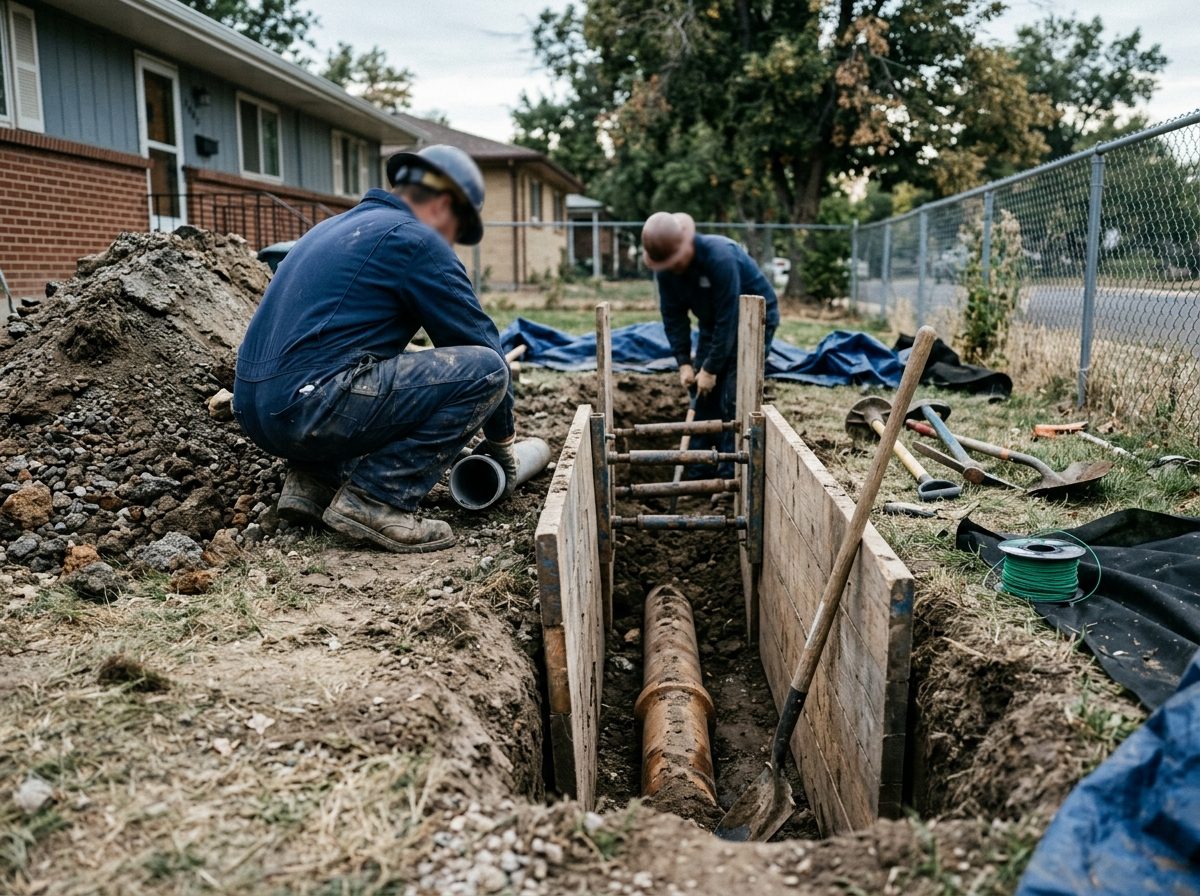
Older sewer laterals here are clay tile, laid in short lengths with a joint every few feet, and roots find those joints. They do not break into sound pipe — they enter where there is already a gap, because a leaking joint is a reliable source of water and nutrient in dry ground. Once inside, a root thickens and branches into a mass that catches everything the household sends down.
The pattern is distinctive and worth recognising. Backups that recur on a roughly seasonal rhythm, worse in the growing season. A line that clears well and then slows again within months. Paper and solids catching at the same point each time. And a mature tree, a hedge line or a windbreak within reach of the route — which out here is often a row planted decades ago for shelter rather than an ornamental in a garden.
The reason it matters is that clearing roots and fixing the cause are different jobs. A cutting head removes the growth and leaves the opening it came through, so the roots return. Ending the cycle means dealing with the joint: lining the affected section so there is no longer a gap, or replacing that length of pipe. A camera run is what decides which, because it shows how many joints are involved and whether the pipe around them is still sound — and repeated clearing without that information is how people spend the cost of the repair twice without getting it.
Worth having confirmed
Every point where irrigation or fill water can reach your domestic supply, and what protection is fitted there. On a property extended over generations, those points accumulate without anyone deciding to create them.
Nearby communities
Avondale sits east of Pueblo along the Arkansas valley, with Boone, Fowler and Pueblo nearby.
Avondale, Colorado
Irrigated property questions answered
Generally no — deliveries, headgates, measuring devices and entitlements are matters for the ditch company or district, governed by water law and their own rules. A plumber is the right person for everything downstream of where that water enters a system on your property, and for the boundary with your drinking water.
It should not be able to reach your domestic plumbing at all. Ditch water is untreated surface water carrying sediment, agricultural runoff and whatever entered the channel upstream. The whole purpose of backflow prevention is making sure the two systems cannot mix.
It makes flow physically one-directional, so water cannot travel from an irrigation line, a fill point or a piece of equipment back into the potable supply. Any point where those connect to drinking water needs proper isolation, and it is a requirement rather than a refinement.
A vacuum breaker, yes, especially where hoses fill tanks, troughs or sprayers. A hose end sitting submerged creates a direct path for that water to be drawn back into the supply if pressure drops. It is an inexpensive fitting for the risk it removes.
They accumulate. On a property extended over generations, each addition was reasonable on its own — a fill line here, a piece of equipment connected there — and the cumulative result is connections nobody decided to make. Having the points identified and confirmed is worth doing rather than assuming.
That is often tailwater and a raised water table rather than a plumbing fault. Run the meter test: shut every fixture, note the meter, and check an hour later. A still meter with water still arriving means the water is not coming from your plumbing at all.
Yes, and more than most owners expect. A field sitting in ground that is periodically saturated has far less capacity to disperse liquid, so heavy irrigation over or near a field works directly against it. Keeping irrigation away from the field area is one of the cheapest ways to extend its life.
Mineral content. Sediment settles across the tank floor so the burner heats through scale rather than steel, lengthening run times and shortening life; on electric units it coats the elements. Draining it annually is the cheapest life extension, and the anode rod is worth checking at the same time.
Only by closing the way in. Cutting them out restores flow and leaves the joint they entered through open, so they grow back — usually within a season or two. Lining or replacing the affected section removes the opening. A camera run shows how many joints are involved, which is what decides between maintaining the line and repairing it.
The Arkansas valley
Avondale, Boone, Fowler and the farms east of Pueblo.
(833) 621-2904 — answered 24/7, statewide.