Plumber in Parker, CO — one call, any hour
Home / Areas / Denver Metro / Parker
Parker is a modern town, built mostly in the last few decades, and that shapes its plumbing entirely. There is very little old pipe here. Instead there are large numbers of houses of similar age, hard water working on all of them, and components that were installed together and therefore fail together.
Subdivisions age together
Whole streets went up within a year or two, with the same water heaters, regulators, expansion tanks and fixture supply lines fitted by the same crews. Those parts have service lives much shorter than the house, so failures cluster.
That clustering is useful rather than ominous. If neighbours are replacing heaters or regulators, yours is a candidate for inspection rather than a coin toss — and a planned replacement in a finished basement costs a fraction of an emergency one, both in the work and in what the water ruins on the way out.
Heater over a decade old? Replacing it on your schedule beats replacing it on its own.
Ask about a heater checkThe other consequence of a young housing stock is that nobody has a repair history yet. On an old house you can often infer what has been done from what you can see; on a fifteen-year-old house the original components are usually still in place, which makes the age of the house a reliable guide to what is next in line. That is why the build year is the single most useful thing to say when you call.
Hard water and what it costs
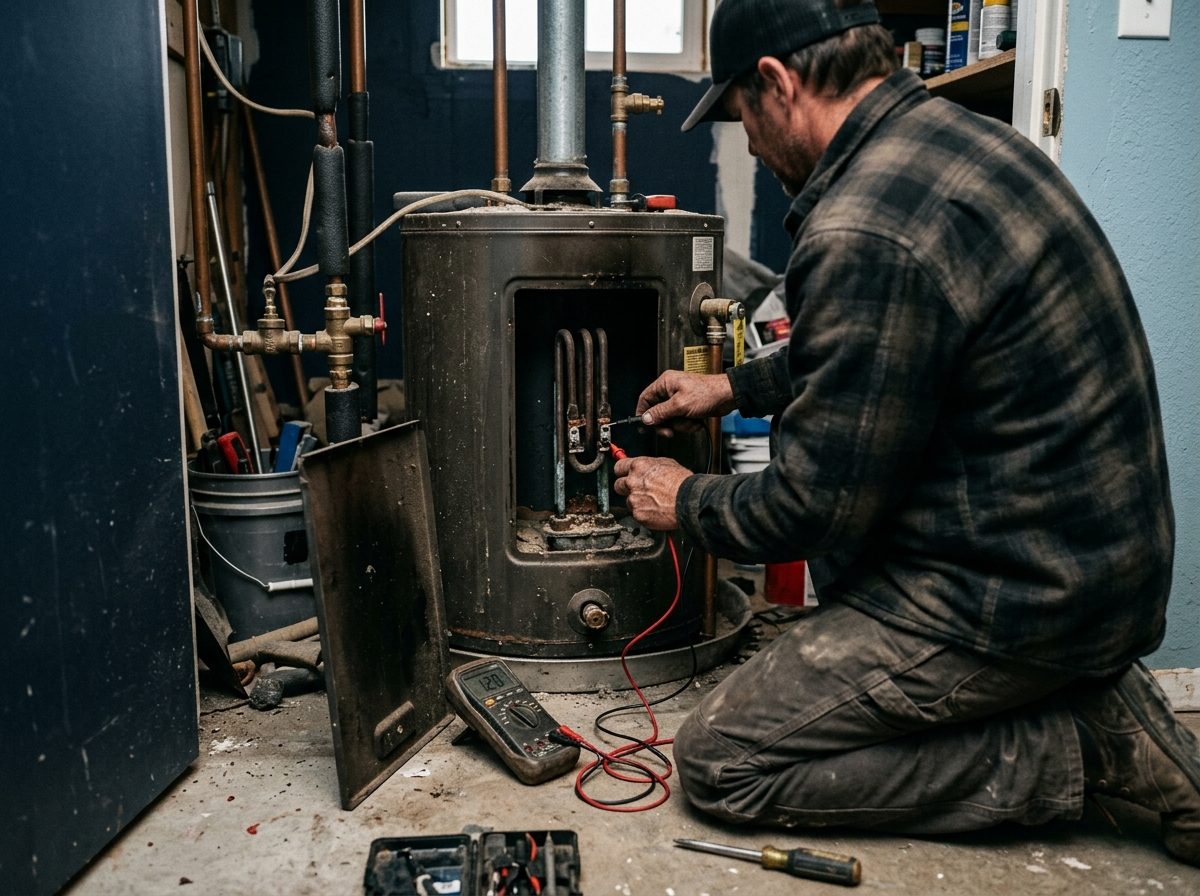
Hardness is a real factor across this part of Douglas County, and its cost is quiet. Scale collects in the bottom of the water heater, insulates the burner from the water and lengthens run times; on electric units it coats the elements. Aerators and shower heads block, toilet fill valves stiffen and weep, dishwashers and washing machines wear faster than they should.
Maintenance first: flush the tank annually and clean aerators when flow drops at a single tap. Then, if you want treatment, test the water so hardness is a number and size the softener to the household. Oversized equipment costs more to buy and run without doing more good.
Pressure and the parts it kills
High static pressure is one of the most under-diagnosed problems in newer housing. A regulator that has drifted passes street pressure through to fixtures never designed for it, and the damage arrives as a scatter of small failures: toilets that run, taps that drip, a washing machine hose that lets go, a heater relief valve that discharges periodically.
Individually those look like worn parts; together they point at one cause. An inexpensive gauge on an outdoor spigot settles it in a minute, and replacing the regulator protects everything downstream of it.
Small failures piling up? Measure pressure before replacing fixtures one by one.
Ask about high pressureSprinklers still charged? Blowout season starts before the first hard freeze.
Ask about winterisingIrrigation, wind and freezing
Lots here are generous and irrigation systems extensive, which makes autumn the busiest predictable season. A system not blown out with compressed air before the first hard freeze holds water at its low points and at the backflow device, and that is where the spring surprise usually appears.
Open ground and wind also mean exposed pipe loses heat faster than the temperature suggests. Disconnect hoses before the freeze, since a connected hose holds water against the bib and defeats its frost protection, and open cabinet doors under sinks on exterior walls during the coldest nights.
What a camera inspection actually shows
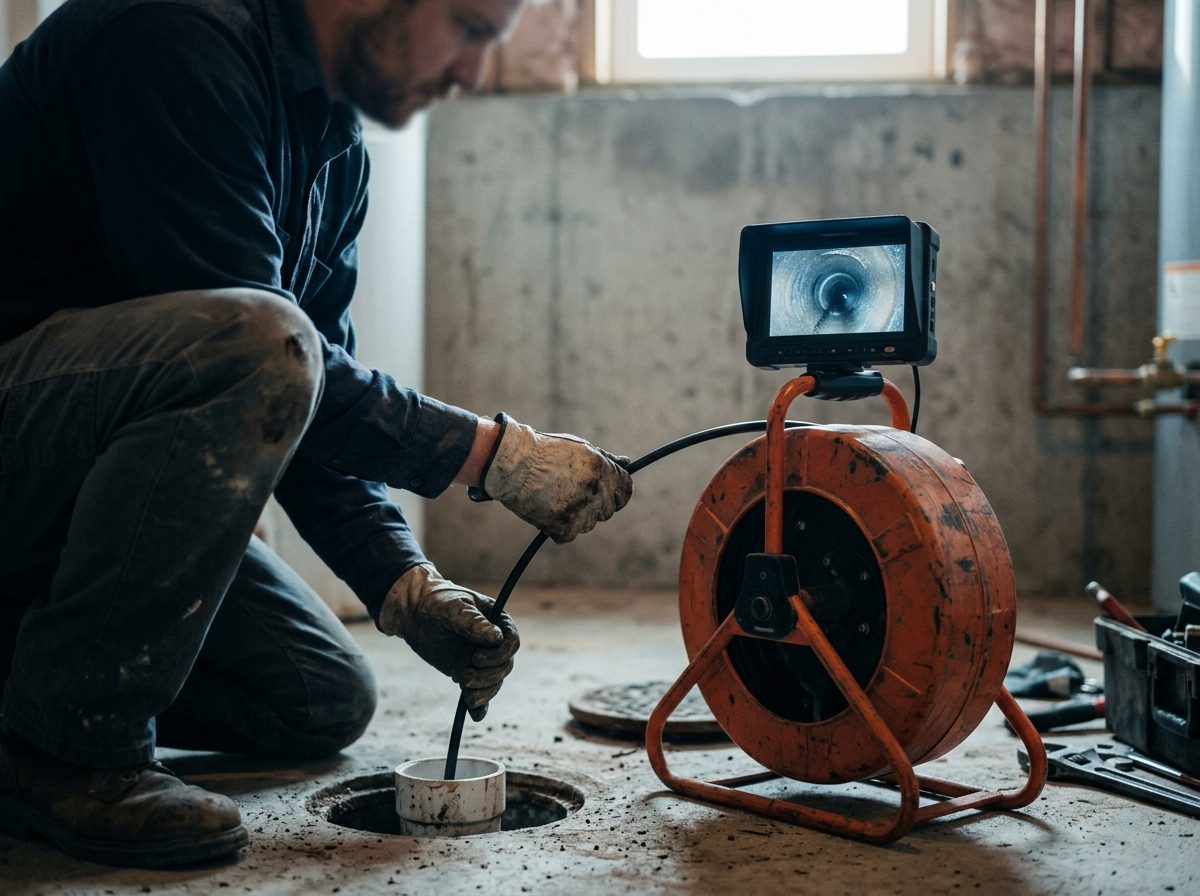
Camera inspection is usually discussed in connection with old clay pipe, which leads owners of newer houses to assume it has nothing to offer them. It does, but for different reasons. On a line thirty or forty years old the camera is looking for root intrusion and failed joints. On a line built in the last twenty-five it is looking for construction defects and settlement — and those are more common in newly developed ground than anyone advertises.
Three findings come up repeatedly. A belly, meaning a section that has settled and no longer runs downhill, which collects waste and produces backups that return a few months after every clearing. An offset joint, where two lengths no longer align, which catches solids on its lip. And construction debris left in the line during the build, which does nothing for years and then becomes the point at which everything else collects. None of these are visible from inside the house, and none of them are fixed by clearing the line.
The reason it is worth the money is that it changes decisions rather than just producing footage. It tells you whether a repeat blockage is maintenance or a repair, whether a repair needs an open trench or can be done from either end, and — on a purchase — whether an apparently sound house has a five-figure problem waiting in the front garden. It also records route and depth, which is useful information long after the inspection itself.
Autumn short list
Irrigation blown out, hoses disconnected, sump pump tested with a bucket of water, and static pressure measured. Four jobs, one afternoon, and they account for a large share of what otherwise arrives as an emergency.
Nearby communities
Parker sits in the middle of the Douglas County suburbs, with Lone Tree, Castle Rock, Aurora and Franktown all close.
Parker, Colorado
Parker plumbing questions answered
For most households the return comes as longer water heater and appliance life rather than anything obvious at the tap. Test first so hardness is a real number, then size the equipment to your household. Check there is a practical place to plumb the loop and a drain for the regeneration cycle before committing to anything.
Two usual suspects, and they compound. Hard water leaves scale that stiffens valves and blocks aerators. High static pressure stresses every seal continuously. Measure the pressure with a gauge on an outdoor spigot and test the water — between them those two checks explain most premature fixture failure in newer housing.
Before the first hard freeze, which can arrive in October. Draining is not enough on most systems because low points and the backflow device hold water gravity cannot move — compressed air is what clears them. Booking early in the season also avoids the week when everyone remembers at once.
It can be, provided it is sized for winter rather than for average conditions. Output is a temperature rise across a flow rate, and January inlet water is much colder than September inlet water. Gas supply, venting and combustion air belong in the same conversation, and hard water makes a descaling routine part of ownership.
Same-day is normal and a few hours is common for urgent problems. Addresses out toward Franktown and Elizabeth add drive time, and during a regional cold snap the whole south metro is busy at once. Expect an honest window plus instructions on what to shut off in the meantime.
Not worried — informed. Houses built in the same year get the same appliances fitted by the same crews, so they age and fail together. Treat it as a prompt to check yours: age, rust at the fittings, damp underneath and how quickly hot water runs out are the things that matter.
It absorbs the pressure rise created when water heats and expands in a closed system. When its internal bladder fails, that pressure has nowhere to go, which commonly shows up as a relief valve discharging periodically or fittings weeping. It is an inexpensive part and worth checking whenever pressure symptoms appear.
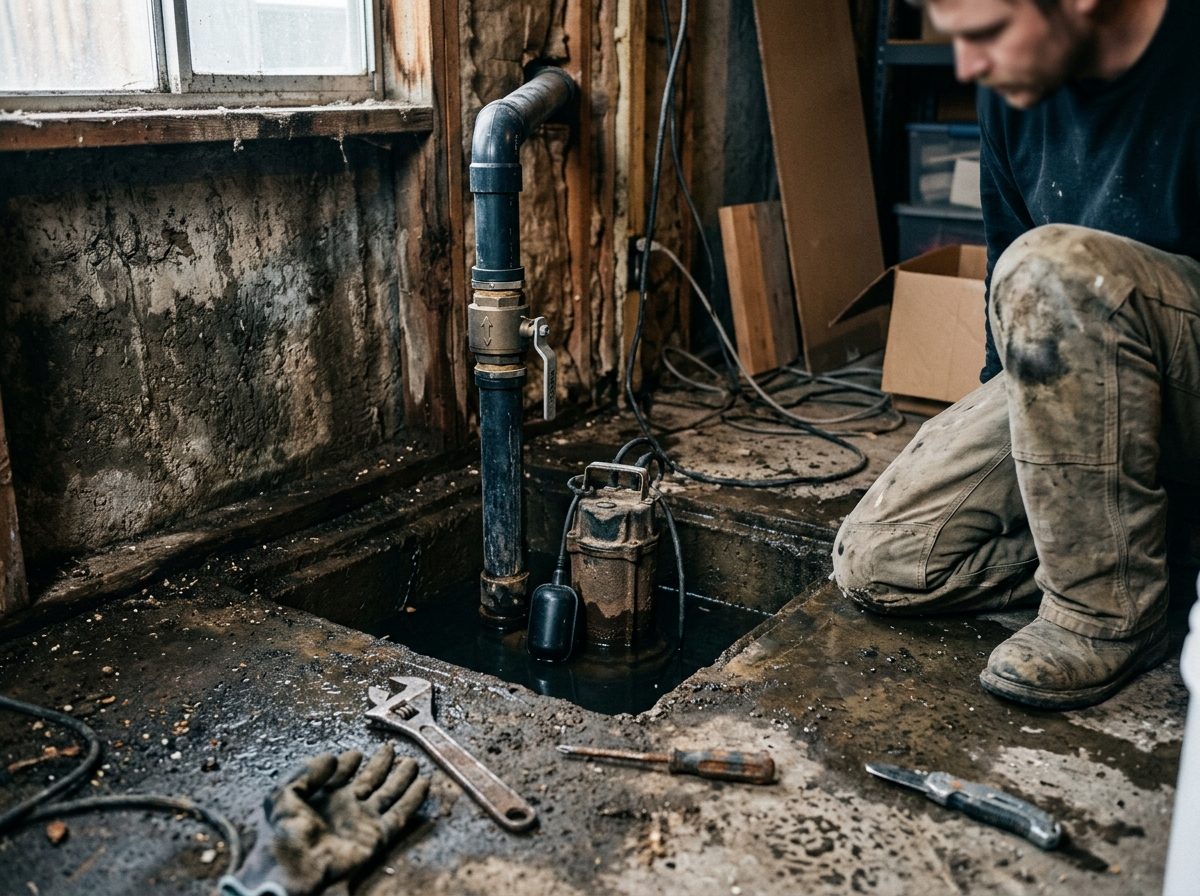
Check whether you have a pit first. Many houses were built with a pit and no pump. If the basement is finished, a pump and check valve are inexpensive against the cost of replacing flooring, and the moment they earn their keep is a fast spring melt or a summer downpour that outpaces the ground.
Often yes, though for different reasons than on an old house. In newer construction the camera is looking for settlement, misaligned joints and debris left in the line during the build rather than roots. Those produce backups that keep returning after clearing, and no amount of rodding fixes them. Particularly worth doing before buying.
Douglas County, any hour
Parker, Lone Tree, Castle Rock, Franktown and the south metro communities nearby.
(833) 621-2904 — answered 24/7, statewide.